
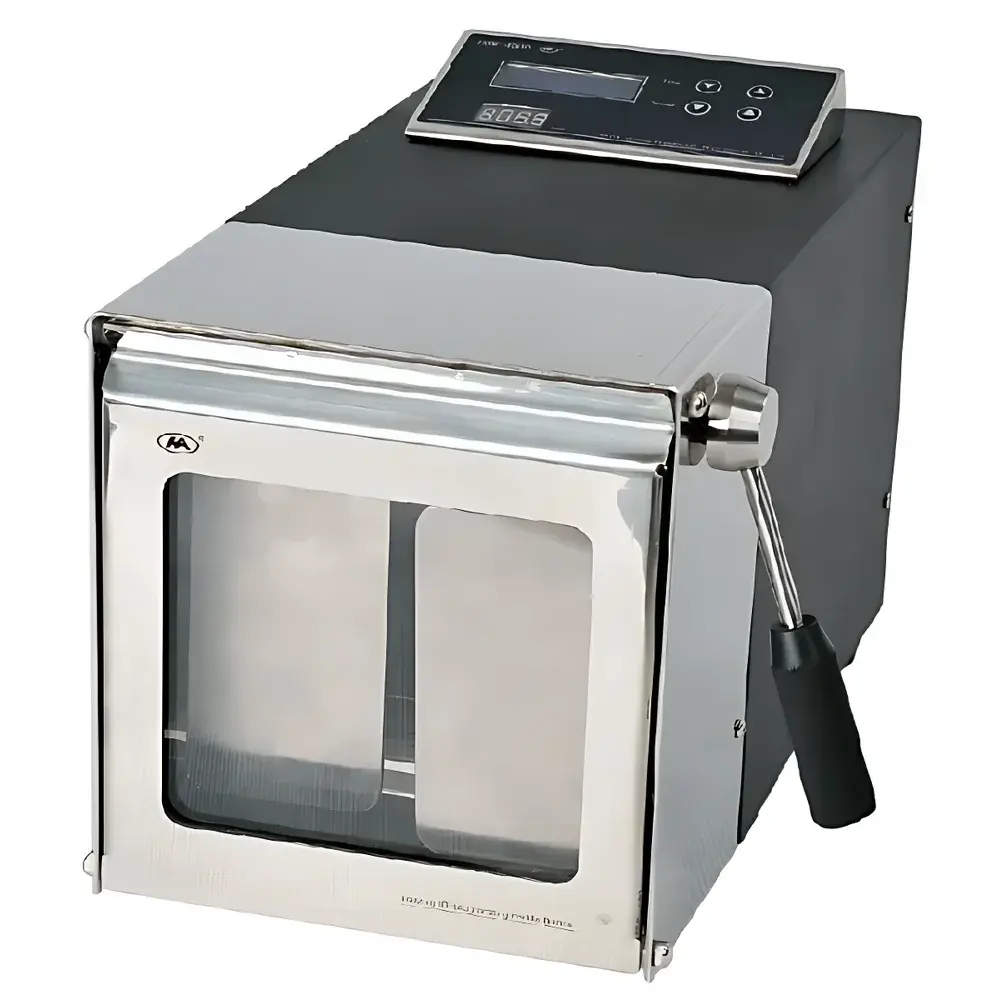
Chu Ding HBM-400C Stomacher-Type Homogenizer (Aseptic Homogenizer)
| Brand | Chu Ding |
|---|---|
| Origin | Shanghai, China |
| Model | HBM-400C |
| Instrument Type | Stomacher-type |
| Dimensions (W×D×H) | 450×270×290 mm |
| Sample Volume Range | 30–400 mL |
| Time Settings | 10, 30, 60, 90, 120, 180, 600 s or continuous mode |
| Adjustable Speed | 6–9 strokes/min (customizable 3–12 strokes/min) |
| Homogenization Bag Size | 30×17 cm |
| Power | 200 W |
| Voltage/Frequency | 220 V / 50 Hz |
| Net Weight | 16.5 kg |
| Enclosure Material | Full stainless steel (304) |
Overview
The Chu Ding HBM-400C Stomacher-Type Homogenizer is a precision-engineered aseptic sample preparation instrument designed for consistent, reproducible mechanical homogenization of solid and semi-solid biological specimens in microbiological, food safety, environmental, and pharmaceutical testing laboratories. Operating on the principle of controlled reciprocal percussion—commonly referred to as “stomaching”—the device applies calibrated, rhythmic compressive forces via dual parallel stainless-steel paddles against a sterile, single-use filter bag containing the sample and diluent. This action induces shear, cavitation, and turbulent mixing within the sealed environment, effectively liberating microorganisms from both surface-adhered and intracellular matrices without cross-contamination or thermal degradation. Unlike rotor-stator or ultrasonic systems, the stomacher method preserves microbial viability and avoids aerosol generation, making it compliant with ISO 6887-1, ISO 7218, and FDA Bacteriological Analytical Manual (BAM) Chapter 3 protocols for enumeration and isolation.
Key Features
- Full 304 stainless-steel enclosure ensures corrosion resistance, cleanability, and compliance with GLP/GMP facility requirements.
- Digital time control with eight preset durations (10–600 s) plus continuous mode enables precise protocol adherence across standardized methods.
- Adjustable stroke frequency (6–9 strokes/min, optionally 3–12 strokes/min) allows optimization for diverse sample matrices—from soft leafy vegetables to fibrous meat tissue or frozen seafood.
- Integrated digital gap display provides real-time visual feedback of paddle-to-bag clearance, enhancing repeatability between operators and batches.
- Full-swing front access door and transparent polycarbonate viewing window facilitate rapid bag loading, process monitoring, and post-run inspection without disassembly.
- Automatic Hall-effect safety interlock halts operation immediately upon door opening, preventing accidental contact during active homogenization.
- Removable waste tray captures minor bag leakage, minimizing contamination risk and simplifying decontamination workflows.
- Non-contact design: the sample remains fully contained within the sterile filter bag; no internal wetted surfaces require cleaning or sterilization between runs.
Sample Compatibility & Compliance
The HBM-400C accommodates standard 30 × 17 cm sterile filter bags (0.45 µm or 0.22 µm pore size), compatible with major international suppliers including Seward, Thermo Fisher, and Pall. It supports sample volumes from 30 mL to 400 mL, covering routine applications such as ISO 11290-1 (Listeria), ISO 6579 (Salmonella), and USP microbial limits testing. The unit meets CE marking requirements under Directive 2014/30/EU (EMC) and 2014/35/EU (LVD). Its mechanical design and operational envelope align with ISO/IEC 17025:2017 clause 6.4.2 for equipment suitability verification, and its closed-system processing supports audit readiness for FDA 21 CFR Part 11–governed data integrity practices when paired with validated electronic loggers.
Software & Data Management
While the HBM-400C operates via standalone digital controls (no embedded software), its time and speed parameters are fully documentable through external laboratory information management systems (LIMS) or electronic lab notebooks (ELN). Each run generates traceable metadata—including date/time stamp, selected duration, stroke rate, and operator ID—when integrated with barcode-scanned bag labels or networked timers. Optional RS-232 or USB output modules (available upon request) enable automated logging into compliant data repositories, supporting ALCOA+ principles (Attributable, Legible, Contemporaneous, Original, Accurate, Complete, Consistent, Enduring, Available) for regulatory submissions.
Applications
This homogenizer is routinely deployed in accredited food testing laboratories for pathogen enrichment prior to PCR or plating (e.g., E. coli O157:H7 in ground beef), pesticide residue extraction in produce homogenates, and mycotoxin recovery from cereal grains. It is equally suited for environmental water concentrate processing (per EPA Method 1603), clinical stool specimen emulsification in public health labs, and QC sampling in pharmaceutical raw material release testing. Academic users apply it in undergraduate microbiology labs for hands-on demonstration of aseptic technique and colony-forming unit (CFU) quantification, while research groups utilize its reproducibility for comparative studies on microbial adhesion kinetics or biofilm disruption efficiency.
FAQ
Is the HBM-400C suitable for use in ISO 17025-accredited laboratories?
Yes—the device’s mechanical stability, documented parameter reproducibility, and compatibility with certified consumables support method validation per ISO/IEC 17025:2017 Section 7.2.
Can the stroke frequency be calibrated and verified?
Yes—frequency accuracy can be confirmed using a handheld tachometer or high-speed camera; Chu Ding provides calibration certificates traceable to NIM (National Institute of Metrology, China) upon request.
What maintenance is required for long-term reliability?
Routine maintenance includes biweekly inspection of paddle alignment, monthly lubrication of drive mechanism bearings, and quarterly verification of Hall sensor response time using a calibrated proximity tester.
Are replacement parts and service support available internationally?
Original spare parts—including paddles, drive belts, and control PCBs—are stocked in EU and North American distribution hubs; technical documentation and firmware updates are accessible via secure customer portal.
Does the unit comply with FDA 21 CFR Part 11 for electronic records?
The base model does not include electronic signature capability; however, integration with validated third-party data acquisition systems satisfies Part 11 requirements for audit trail, user authentication, and record retention.



