
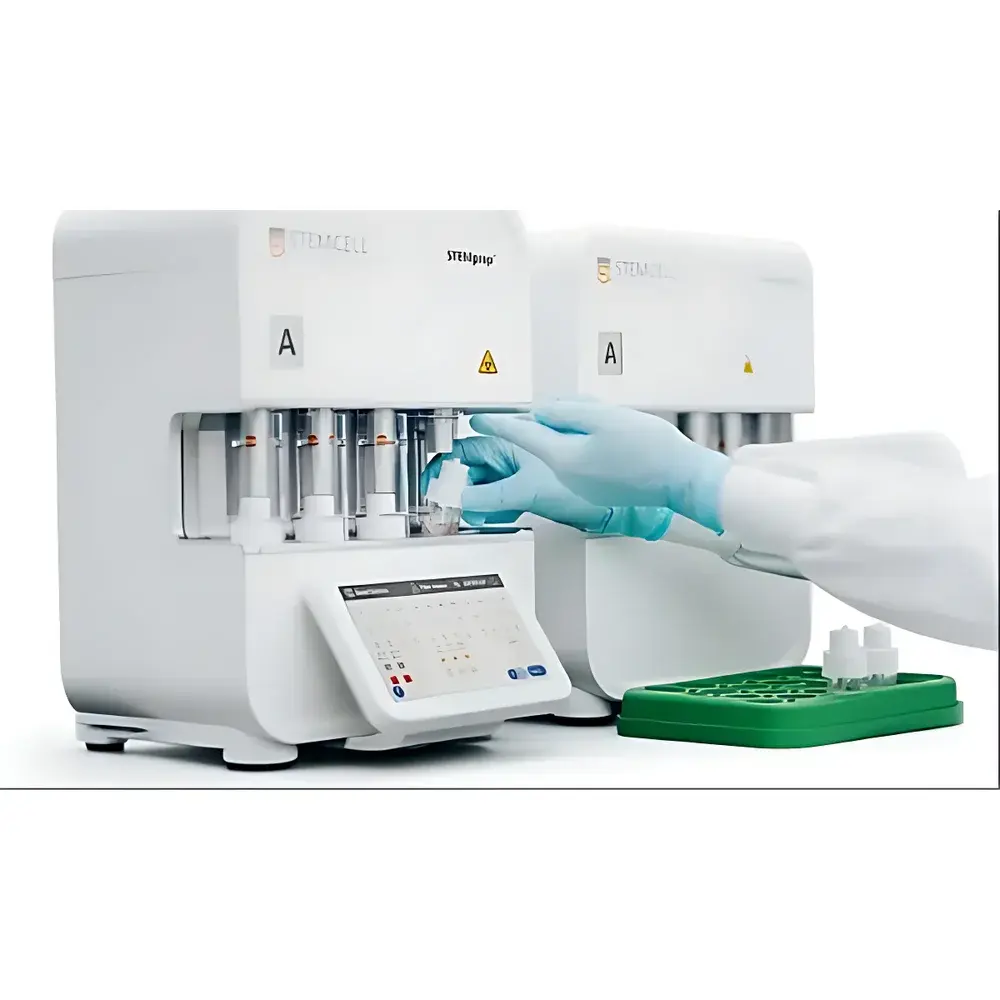
STEMCELL STEMprep™ Automated Tissue Dissociator
| Brand | STEMCELL Technologies |
|---|---|
| Origin | Canada |
| Model | STEMprep™ |
| Temperature Range | 4–37°C (integrated heating & cooling) |
| Throughput Options | 4-, 8-, or 12-sample modular configurations |
| Compliance | Designed for GLP-compliant workflows |
| Software Interface | Touchscreen-based protocol management system |
| Sample Tube Compatibility | STEMprep™-specific consumable tubes with integrated agitation and thermal control |
Overview
The STEMCELL STEMprep™ Automated Tissue Dissociator is an engineered solution for reproducible, high-viability single-cell suspension generation from heterogeneous solid tissues. It operates on a controlled mechanical–enzymatic dissociation principle: combining precisely regulated rotational agitation, programmable temperature modulation (4–37°C), and timed reagent delivery to replicate optimized tissue digestion kinetics without manual intervention. Unlike conventional manual methods—such as pipette-based trituration, collagenase incubation in water baths, or rotor–stator homogenization—the STEMprep™ system eliminates operator-dependent variability, reduces processing time by up to 50%, and maintains cell surface epitope integrity critical for downstream flow cytometry, scRNA-seq, and functional assays. Its design reflects direct input from academic and biopharma laboratories handling primary human and murine tissues—including tumor biopsies, spleen, lung, brain, and intestinal samples—where consistency in cell yield (>85% viability, typical across validated protocols) and minimal stress-induced gene expression artifacts are non-negotiable.
Key Features
- Integrated dual-mode thermal control: Independent Peltier-based heating and cooling per sample slot ensures precise maintenance of physiological (37°C) or cryopreservation-compatible (4°C) dissociation temperatures—critical for protease activity modulation and membrane stability.
- Modular throughput architecture: Field-upgradable from 4- to 8- or 12-sample capacity via plug-in secondary modules; all slots operate synchronously yet independently, enabling parallel processing of dissimilar tissue types under distinct protocols.
- Protocol-driven operation: Pre-validated dissociation programs for >30 tissue types (e.g., human PBMC-enriched lymphoid tissue, murine mammary gland, FFPE-adjacent fresh tumor) are embedded in firmware; users may also define custom ramp profiles for agitation speed (50–250 rpm), duration (1–90 min), temperature setpoints, and pause intervals.
- Consumable-integrated workflow: Proprietary STEMprep™ sample tubes feature conical geometry, magnetic stir-bar coupling, and chemical-resistant polymer housing—designed to minimize shear stress while ensuring uniform reagent mixing and preventing cross-contamination between runs.
- Touchscreen HMI with audit trail: A 7-inch capacitive display supports intuitive protocol selection, real-time status monitoring (temperature, RPM, elapsed time), and automatic logging of run parameters, user ID, and timestamp—supporting 21 CFR Part 11–aligned data integrity requirements when paired with optional LIMS integration.
Sample Compatibility & Compliance
The STEMprep™ system is validated for use with fresh, chilled, or cold-preserved (on ice ≤2 hr) mammalian tissues, including but not limited to solid tumors, immune organs, neural tissue, and epithelial explants. It is incompatible with fixed (formaldehyde- or methanol-fixed) or decalcified samples. All protocols undergo internal verification per ISO/IEC 17025-aligned performance criteria: inter-run CVs <8% for total viable cell yield, <5% for %CD45+ cells in splenic digests, and <0.3°C thermal deviation across slots at steady state. The instrument meets IEC 61010-1 safety standards for laboratory equipment and carries CE marking for in vitro diagnostic (IVD) ancillary use in research settings. Documentation packages include full traceability of calibration records, protocol validation reports, and material compatibility certifications for contact surfaces (USP Class VI compliant polymers).
Software & Data Management
Firmware version 3.2+ provides local storage of ≥500 completed run logs with export via USB-C (CSV/JSON). Optional STEMprep Connect™ software enables remote scheduling, centralized protocol library management across multiple instruments, and automated PDF report generation—including QC metrics (viability post-dissociation, debris index, DAPI exclusion rate). Audit trails capture every parameter change, user login/logout event, and firmware update—retained for ≥10 years per configurable retention policy. For GMP environments, optional 21 CFR Part 11 compliance mode enforces electronic signatures, role-based access control, and immutable log archiving.
Applications
- Primary cell isolation for adoptive immunotherapy development (e.g., TIL expansion, CAR-T manufacturing support)
- Single-cell multi-omics preparation where transcriptomic fidelity depends on minimized ex vivo stress (scRNA-seq, ATAC-seq, CITE-seq)
- Preclinical efficacy studies requiring longitudinal comparison of immune infiltrates across treatment cohorts
- Biobanking workflows demanding standardized dissociation across hundreds of donor-matched samples
- Quality control of patient-derived xenograft (PDX) models prior to implantation or drug screening
FAQ
Can the STEMprep™ process fibrotic or highly dense tissues such as pancreatic carcinoma?
Yes—when used with STEMCELL’s Collagenase/Dispase + DNase I combinatorial kits and extended agitation protocols (up to 90 min at 37°C), it achieves ≥70% single-cell recovery from desmoplastic tumor specimens, as verified by flow-based stromal depletion metrics.
Is third-party tube compatibility supported?
No—only STEMprep™-branded consumables are qualified for thermal transfer efficiency, mechanical coupling, and chemical resistance; non-OEM tubes void warranty and compromise temperature accuracy.
How often does the system require recalibration?
Temperature sensors are factory-calibrated with NIST-traceable references and require no user recalibration; annual verification using external thermocouple probes is recommended per lab QA policies.
Does the instrument support unattended overnight runs?
Yes—protocols may be scheduled with auto-shutdown and cooldown to 4°C upon completion; ambient temperature must remain within 15–25°C during operation.
What maintenance is required beyond routine cleaning?
Bi-weekly inspection of stir-bar coupling integrity and quarterly lubrication of drive shafts by certified service engineers—documented in the included maintenance logbook.



