
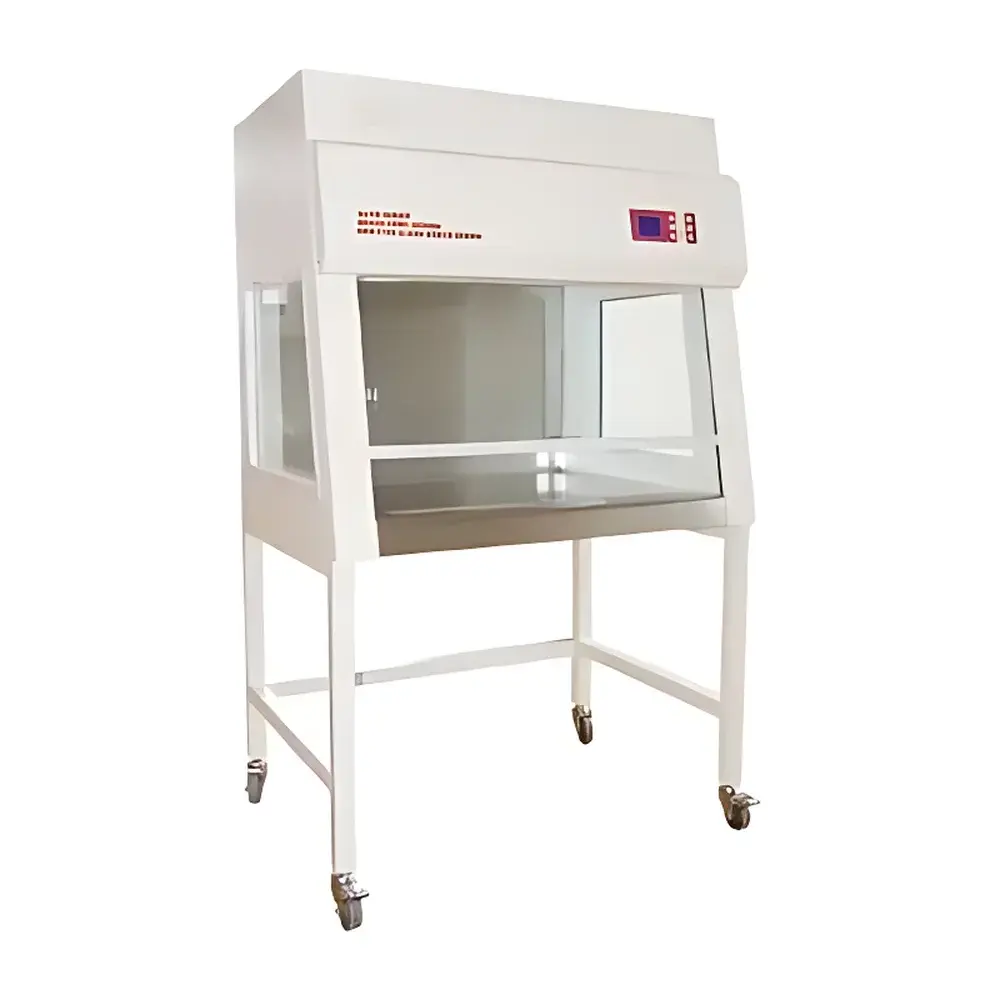
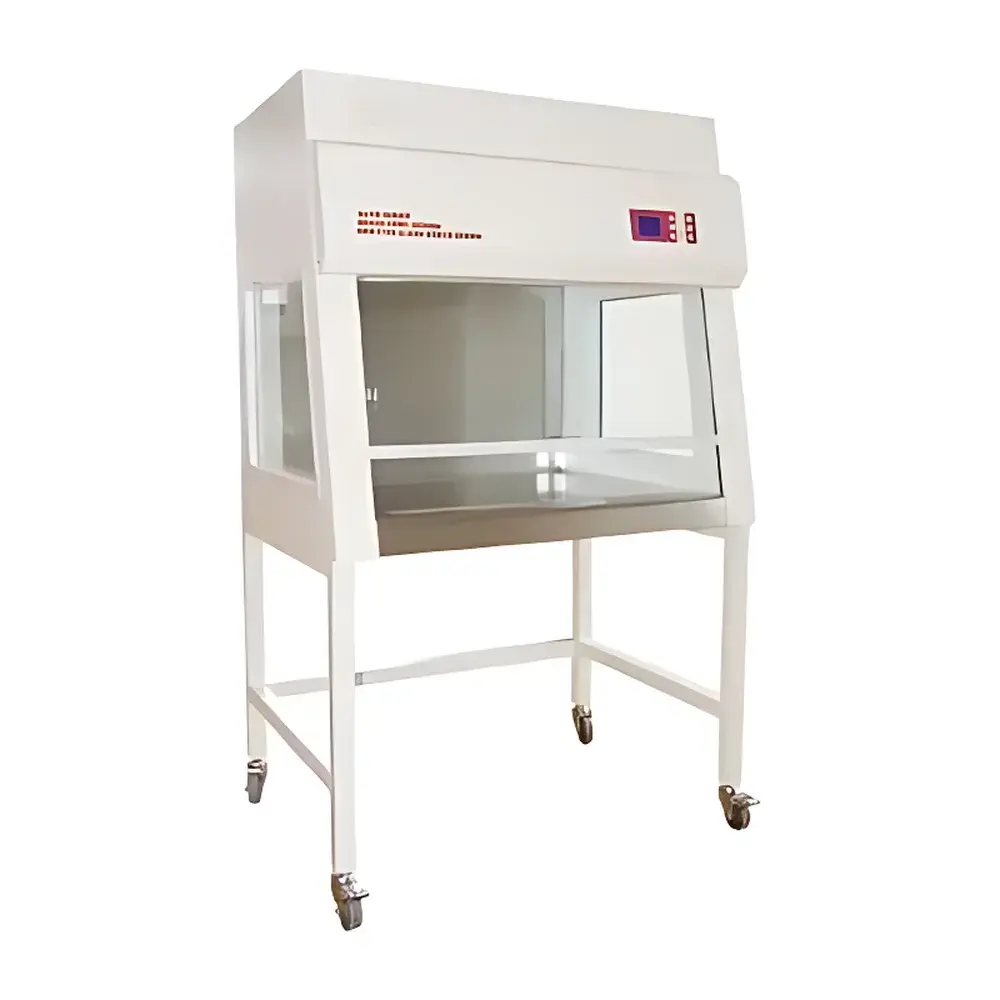
BOXUN BJ-1CD and BJ-2CD Vertical Laminar Flow Clean Benches
| Brand | BOXUN |
|---|---|
| Origin | Shanghai, China |
| Model | BJ-1CD / BJ-2CD |
| Airflow Type | Vertical Downflow |
| Cleanliness Class | ISO Class 5 (equivalent to Fed. Std. 209E Class 100 @ ≥0.5 µm) |
| Adjustable Air Velocity Range | 0.1–0.6 m/s |
| Noise Level | ≤62 dB(A) |
| Illuminance | ≥300 lx |
| Vibration Half-Peak Amplitude | ≤3 µm (X/Y/Z axes) |
| Power Supply | AC 220 V, 50 Hz |
| Max. Power Consumption | 0.2 kW (BJ-1CD) / 0.37 kW (BJ-2CD) |
| Net Weight | 115 kg (BJ-1CD) / 205 kg (BJ-2CD) |
| Work Area Dimensions | 830 × 700 × 520 mm (BJ-1CD) / 1300 × 700 × 520 mm (BJ-2CD) |
| External Dimensions | 891 × 725 × 1577 mm (BJ-1CD) / 1460 × 725 × 1577 mm (BJ-2CD) |
| HEPA Filter Specifications | 765 × 548 × 50 mm × 1 (BJ-1CD) / 1236 × 549 × 50 mm × 1 (BJ-2CD), Unibody Pleated HEPA, ≥99.995% @ 0.3 µm |
| Pre-filter | Synthetic Fiber Medium-Efficiency Panel Filter |
| Lighting | 30 W Fluorescent Lamp × 1 + 20 W UV Lamp × 1 (BJ-1CD) / 40 W Fluorescent Lamp × 1 + 30 W UV Lamp × 1 (BJ-2CD) |
| Safety Interlock | UV Lamp & Main Light Interlocked |
| Control Interface | LCD Display with Real-Time Parameters (Air Velocity, Differential Pressure, Cumulative Operating Time, Clock, HEPA Status) |
Overview
The BOXUN BJ-1CD and BJ-2CD Vertical Laminar Flow Clean Benches are engineered for precision-controlled, ISO Class 5 (Fed. Std. 209E Class 100) local air purification in non-sterile but particle-sensitive laboratory environments. These units operate on the principle of unidirectional vertical laminar airflow: ambient air is drawn through a pre-filter to remove coarse particulates, then pressurized into a plenum chamber before passing through a certified high-efficiency particulate air (HEPA) filter—tested to retain ≥99.995% of particles ≥0.3 µm. The resulting uniform, low-turbulence downflow creates a sterile-grade working zone free from cross-contamination, suitable for aseptic manipulations where full enclosure (e.g., biosafety cabinets) is unnecessary. Designed for continuous operation in QC labs, R&D facilities, and electronics assembly areas, the benches comply with fundamental cleanroom engineering principles outlined in ISO 14644-1 and support adherence to GLP documentation requirements through integrated operational logging.
Key Features
- Unibody pleated HEPA filters with validated filtration efficiency ≥99.995% at 0.3 µm—certified per EN 1822-1 and tested per IEST-RP-CC001.2;
- LCD control panel displaying real-time air velocity (0.1–0.6 m/s, six-step adjustable), differential pressure across HEPA, cumulative operating hours, system clock, and visual status indicators for HEPA integrity;
- Dual-stage filtration architecture: synthetic fiber medium-efficiency pre-filter extends HEPA service life and maintains consistent downstream cleanliness;
- Acoustic-visual HEPA failure alarm: triggered by pressure differential deviation beyond ±15% of baseline or physical breach detection;
- Ergonomic 10° forward-sloped work surface fabricated from electropolished SUS304 stainless steel—corrosion-resistant, non-porous, and compliant with USP surface cleaning protocols;
- Interlocked UV germicidal lamp (254 nm) and fluorescent lighting: UV deactivation occurs automatically when sash is opened beyond safe threshold;
- Balanced counterweighted vertical sash with frictionless linear guides—positionable within 200–600 mm height range and lockable at discrete intervals;
- Integrated dual GFCI-protected 220 V AC power outlets (IP44 rated), plus optional gas/water quick-connect ports for modular lab integration;
- Modular chassis design: powder-coated cold-rolled steel housing separates from reinforced base frame equipped with dual-locking casters and leveling feet for stable repositioning.
Sample Compatibility & Compliance
These clean benches accommodate standard Petri dishes, culture flasks, pipette racks, weighing boats, and microcentrifuge tubes without airflow obstruction. The vertical downflow geometry ensures optimal protection for open-container procedures involving non-hazardous biological agents (BSL-1), pharmaceutical compounding (non-sterile), semiconductor wafer handling, and precision optical alignment. Units meet structural and electrical safety requirements per IEC 61010-1 and EMC compliance per CISPR 11 Group 1, Class B. While not classified as biosafety equipment under NSF/ANSI 49, their performance aligns with ISO 14644-1:2015 Annex B test methodologies for airflow uniformity (±20% tolerance), particle count verification (≥5 sampling points per ISO 14644-1), and turbulence assessment via smoke visualization. Documentation supports audit readiness for FDA 21 CFR Part 11–governed environments when paired with validated SOPs.
Software & Data Management
The embedded microcontroller logs time-stamped operational parameters—including total runtime, HEPA delta-P history, and UV exposure cycles—to non-volatile memory. Data export is supported via USB-C interface (optional firmware upgrade) for CSV-formatted reports compatible with LIMS platforms. Audit trail functionality records operator-initiated parameter changes with timestamp and session ID, satisfying basic ALCOA+ data integrity criteria. No cloud connectivity or remote access is implemented—ensuring air-gapped operation per ITAR and institutional cybersecurity policies. Calibration certificates for airflow sensors (traceable to NIST standards) and HEPA filter test reports (including DOP/PAO scan results) are supplied with each unit.
Applications
- Aseptic transfer of microbial cultures and cell lines in academic and industrial microbiology labs;
- Preparation of media, reagents, and standards in pharmaceutical quality control laboratories;
- Handling of sensitive electronic components during PCB inspection and soldering;
- Environmental monitoring sample processing (e.g., air/water filter analysis) under low-particulate conditions;
- Non-hazardous chemical dispensing and gravimetric analysis requiring particulate-free weighing environments;
- Support function for laminar flow hoods in hybrid cleanroom layouts where localized particle control suffices.
FAQ
What ISO classification does this clean bench achieve?
It delivers ISO Class 5 (≤3,520 particles/m³ ≥0.5 µm), equivalent to Fed. Std. 209E Class 100.
Is UV sterilization validated for surface decontamination?
UV irradiance is calibrated to deliver ≥100 µW/cm² at work surface; validation requires user-performed biological indicators (e.g., Bacillus subtilis spores) per ISO 15714.
Can the unit be installed in a non-air-conditioned room?
Ambient temperature must remain between 15–30°C and relative humidity ≤70% RH to prevent condensation on HEPA media and ensure motor longevity.
How often should the pre-filter be replaced?
Typical interval is every 3–6 months depending on particulate load; differential pressure increase >25 Pa above baseline signals replacement necessity.
Does the bench include HEPA certification documentation?
Yes—each unit ships with a factory-issued HEPA filter test report (scan map, efficiency curve, leakage test result) and calibration certificate for the anemometer.



