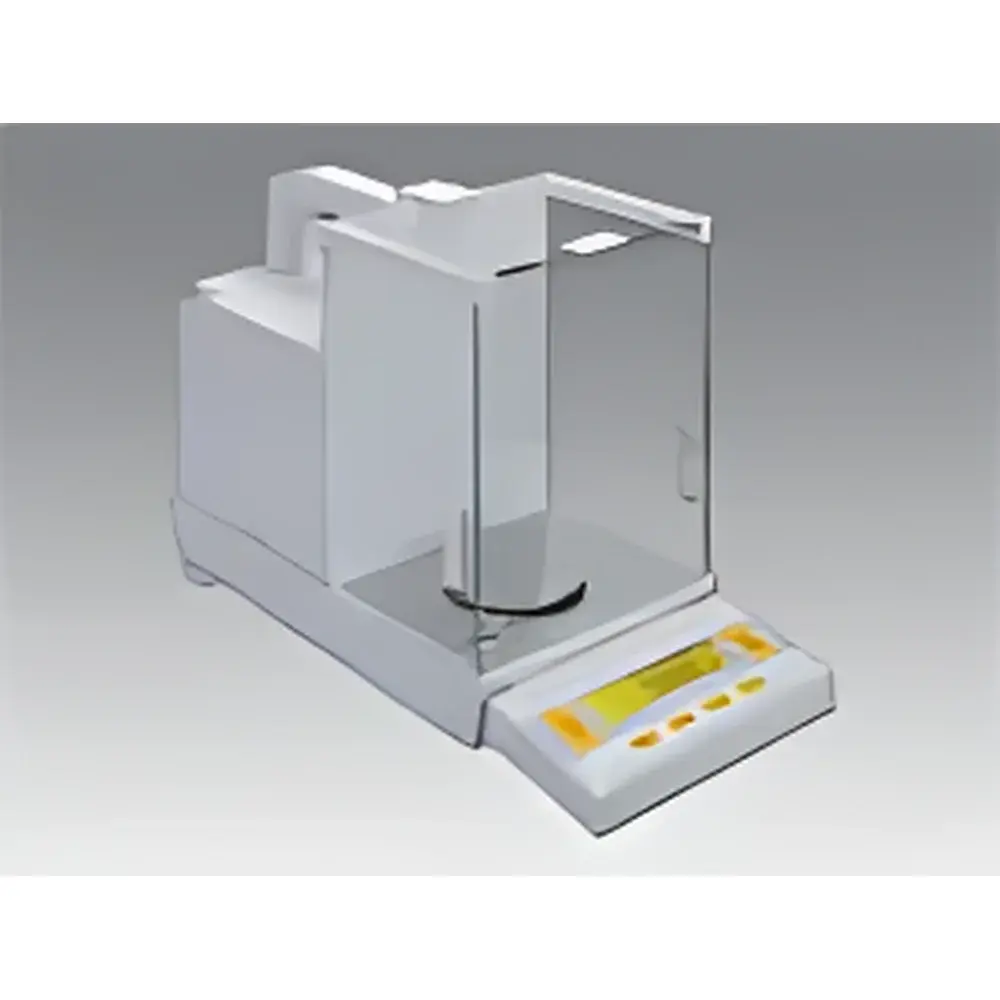
FA1604 Precision Analytical Balance (0.1 mg Readability)
| Origin | Shanghai, China |
|---|---|
| Manufacturer Type | Authorized Distributor |
| Product Origin | Domestic (China) |
| Model | FA1604 |
| Price | USD 950 (FOB Shanghai) |
| Capacity | 160 g |
| Readability | 0.1 mg |
| Repeatability | ≤ 0.1 mg |
| Linearity | ±0.2 mg |
| Draft Shield Dimensions | 195 × 160 × 235 mm |
| Overall Dimensions | 195 × 445 × 300 mm |
| Pan Diameter | Φ90 mm |
| Power Options | AC Adapter (100–240 VAC) or 9 V DC Battery |
| Interface | RS232 |
| Environmental Compensation | Dynamic Temperature Compensation |
| Calibration | Internal Auto-Calibration |
| Protection | Overload Alarm & Mechanical Overload Protection |
| Units | g, oz, ct, %, pcs |
Overview
The FA1604 Precision Analytical Balance is an entry-level high-accuracy laboratory balance engineered for routine quantitative mass measurement in quality control, academic teaching labs, pharmaceutical QC, and materials testing environments. It operates on electromagnetic force compensation (EMFC) principle—where the restoring force required to maintain zero displacement of the weighing pan is precisely measured via a feedback-controlled coil system—ensuring superior long-term stability, minimal creep, and inherent linearity compared to strain-gauge-based architectures. With a maximum capacity of 160 g and readability of 0.1 mg (100 µg), the FA1604 meets the performance requirements for Class II analytical applications per OIML R76 and ISO 9001-compliant workflows. Its robust aluminum-plastic hybrid housing, stainless-steel weighing pan (Φ90 mm), and integrated draft shield (195 × 160 × 235 mm) provide mechanical stability and environmental isolation under typical lab conditions (20–25 °C, <70% RH, non-condensing). The balance supports dual power modes—AC mains or 9 V DC battery—enabling portable operation during field calibration checks or temporary lab relocations.
Key Features
- Electromagnetic force compensation sensor with rear-mounted design for enhanced thermal and mechanical stability
- Dynamic temperature compensation algorithm minimizing drift across ambient fluctuations (±0.5 °C/h typical)
- Four-stage anti-vibration damping system with adjustable stabilization speed (fast/standard/slow modes)
- Backlit LCD display with user-selectable contrast and multiple display formats (mass, %, count, net/gross)
- Internal automatic calibration (AutoCal™) triggered by time interval, temperature shift (>1.5 °C), or manual initiation
- Full-range tare function with memory retention across power cycles
- RS232 serial interface compliant with standard ASCII protocol for direct connection to PCs, printers, or LIMS
- Overload protection circuitry with audible and visual alarm at ≥110% of rated capacity
- Configurable auto-zero tracking threshold and programmable auto-power-off delay (1–60 min)
- Factory reset capability preserving calibration coefficients and regulatory configuration settings
Sample Compatibility & Compliance
The FA1604 accommodates solid, granular, and low-viscosity liquid samples within its 160 g limit. The Φ90 mm stainless-steel pan ensures chemical resistance to common solvents and cleaning agents (e.g., ethanol, isopropanol, diluted acids/bases). Optional accessories—including density kits, below-balance weighing hooks, and sample spatulas—are mechanically compatible and do not compromise metrological integrity. The instrument conforms to international metrological standards including OIML R76-1 (2006) for non-automatic weighing instruments, and supports GLP/GMP documentation through traceable calibration logs (via RS232 output). While not certified to FDA 21 CFR Part 11 out-of-the-box, audit trails can be generated externally using validated third-party data acquisition software adhering to ALCOA+ principles.
Software & Data Management
Data output follows standard NIST-traceable ASCII format over RS232 at 9600 baud, 8N1 configuration. Each transmission includes timestamp (if external clock source connected), unit identifier, stable flag (S = stable reading), and status codes (e.g., “OVR” for overload, “CAL” during calibration). No proprietary driver is required; native Windows/macOS terminal emulators or generic serial logging tools (e.g., Tera Term, CoolTerm) suffice for raw data capture. For regulated environments, integration with laboratory information management systems (LIMS) or electronic lab notebooks (ELN) is achievable via middleware that maps ASCII fields to structured JSON/XML schemas. Firmware supports firmware version reporting and error-code diagnostics (e.g., E01 = sensor fault, E05 = temperature sensor out-of-range).
Applications
- Quantitative formulation in pharmaceutical tablet development (active ingredient dosing at 0.1 mg resolution)
- Gravimetric preparation of standard solutions (e.g., 100 ppm stock solutions per USP )
- Moisture content determination via loss-on-drying (LOD) protocols when paired with a compatible drying oven
- Particle counting and statistical sampling in powder metallurgy and catalyst manufacturing
- Teaching fundamental metrology concepts—including uncertainty estimation, repeatability assessment, and calibration hierarchy—in undergraduate chemistry and physics labs
- Raw material acceptance testing in food and cosmetics QA/QC where batch conformity to ±0.2 mg linearity tolerance is mandated
FAQ
What is the recommended calibration frequency for the FA1604 in a GLP environment?
Per ISO/IEC 17025:2017 Clause 6.5.2, internal auto-calibration should be performed before first use each day and after any significant ambient temperature change (>1.5 °C). External verification using Class E2 or better weights is advised weekly or per risk-based assessment.
Does the FA1604 support connectivity to modern LIMS platforms?
Yes—via RS232 ASCII output. Integration requires middleware or custom scripting to parse delimiter-separated values into HL7 or ASTM E1384-compliant messages. No USB or Ethernet interface is built-in.
Can the balance operate continuously on battery power?
The included 9 V alkaline battery provides up to 8 hours of continuous operation under typical usage (10 s stabilization intervals, backlight enabled); rechargeable NiMH variants are not supported due to voltage regulation constraints.
Is the draft shield removable for cleaning without affecting calibration?
Yes—the acrylic shield is mechanically decoupled from the sensor assembly. Removal and reinstallation do not require recalibration, though full-system verification using test weights is recommended post-cleaning.
What does the “E03” error code indicate during startup?
E03 signifies an initialization failure in the electromagnetic transducer feedback loop—typically caused by mechanical obstruction of the pan or contamination on the magnetic gap. Power cycling followed by visual inspection of the pan suspension resolves >95% of occurrences.