
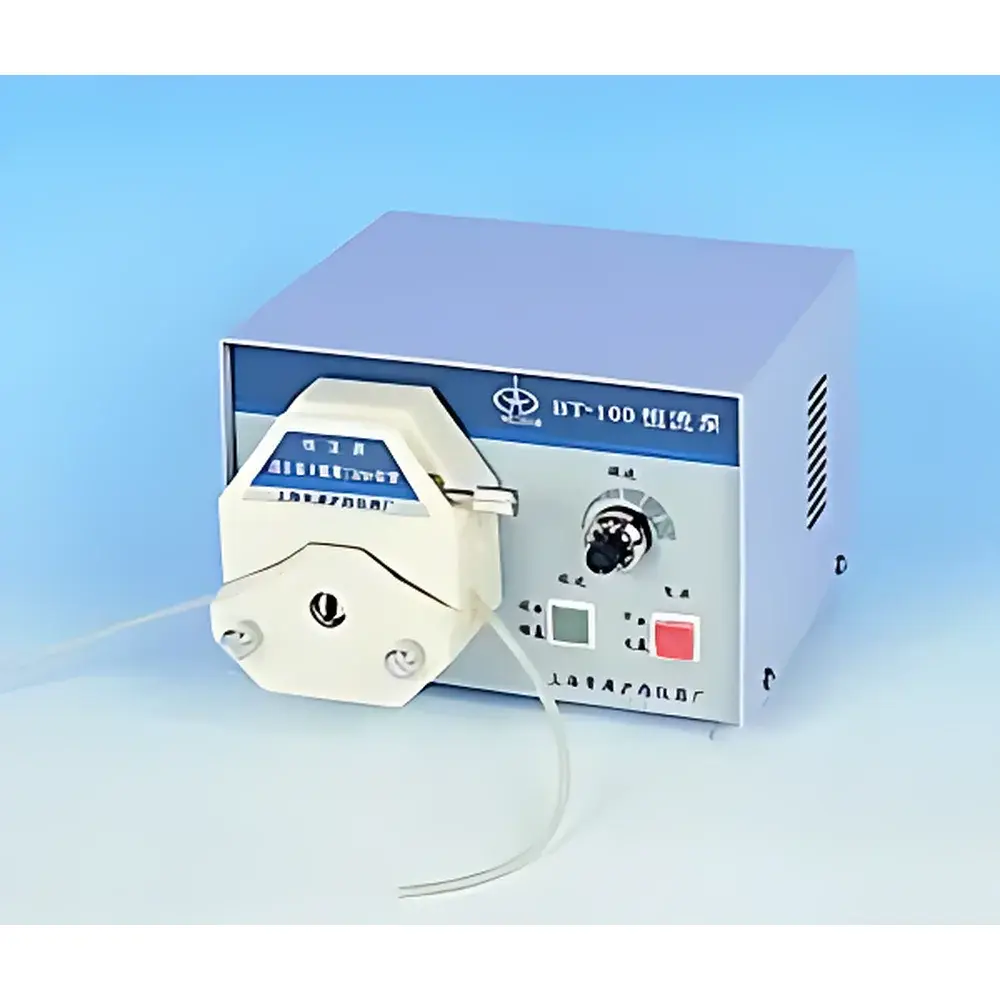
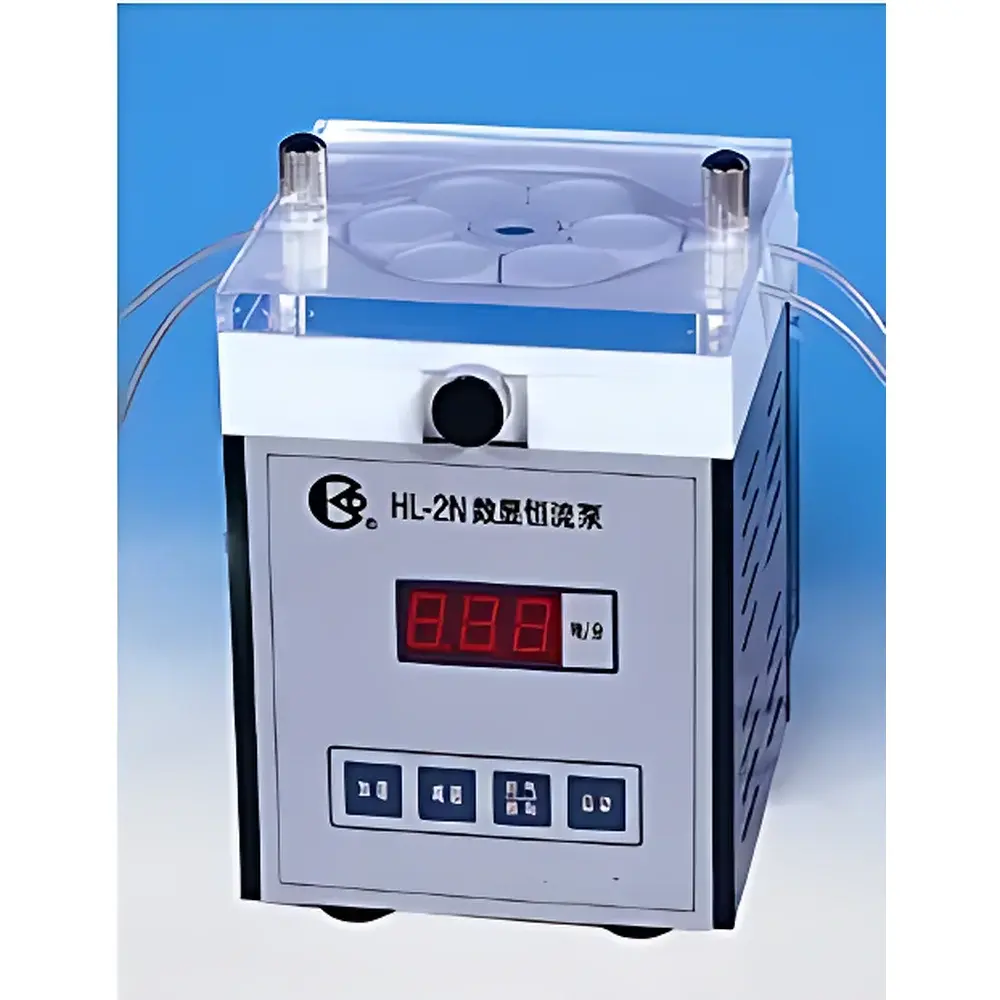
DHL-A/DHL-B Digital Peristaltic Pump with Organic-Solvent-Resistant Pump Head
| Key | Origin: Shanghai, China |
|---|---|
| Manufacturer Type | Authorized Distributor |
| Product Origin | Domestic (PRC) |
| Model | DHL-A / DHL-B |
| Flow Rate Range | 0.5–900 mL/min |
| Speed Range | 0–60 rpm |
| Channel Configuration | Single-Channel (DHL-A), Dual-Channel (DHL-B) |
| Display | LED Digital Speed Readout |
| Pump Head Material | Chemically Resistant Polymer (PTFE-reinforced) |
| Tubing Compatibility | Certified Organic-Solvent-Resistant Silicone Tubing (e.g., chloroform, ethyl acetate) |
| Max Back Pressure | ≥3 kg/cm² |
| Dimensions (DHL-A) | 200 × 240 × 160 mm |
| Dimensions (DHL-B) | 120 × 120 × 180 mm |
Overview
The DHL-A and DHL-B digital peristaltic pumps are precision-engineered laboratory fluid transfer systems designed for reliable, pulse-free, and contamination-free operation in demanding analytical and preparative workflows. Based on the fundamental principle of peristalsis—where rollers compress flexible tubing to generate positive displacement—the DHL series delivers accurate volumetric flow control without internal valves or seals contacting the fluid path. This design ensures complete fluid isolation, eliminating cross-contamination risks and enabling safe handling of aggressive organic solvents including chloroform, ethyl acetate, dichloromethane, and acetonitrile. Both models integrate microprocessor-based speed regulation, real-time rotational speed feedback, and non-volatile memory to retain user-defined operational parameters across power cycles. The DHL-A is configured as a single-channel unit optimized for high-flow applications up to 900 mL/min, while the DHL-B provides dual independent channels—each capable of 1–600 mL/h—supporting parallel or differential delivery protocols common in HPLC gradient preparation, cell culture media perfusion, and multi-stream reagent dosing.
Key Features
- Organic-solvent compatibility validated via chemically resistant pump head construction (PTFE-reinforced polymer housing) and certified imported silicone tubing rated for prolonged exposure to halogenated and ester-based solvents
- Digital LED speed display with 0.1 rpm resolution and smooth, stepless speed adjustment across the full 0–60 rpm range
- Non-volatile parameter memory retains last-used speed setting and channel activation state after power interruption
- Robust mechanical architecture featuring precision-machined stainless-steel rollers, low-backlash gear train, and thermally stable motor windings for long-term speed stability (±0.5% repeatability over 8-hour continuous operation)
- Front-panel tactile controls with intuitive layout; no software dependency for basic operation—ideal for glove-box or fume hood integration
- Compliance-ready design supports traceable operation: speed calibration certificate available upon request (traceable to NIM-certified standards)
Sample Compatibility & Compliance
The DHL-A/DHL-B series is explicitly engineered for use with Class II and III organic solvents per ICH Q5C and ASTM D471 guidelines. Pump heads and tubing assemblies undergo accelerated chemical immersion testing (72 h at 25°C) in chloroform, ethyl acetate, and acetone to verify dimensional stability and extractables profile. All wetted materials comply with USP Class VI biocompatibility requirements. While not intrinsically rated for hazardous area use, the pumps meet CE marking requirements under Directive 2014/30/EU (EMC) and 2014/35/EU (LVD). For regulated environments, optional audit trail logging modules (sold separately) support 21 CFR Part 11-compliant electronic records when paired with validated PC-based control software.
Software & Data Management
Standalone operation requires no external software. However, optional RS-232 or USB-to-serial interface kits enable integration with LabVIEW, MATLAB, or custom SCADA platforms for automated protocol execution. Firmware v2.1+ supports Modbus RTU protocol for PLC-level coordination in process labs. Data export includes timestamped speed logs (CSV format), runtime counters per channel, and thermal event alerts. All firmware updates are delivered via signed binary packages with SHA-256 verification to ensure integrity—critical for GLP/GMP-aligned laboratories maintaining instrument qualification documentation.
Applications
- HPLC and UHPLC mobile phase delivery, particularly in solvent-intensive gradient methods requiring consistent flow under variable backpressure
- Continuous feeding of organic reaction mixtures in flow chemistry reactors (e.g., photochemical or cross-coupling systems)
- Controlled nutrient/media infusion in bioreactors and hollow-fiber perfusion systems where sterility and solvent resistance are mandatory
- Automated sample introduction in GC-FID and LC-MS workflows involving volatile organic extracts
- Calibration standard delivery in environmental labs performing EPA Method 525.3 (purge-and-trap GC/MS) and ASTM D7089 (dissolved hydrocarbon analysis)
FAQ
What tubing sizes are supported by the DHL-A and DHL-B pump heads?
Standard configurations accommodate 1/4″ (6.4 mm) OD silicone tubing with wall thicknesses of 1.6 mm or 2.4 mm. Custom pump head inserts for 1/8″ and 3/8″ tubing are available under OEM part numbers DH-TB-08 and DH-TB-10.
Is speed calibration traceable to national metrology institutes?
Yes—calibration certificates issued by our Shanghai Metrology & Testing Center (accredited to ISO/IEC 17025:2017) include uncertainty budgets and reference to NIM Standard 2021-FL-004 for rotational speed measurement.
Can the DHL-B operate both channels at different speeds simultaneously?
Yes. Each channel features independent speed control with isolated motor drivers, enabling asynchronous operation—for example, 45 rpm on Channel 1 and 12 rpm on Channel 2—with no crosstalk or torque coupling.
Does the pump support external start/stop triggering via TTL signal?
Yes. Pin 3 (TTL IN) on the rear DB9 connector accepts 0–5 V logic signals for remote run/hold control, compatible with common PLC output modules and Arduino-based automation controllers.
What maintenance intervals are recommended for routine operation?
Roller alignment verification every 500 operating hours; tubing replacement every 200–300 hours depending on solvent aggressiveness and flow rate. Full lubrication service (grease renewal on gear train) is advised annually or after 2,000 hours—whichever occurs first.



