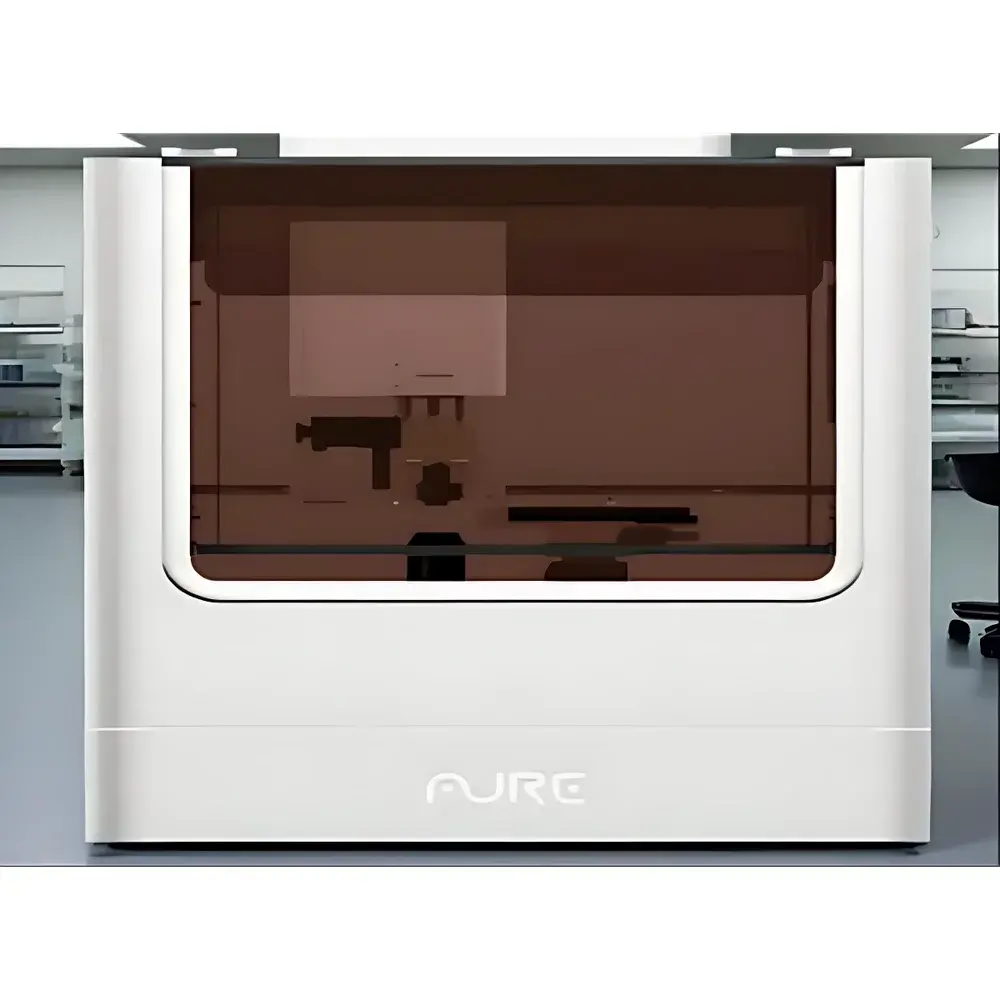
Aure SCP4000 High-Throughput Single-Cell Printing System
| Brand | Aure |
|---|---|
| Origin | Beijing, China |
| Model | SCP4000 |
| Sample Throughput | 16 samples per run |
| Chip Configuration | 640 parallel nozzles per disposable B150 print chip |
| Compliance | Designed for GLP-compliant cell line development workflows |
| Software | Embedded AI-powered image recognition engine for real-time single-cell identification and deposition targeting |
Overview
The Aure SCP4000 High-Throughput Single-Cell Printing System is an engineered solution for deterministic, image-guided single-cell isolation and direct deposition into multiwell plates (e.g., 1536-well format) or custom spatial arrays. Unlike conventional fluorescence-activated or droplet-based sorting platforms, the SCP4000 employs a solid-state, nozzle-based digital dispensing architecture grounded in precision piezoelectric inkjet actuation and real-time high-resolution brightfield/phase-contrast imaging. Each operation cycle integrates optical acquisition, AI-driven morphological classification, and synchronized microdispensing—enabling true single-cell resolution without reliance on fluorescent labeling or hydrodynamic focusing. This principle ensures minimal mechanical perturbation to cells, preserving viability, clonogenic potential, and native transcriptional states—critical parameters for therapeutic cell line development, CRISPR clone validation, and primary cell banking.
Key Features
- Deterministic deposition architecture: 640 independently addressable piezoelectric nozzles per disposable B150 chip enable massively parallel single-cell printing with >99.8% positional accuracy across 1536-well plates.
- No-tube, no-shear fluidics: Fully sealed, monolithic microfluidic chip eliminates tubing, valves, and laminar shear stress—reducing cellular deformation and membrane damage during dispensing.
- Integrated sterility assurance: Onboard HEPA filtration (ISO Class 5 environment) and UV-C irradiation (254 nm, 30 mJ/cm²) decontaminate internal chamber surfaces between runs; all wetted components are single-use.
- Zero-calibration workflow: Plug-and-play B150 chip installation requires no alignment, pressure tuning, or nozzle priming—validated at factory and maintained through chip lifetime.
- Embedded AI inference engine: Real-time CNN-based image analysis (trained on >2.1 million annotated cell images) classifies cell morphology, confluence, debris, and doublets with configurable confidence thresholds—adaptable to diverse suspension types (CHO, HEK293, hybridomas, iPSCs, PBMCs).
Sample Compatibility & Compliance
The SCP4000 accommodates suspension cultures ranging from 1 × 10⁵ to 2 × 10⁷ cells/mL, including adherent cells pre-dissociated with enzymatic or EDTA-based protocols. It supports viscous media (up to 5% FBS, 1% methylcellulose) and low-volume loading (as little as 20 µL per sample). All hardware and software modules comply with ISO 13485 design controls and support audit-ready documentation for GMP-aligned cell line development (CLD) processes. The system generates ALCOA+ compliant electronic records—including full image logs, deposition coordinates, timestamped event traces, and user action audit trails—meeting requirements for FDA 21 CFR Part 11 and EU Annex 11 validation frameworks.
Software & Data Management
The SCP4000 Control Suite runs on a locked-down Windows IoT OS with TLS 1.2 encrypted communication and role-based access control (RBAC). Each session exports structured data in HDF5 format containing raw images, AI classification metadata, plate map annotations, and QC metrics (e.g., cell roundness, area variance, inter-nozzle consistency). Integration with LIMS via RESTful API enables automated job queuing and result ingestion. Software versioning follows ICH M4 Q5A guidelines, with change logs, regression test reports, and patch history archived for regulatory submission readiness.
Applications
- Monoclonal antibody and recombinant protein cell line development (targeting ≥90% monoclonality confirmation rate per well)
- CRISPR-edited clone isolation and expansion validation
- Primary immune cell cloning for CAR-T and TCR-T therapy manufacturing
- Single-cell RNA-seq library preparation via spatially resolved seeding into barcoded wells
- Synthetic biology strain construction requiring high-fidelity founder population isolation
- Diagnostic reagent antibody production with stringent clonality and stability requirements
FAQ
Does the SCP4000 require fluorescent labeling for cell identification?
No. It relies exclusively on label-free brightfield/phase contrast imaging and morphology-based AI classification.
Can the system validate monoclonality post-deposition?
Yes—integrated time-lapse imaging (optional module) captures growth kinetics and confirms origin of each colony from a single founder cell.
What is the expected chip lifetime and lot-to-lot consistency?
Each B150 chip is qualified for ≥5,000 single-cell dispense events per nozzle with ≤0.3% clogging incidence across 120+ production lots; full QC traceability is provided with every shipment.
Is remote monitoring and troubleshooting supported?
Yes—secure cloud telemetry (opt-in) provides real-time status dashboards, predictive nozzle health alerts, and encrypted remote diagnostics by certified field application engineers.
How does the SCP4000 handle viscous or aggregated samples?
Pre-run sample analysis detects aggregation; the software dynamically adjusts dispensing voltage, dwell time, and image focus to maintain deposition fidelity across heterogeneous suspensions.