
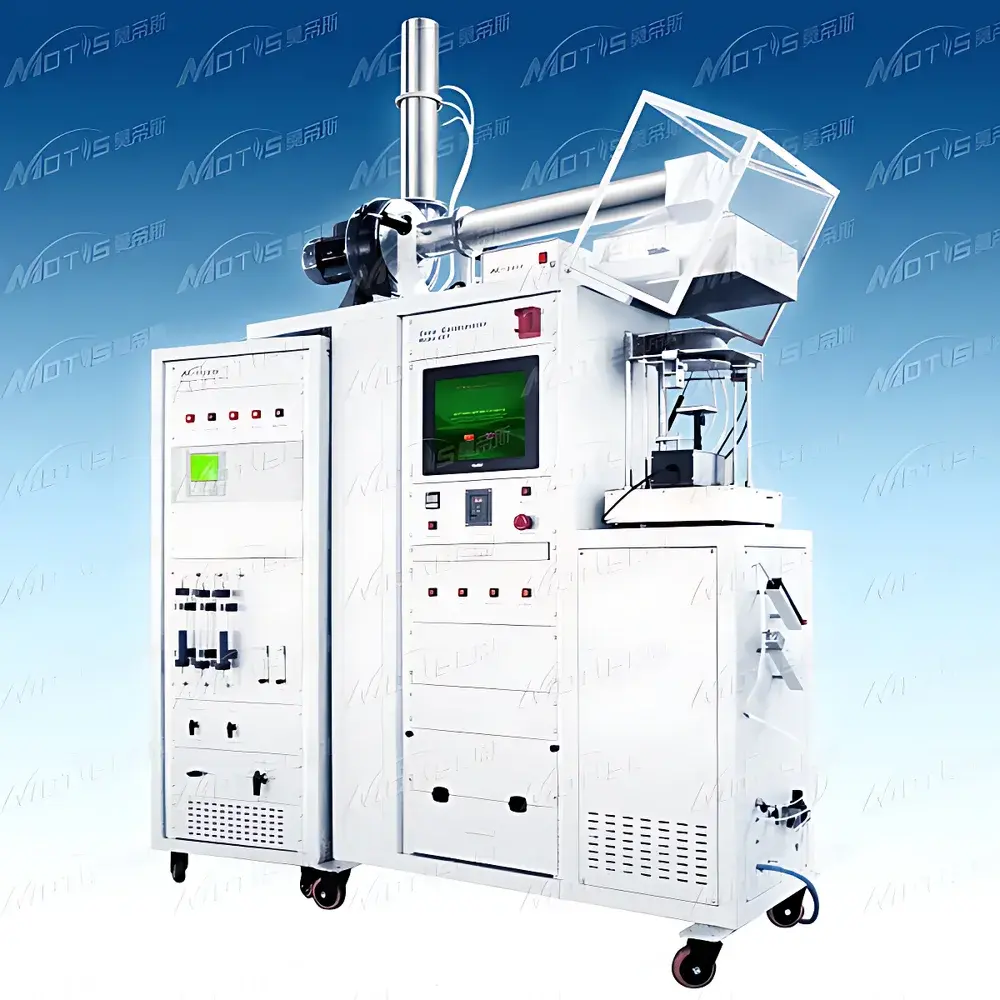
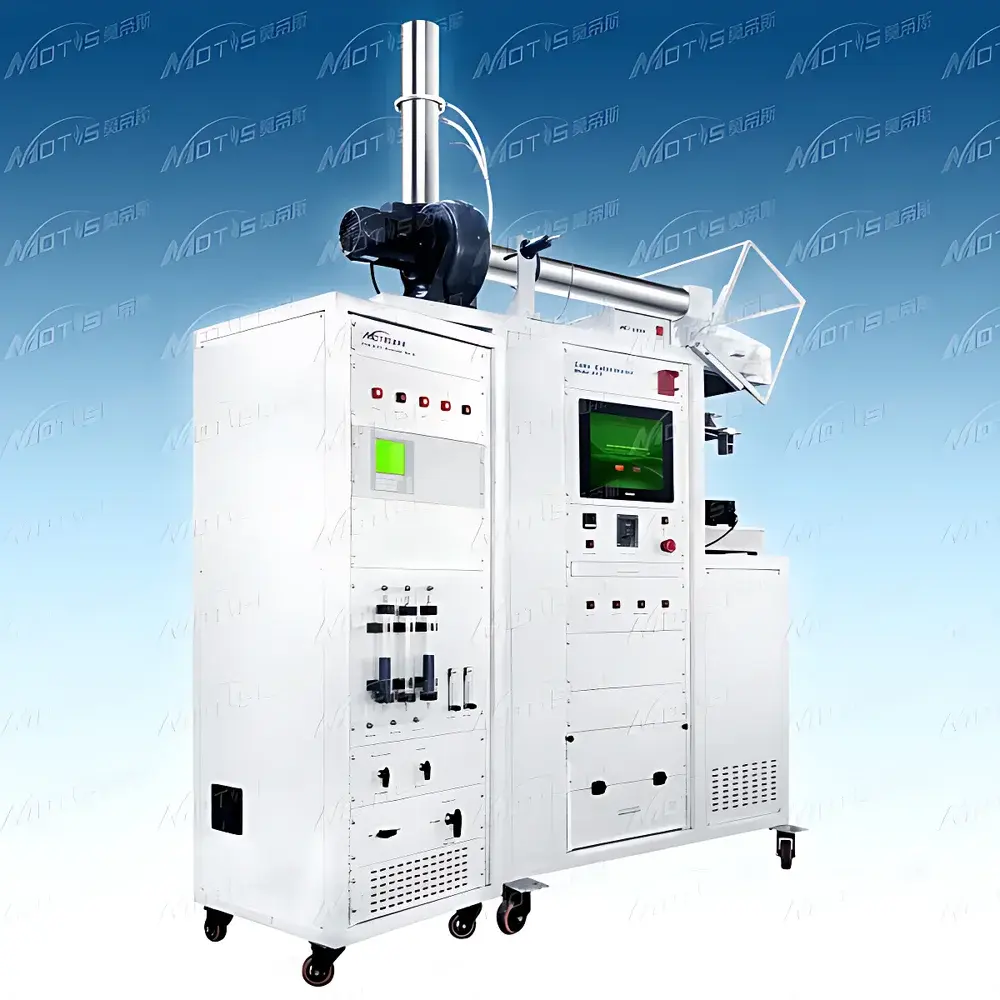
MOTIS CCT Cone Calorimeter
| Brand | MOTIS |
|---|---|
| Origin | Jiangsu, China |
| Model | CCT |
| Heating Source | 5 kW Cone Heater (0–100 kW/m²) |
| Sample Capacity | 100 mm × 100 mm × 50 mm |
| Mass Measurement Range | 0–2000 g (±0.1 g) |
| O₂ Analyzer | Paramagnetic, 0–25% vol, T₉₀ < 1.5 s, drift < 0.5%/month |
| CO/CO₂ Analyzers | NDIR, CO: 0–1%, CO₂: 0–10% |
| Smoke Measurement | He-Ne Laser (0.5 mW), Dual Photodiode Detection |
| Exhaust Flow Control | 0–50 g/s (±0.1 g/s) |
| Heat Flux Calibration | NIST-traceable foil-type heat flux meter (0–100 kW/m², ±3% accuracy, water-cooled, 12.5 mm aperture) |
| C-Factor Calibration | ISO 5660-compliant brass burner, auto-calculated C-value logging |
| Compliance | ASTM E1354, ISO 5660-1 & -2, GB/T 16172, BS 476-15 |
| Data Acquisition | Integrated 17″ touchscreen PC, real-time synchronization of O₂ delay, mass loss, gas concentration, and thermocouple signals |
| Software | Excel-based reporting, sensor calibration wizard (single/dual-point), C-factor history log, system health dashboard, GLP-ready audit trail |
Overview
The MOTIS CCT Cone Calorimeter is a research-grade fire testing instrument engineered for precise, reproducible quantification of material combustion behavior under controlled radiant exposure. Based on the oxygen consumption calorimetry principle—first established by NIST researchers in the early 1980s—the system calculates heat release rate (HRR) by measuring the mass flow and oxygen depletion of combustion effluent gases. This principle relies on the empirically validated correlation that most common organic materials release approximately 13.1 MJ per kilogram of oxygen consumed (±5%), enabling robust, chemistry-agnostic HRR determination without assumptions about fuel composition or flame stoichiometry. Unlike small-scale flammability tests (e.g., UL 94, LOI), the cone calorimeter replicates critical elements of real-fire conditions—including defined radiant flux (0–100 kW/m²), controlled ventilation, and complete smoke capture—making its outputs directly scalable to large-scale fire modeling and regulatory assessment. The CCT integrates all core subsystems—including conical heater, load cell, paramagnetic O₂ analyzer, NDIR CO/CO₂ sensors, laser-based smoke obscuration measurement, and calibrated exhaust flow control—into a unified platform compliant with ISO 5660-1, ASTM E1354, and GB/T 16172.
Key Features
- Modular cabinet architecture: Separable analysis cabinet (19″ rack-mount) supports standalone operation or integration into larger heat release rate (HRR) test systems.
- 5 kW conical heater with PID-controlled surface temperature regulation (0–1000 °C range, ±2 °C stability); radiation uniformity ±2% over central 50 mm × 50 mm sample area.
- NIST-traceable water-cooled foil heat flux meter (0–100 kW/m², ±3% accuracy, 12.5 mm aperture, matte black absorber) with integrated portable chiller—no external water supply required.
- High-fidelity paramagnetic O₂ analyzer (0–25% vol, T₉₀ < 1.5 s, zero drift < 0.5%/month) and dual-channel NDIR analyzers for CO (0–1%) and CO₂ (0–10%).
- Laser smoke measurement system: 0.5 mW He-Ne source with dual photodiode detection for accurate specific extinction area (SEA) calculation per ISO 5660-2.
- Exhaust flow management via precision orifice plate (57 mm ±1 mm diameter) and differential pressure transducer; flow range 0–50 g/s (±0.1 g/s resolution).
- Automated C-factor calibration using certified brass burner; software computes, logs, and validates C-values per ISO 5660-1 (target: 0.035–0.045, optimal 0.040).
- Real-time data acquisition synchronizing O₂ delay compensation, mass loss, thermocouple readings (Type K, 1.6 mm sheathed), and gas concentrations.
Sample Compatibility & Compliance
The CCT accommodates solid specimens up to 100 mm × 100 mm × 50 mm in dimension and 2000 g in mass, supporting diverse material classes including polymers, composites, foams, textiles, and coated substrates. Specimens are mounted horizontally on a motorized load cell stage with automatic ignition via high-voltage spark generator (10 kV, safety interlocked). All measurements adhere strictly to internationally harmonized protocols: ISO 5660-1 (heat release rate and smoke production), ISO 5660-2 (fire effluent toxicity screening), ASTM E1354 (standard test method for heat and visible smoke release rates), BS 476-15 (fire testing of building materials), and GB/T 16172 (Chinese national standard for cone calorimetry). The system’s design enables full traceability to SI units and NIST reference standards, satisfying GLP and pre-submission requirements for regulatory filings with fire safety authorities.
Software & Data Management
The embedded 17″ industrial touchscreen PC runs proprietary firmware with ISO 5660-aligned test sequencing, sensor diagnostics, and compliance-driven data handling. Calibration routines support single- and dual-point linearization for O₂, CO, CO₂, pressure, and smoke channels. The software automatically compensates for gas analyzer transport delays to ensure time-synchronized HRR computation. A dedicated C-factor module executes automated burner calibrations at user-defined power levels (1 kW, 3 kW, 5 kW), computes mean C-values, stores historical logs, and flags deviations exceeding ±5%. System health monitoring provides real-time status visualization for all sensors and actuators. Final reports export to Excel (.xlsx) format with tabulated numerical results and time-resolved graphical plots (HRR, MLR, TTI, THR, SEA, CO yield, etc.). Audit trails record operator actions, calibration events, and parameter modifications—supporting 21 CFR Part 11 readiness when configured with electronic signatures.
Applications
The MOTIS CCT delivers quantitative fire performance metrics essential for materials development, fire hazard assessment, and regulatory compliance. It is routinely deployed to evaluate flame retardant efficacy in polymer formulations, assess fire growth potential of construction products (e.g., insulation, cladding, flooring), characterize pyrolysis kinetics in battery thermal runaway studies, and generate input data for computational fire models (e.g., CFD-based zone or field models). Key output parameters include heat release rate (HRR) and peak HRR (pkHRR), total heat release (THR), time to ignition (TTI), mass loss rate (MLR), effective heat of combustion (EHC), specific extinction area (SEA), smoke production rate (SPR), CO/CO₂ yields, and oxygen depletion integral. These parameters inform fire risk ranking, product certification (e.g., EN 13501-1, ASTM E84), and formulation optimization where thermal stability, char formation, and gas-phase inhibition mechanisms must be quantified objectively.
FAQ
What is the fundamental principle underlying cone calorimetry?
Cone calorimetry applies the oxygen consumption principle: combustion of most organic materials releases ~13.1 MJ per kg of O₂ consumed. By precisely measuring exhaust gas O₂ concentration and mass flow, HRR is calculated without reliance on flame temperature or chemical speciation.
How is system accuracy maintained over time?
Through routine C-factor calibration using the certified brass burner, NIST-traceable heat flux meter verification, and scheduled multi-point sensor recalibration—each logged and auditable within the software.
Can the CCT quantify toxic gas emissions?
Yes—integrated NDIR CO and CO₂ analyzers provide real-time yield data. For broader toxicant profiling (e.g., HCN, HCl), the exhaust stream can be routed to optional FTIR or GC-MS modules via the standardized sampling port.
Is the system suitable for GMP/GLP-regulated environments?
With enabled audit trail, electronic signature, and calibration documentation features, the CCT meets foundational requirements for GLP-compliant fire testing laboratories and supports validation for regulated product submissions.
What sample preparation standards apply?
Specimens must be conditioned per ISO 291 (23 °C, 50% RH, ≥48 h) and mounted flat without gaps; edge effects are minimized using aluminum foil shielding per ISO 5660-1 Annex A.



