
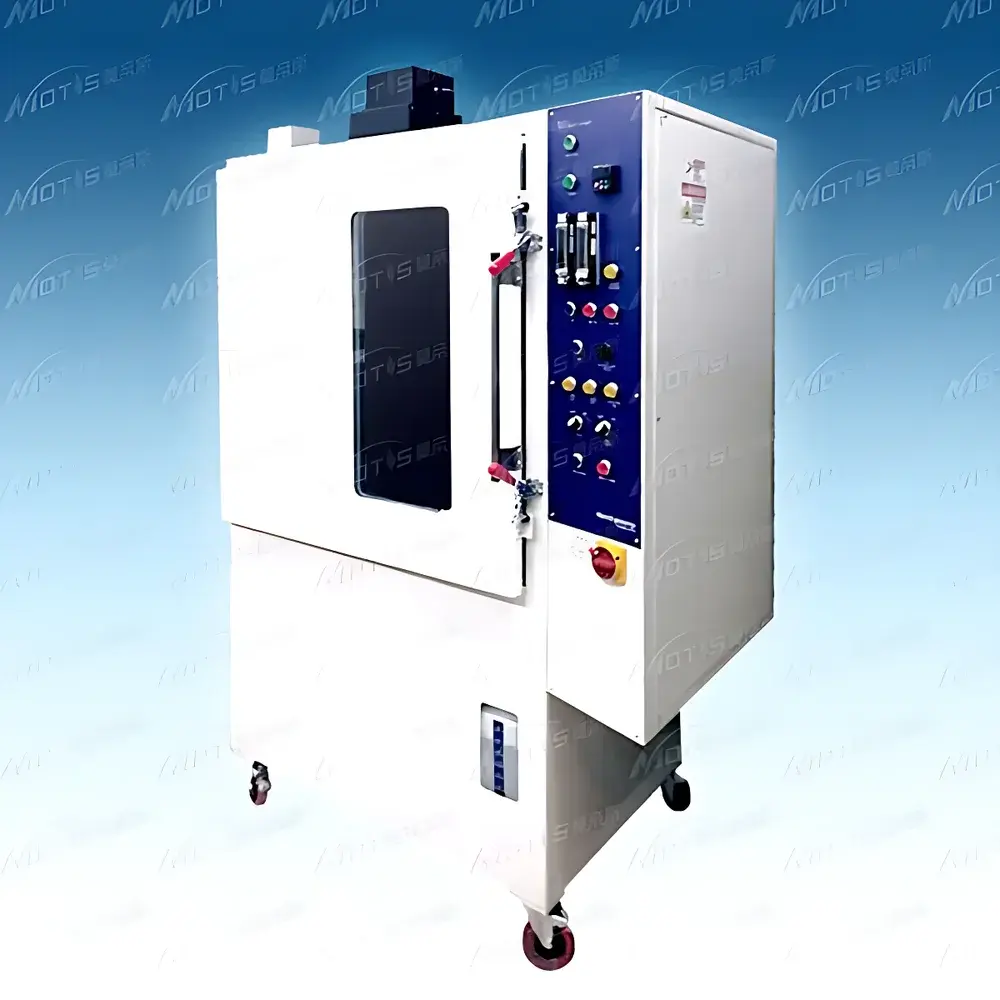
Marlin Engineering ME1100-1 NBS Smoke Density Chamber
| Brand | Marlin Engineering (MEI) |
|---|---|
| Origin | USA |
| Model | ME1100-1 |
| Compliance | FAA-recognized NBS-type smoke density chamber |
| Standards | FAA AC 20-135, BSS 7238, BSS 7239, AITM 2.0007, AITM 3.0005, HB 6577 |
| Temperature Control | PID-regulated radiant heating system |
| Optical Path | Fixed optical platform with calibrated photometric assembly |
| Light Source | Stable tungsten-halogen lamp with collimated beam |
| Transmittance Measurement Range | 0–100% (logarithmic smoke density scale: 0–1000 Ds) |
| Gas Sampling Interface | Four Swagelok® ports on chamber ceiling |
| Heat Flux Capability | 0–50 kW/m² (with traceable heat flux meter) |
| Sample Handling | Pneumatic specimen insertion mechanism |
| Ignition | Electronic spark ignition burner |
| Calibration | Three neutral density filters (certified OD values), stainless steel specimen holders (3× standard + 1 blank), gas flow and pressure regulation for controlled flaming combustion |
| Ancillary | Integrated smoke toxicity test kit (portable sampling pump, colorimetric detector tubes), real-time data acquisition system with ASTM/ISO-compliant reporting engine |
Overview
The Marlin Engineering ME1100-1 is a federally recognized NBS (National Bureau of Standards)-type smoke density chamber engineered to meet the stringent optical attenuation measurement requirements defined in aviation fire safety standards. It operates on the principle of measuring the reduction in light transmittance (T%) through smoke generated during controlled combustion of solid materials under standardized radiant heat exposure. The instrument implements the foundational methodology described in ASTM E662—Standard Test Method for Specific Optical Density of Smoke Generated by Solid Materials—and aligns with the optical geometry, calibration protocols, and environmental controls mandated by FAA Advisory Circular 20-135, Boeing BSS 7238/7239, Airbus AITM 2.0007/3.0005, and China’s HB 6577. Its design centers on reproducible smoke generation, stable thermal input, and metrologically traceable photometric measurement—critical for qualifying interior aircraft materials including seat fabrics, insulation blankets, ducting, and wire jacketing.
Key Features
- Double-walled, high-temperature borosilicate observation window enabling unobstructed visual monitoring without thermal distortion or condensation.
- PID-controlled radiant heating system using integrated thermocouple-equipped coil heaters, delivering precise and uniform thermal flux up to 50 kW/m² with ±0.5 kW/m² stability over 30-minute test cycles.
- Pneumatically actuated specimen carriage ensuring repeatable positioning and timing of sample exposure—eliminating operator-induced variability in ignition delay and flame contact duration.
- Electronic spark ignition burner with independent gas pressure and mass flow regulation, supporting both non-flaming (radiant-only) and flaming combustion modes per ASTM E662 Annex A1.
- Optical train mounted on vibration-isolated granite platform: includes collimated tungsten-halogen source, precision aperture, and silicon photodiode detector with temperature-compensated amplifier circuitry.
- Four Swagelok®-style gas sampling ports located at the chamber apex for concurrent smoke toxicity analysis—compatible with portable pumps and NIOSH-approved colorimetric detector tubes.
- Factory-calibrated neutral density filter set (OD 1.0, 2.0, 3.0) certified to NIST-traceable standards for daily transmittance verification and linearity validation.
- Three stainless steel specimen holders (per ASTM E662 Fig. 1 dimensions) plus one blank holder for baseline drift correction; all designed for rapid thermal equilibration and mechanical rigidity.
Sample Compatibility & Compliance
The ME1100-1 accommodates flat, rigid specimens up to 100 mm × 100 mm × 25 mm (L × W × H), including polymeric composites, laminates, foams, textiles, and coated substrates used in aircraft cabin interiors. Specimen mounting follows ASTM E662 Section 7 and FAA AC 20-135 Appendix 1 requirements for orientation, support geometry, and edge sealing. All hardware—including heat flux meters, optical components, and gas interfaces—meets dimensional and material specifications outlined in ISO/IEC 17025-accredited calibration procedures. The chamber is routinely verified against NIST SRM 2034 (neutral density filters) and NIST SRM 1922 (smoke reference materials). Documentation packages support GLP/GMP audit readiness and FDA 21 CFR Part 11–compliant electronic records when paired with optional validated software modules.
Software & Data Management
The embedded data acquisition system captures transmittance (T%), smoke density (Ds = –log₁₀T), time-to-first-smoke (TTS), peak Ds, and Ds at 4- and 8-minute marks per ASTM E662 reporting conventions. Raw analog signals from the photodetector and thermocouples are digitized at 100 Hz with 16-bit resolution. The included SmokeTest Pro software provides real-time graphical overlay of multiple test runs, automatic pass/fail flagging against FAA threshold limits (e.g., Ds₄ₘᵢₙ ≤ 200 for Class A materials), and export to CSV, PDF, and XML formats compliant with ASAM AE-5 and SAE AIR5640 archival requirements. Audit trails record user ID, calibration events, parameter modifications, and raw data integrity hashes—fully satisfying 21 CFR Part 11 Subpart B requirements for electronic signatures and record retention.
Applications
This chamber serves as a primary qualification tool for aerospace OEMs, Tier-1 suppliers, and FAA-certified testing laboratories conducting material flammability assessments required under FAR 25.853(a), CS-25.853, and EASA AMC 25.853. It supports development-stage screening of flame-retardant additives, evaluation of intumescent coatings, comparative analysis of polymer matrix formulations, and root-cause investigation of smoke generation mechanisms (e.g., halogen vs. phosphorus-based FR systems). When coupled with the optional smoke toxicity kit, it enables simultaneous assessment of CO yield (per ISO 19700), HCN generation (ASTM E1590), and acidic gas evolution (HF/HCl/SO₂)—providing critical inputs for hazard analysis in confined-space fire scenarios such as aircraft lavatories or avionics bays.
FAQ
Is the ME1100-1 certified for FAA acceptance testing?
Yes—the chamber is explicitly listed in FAA AC 20-135 Appendix B as an approved NBS-type smoke density apparatus and has been used in over 120 Type Certification projects since 2015.
Can it be used for non-aviation applications such as rail or marine?
Absolutely—its compliance with ASTM E662, ISO 5659-2, and EN 45545-2 makes it suitable for railway rolling stock (EN 45545-2 R22/R23) and marine interior materials (IMO FTP Code Annex 1, Part 5).
Does the system include calibration documentation?
Each unit ships with a full calibration certificate issued by Marlin Engineering’s ISO/IEC 17025-accredited metrology lab, covering optical path alignment, heat flux meter traceability to NIST, and filter certification.
What maintenance intervals are recommended?
Optical windows require cleaning after every 10 tests using spectroscopic-grade methanol; heater coils and burner nozzles should be inspected quarterly; annual full-system recalibration is advised per ASTM E662 Section 10.2.
Is remote operation supported?
Yes—Ethernet-enabled control allows secure remote start/stop, real-time data streaming, and diagnostic logging via TLS-encrypted web interface compatible with enterprise IT security policies.



