
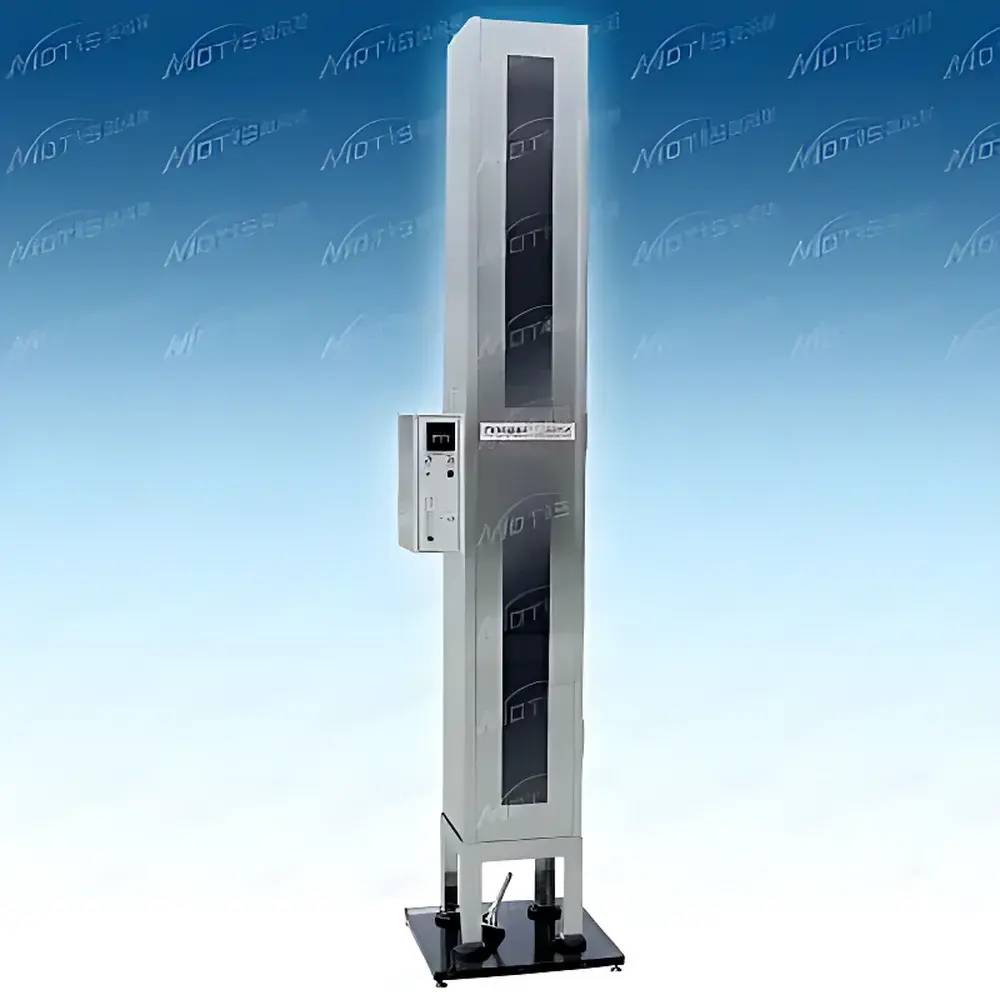
NFPA 701 Large-Scale Combustion Test Chamber – MOTIS NFP-2
| Brand | MOTIS |
|---|---|
| Origin | Shanghai, China |
| Model | NFP-2 |
| Construction | Full stainless steel chamber |
| Burner | Standard NFPA 701-compliant burner with precision mass flow control and real-time gas flow monitoring |
| Ignition Angle | 25° fixed-angle burner head |
| Timing System | Programmable pre-set ignition duration + automatic test time logging |
| Compliance | NFPA 701–2004 (Method 1 & Method 2) |
Overview
The MOTIS NFP-2 NFPA 701 Large-Scale Combustion Test Chamber is an engineered platform designed for standardized flammability evaluation of vertically oriented textile specimens under controlled radiant and convective heat exposure. It implements the core physical test protocol defined in NFPA 701–2004, specifically Methods 1 (for fabrics ≤ 24 oz/yd²) and 2 (for heavier or laminated materials), where a calibrated 25° inclined burner delivers a defined propane-air flame to the lower edge of a suspended specimen. The system measures critical fire performance parameters—including afterflame time, afterglow duration, char length, and whether flaming debris falls—under repeatable thermal insult conditions. Unlike small-scale screening tools (e.g., ASTM D6413 or ISO 6941), the NFP-2 replicates real-world vertical exposure geometry and heat flux distribution, making it a regulatory requirement for certification of curtains, draperies, awnings, canopies, and other architectural textiles installed in assembly occupancies per U.S. fire codes (e.g., IBC Chapter 8, NFPA 101).
Key Features
- Full 304 stainless steel enclosure with reinforced viewing window and integrated ventilation interlock—designed for long-term corrosion resistance and safe containment of combustion byproducts.
- Calibrated 25° burner assembly conforming to NFPA 701 dimensional and angular tolerances; includes traceable mass flow controller for propane delivery and digital flow meter with ±1% full-scale accuracy.
- Dual-mode timing architecture: user-configurable ignition duration (typically 12 s for Method 1, 60 s for Method 2) plus autonomous post-ignition chronometry for afterflame and afterglow periods.
- Specimen mounting frame with adjustable tension clamps and standardized 2.5″ × 12″ (63.5 mm × 305 mm) test area definition—ensuring consistent sample orientation and edge alignment per Clause 7.3 of NFPA 701–2004.
- Integrated safety circuitry including flame-out detection, overtemperature cutoff (>200°C chamber ambient limit), and emergency shutdown via manual pull station.
Sample Compatibility & Compliance
The NFP-2 accommodates rigid and flexible textile substrates up to 1.5 m in height and 0.5 m in width, including woven, knitted, coated, laminated, and metallized fabrics used in commercial interiors. Specimens are conditioned per ASTM D1776 prior to testing (21°C ± 1°C, 65% RH ± 2%) and mounted without stretching or compression. The chamber satisfies all mechanical, dimensional, and operational requirements of NFPA 701–2004 Sections 5–8. While not certified to UL 94 or EN ISO 11925-2, its test output is accepted by AHJs (Authorities Having Jurisdiction), third-party laboratories (e.g., UL, Intertek, BSI), and building code officials for Class A/B/C flame spread classification submissions. Documentation supports GLP-aligned test record retention, including burner calibration logs, environmental chamber readings, and operator sign-off fields.
Software & Data Management
The NFP-2 operates as a standalone hardware platform with embedded microcontroller-based logic—no proprietary software required for core test execution. All timing, flow, and safety functions are managed via hardened firmware with non-volatile memory for event logging (test ID, date/time, operator, ignition duration, afterflame time, pass/fail flag). Optional RS-485 or Ethernet interface enables integration into LIMS environments supporting ASTM E1382-compliant data exchange. Audit trails comply with basic 21 CFR Part 11 principles (user authentication, electronic signatures, immutable records) when paired with validated laboratory informatics systems. Calibration certificates for flow meters and thermocouples are issued annually per ISO/IEC 17025 requirements.
Applications
- Pre-market validation of flame-retardant treatments applied to polyester, nylon, cotton blends, and fiberglass composites.
- Quality assurance testing for textile mills supplying hospitality, healthcare, and education sectors—where NFPA 701 compliance is contractually mandated.
- Root-cause analysis of field failures involving curtain ignition propagation during fire investigations.
- Supporting ASTM E84 tunnel test correlation studies for composite wall systems incorporating textile facings.
- Training fire protection engineers and lab technicians on large-scale textile fire behavior per NFPA 921 Chapter 18 guidance.
FAQ
Does the NFP-2 meet current editions of NFPA 701 beyond the 2004 version?
The NFP-2 is validated against NFPA 701–2004, which remains widely enforced. While NFPA 701–2022 introduces updated sampling and reporting clauses, the core burner geometry, ignition protocol, and pass/fail criteria remain unchanged—making the NFP-2 technically suitable for 2022-compliant testing when used with updated procedural documentation.
Can the chamber be used for NFPA 262 (Steiner Tunnel) testing?
No. The NFP-2 is purpose-built for NFPA 701 vertical fabric testing only. NFPA 262 requires a 25-ft horizontal tunnel apparatus with distinct airflow, thermocouple array, and optical density measurement capabilities.
Is third-party calibration service available for the flow meter and timing system?
Yes. MOTIS partners with ISO/IEC 17025-accredited metrology providers in North America and EU for annual calibration of gas flow controllers and electronic timers, with NIST-traceable certificates supplied upon request.
What electrical and gas utility requirements does the NFP-2 have?
Standard configuration requires 120 VAC ±10%, 60 Hz, 15 A dedicated circuit and Type 10 (propane) gas supply at 10–15 psi regulated inlet pressure with shutoff valve and leak-tested piping.
How is operator safety ensured during repeated testing cycles?
The chamber features dual redundant thermal cutoffs, forced exhaust interlocked with burner operation, UV-blocking viewport, and automatic purge cycle initiation post-test to clear residual CO and unburned hydrocarbons before door access.



