
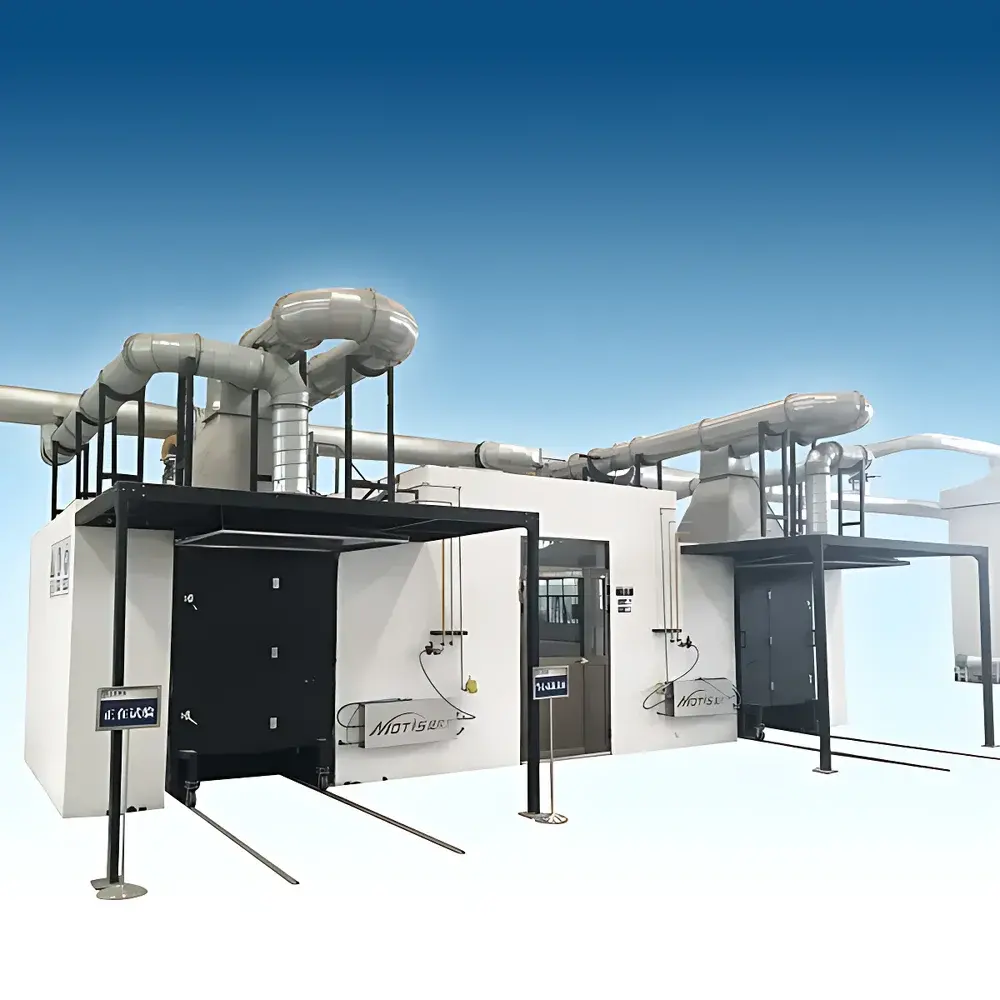
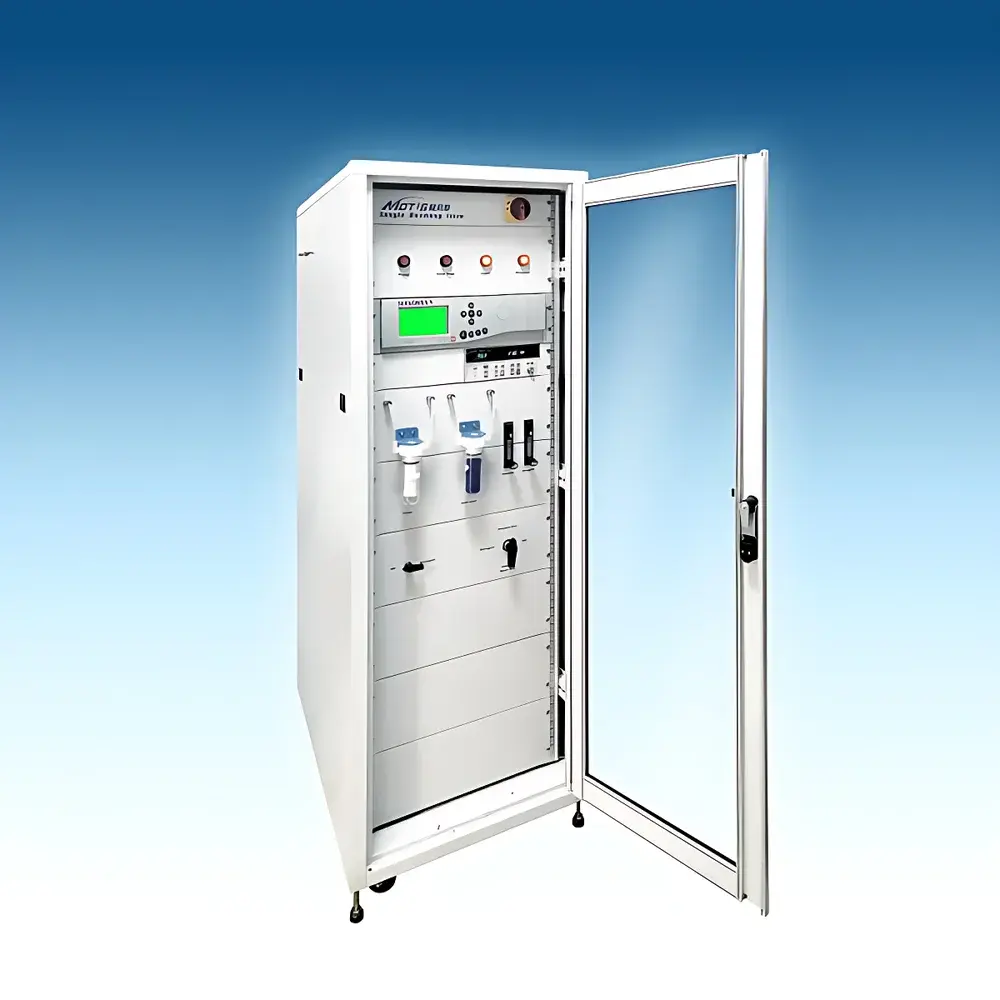
MOTIS SBI Single Burning Item Test Apparatus
| Brand | MOTIS |
|---|---|
| Origin | Jiangsu, China |
| Model | SBI |
| Combustion Source | 31 kW Propane Corner Burner (250 mm × 250 mm × 80 mm) |
| Test Chamber Dimensions | 3 m × 3 m × 2.4 m (W × L × H) |
| Exhaust Flow Rate | 0.50–0.65 m³/s at 298 K |
| Exhaust Duct | SUS304 J-type, Ø315 ±5 mm, insulated with 50 mm mineral wool |
| Cone Calorimetry-Compatible Sampling Zone Length | 2155 mm |
| Oxygen Analyzer | Servomex 4100 (paramagnetic, 16–21% v/v O₂, ≤12 s response, drift <100 ppm/30 min) |
| CO₂ Analyzer | Servomex 4100 (NDIR, 0–10% v/v CO₂, linearity ≥1% FS) |
| Smoke Obscuration System | Incandescent light source (2900 ±100 K), collimated beam ≥20 mm diameter, Si photodiode detector compliant with CIE V(λ) ±5% |
| Thermocouples | Three OMEGA K-type armored, 0.5 mm dia., spaced 120° on 87 ±5 mm radius circle |
| Pressure Transducer | ±2 Pa accuracy, ≤1 s 90% response |
| Mass Flow Controller | 0–2.5 g/s, ±1.5% reading accuracy |
| Propane Supply Control | Dual independent solenoid valves, switch time ≤12 s, flame stabilization ±5 mg/s for 30.7 ±2 kW output |
Overview
The MOTIS SBI Single Burning Item Test Apparatus is a fully integrated, standards-compliant fire testing system engineered for the quantitative assessment of fire growth, heat release rate, smoke production, and gas emissions from building products under controlled, intermediate-scale combustion conditions. Designed in strict accordance with ISO 11925-2, EN 13823 (SBI method), and ASTM E2057, the apparatus employs a defined propane corner burner configuration to simulate real-world ignition scenarios where vertically mounted specimens interact with radiant and convective fluxes at wall-floor intersections. The test principle relies on measuring time-resolved oxygen depletion, carbon dioxide generation, smoke obscuration, and mass loss—enabling calculation of critical fire parameters including Heat Release Rate (HRR), Total Heat Released (THR), Specific Extinction Area (SEA), and CO yield. Its modular architecture supports GLP-aligned operation, with all sensors traceable to NIST or equivalent national metrology institutes and full compliance with data integrity requirements per FDA 21 CFR Part 11 when paired with validated software.
Key Features
- Robust stainless-steel (SUS304) construction throughout exhaust ducting, hood, and collector—including J-type duct with precision-machined orifice plate (Ø265 mm inner, Ø314 mm outer) and flow-straightening vane assembly for laminar, low-turbulence sampling.
- Dual independent propane burner system: primary corner burner (31 kW nominal) and auxiliary wall-mounted burner, each equipped with UV flame detection for automatic shutdown and surface-ignition assurance (100% ignition success rate).
- Thermally stable smoke measurement section: 2155 mm-long calibrated duct housing three spatially distributed K-type thermocouples (OMEGA, 0.5 mm sheath), differential pressure probe (±2 Pa accuracy), and multi-point gas sampling manifold.
- High-fidelity optical smoke density system: incandescent lamp (2900 ±100 K) with collimating optics, silicon photodiode detector meeting CIE V(λ) spectral responsivity (±5%), and compressed-air purged side port to maintain optical path cleanliness during extended tests.
- Traceable gas analysis suite: Servomex 4100 paramagnetic O₂ analyzer (16–21% v/v range, ≤12 s T₉₀) and NDIR CO₂ analyzer (0–10% v/v, ≥1% FS linearity), both delivering 100 ppm resolution to the acquisition system.
- Redundant mass flow control: dual-stage regulation via high-accuracy mass flow controller (0–2.5 g/s, ±1.5% reading) and solenoid valve switching (≤12 s transition) ensuring stable 30.7 ±2 kW thermal output over test duration.
Sample Compatibility & Compliance
The SBI apparatus accommodates standard specimen configurations per EN 13823: vertical samples measuring 495 mm (height) × 1000 mm (width), mounted on two perpendicular non-combustible calcium silicate backboards (370 ±5 mm × 550 ±5 mm). Specimen mounting ensures reproducible geometry and boundary conditions. The system meets full mechanical and metrological requirements of ISO/IEC 17025 for accredited fire testing laboratories. All sensor calibrations are documented with uncertainty budgets; gas analyzers undergo daily zero/span verification using certified reference gases (NIST-traceable). Data acquisition timestamps, operator IDs, and calibration logs are automatically embedded—supporting audit readiness for CE marking, UKCA, and third-party certification bodies (e.g., UL, Intertek, BRE).
Software & Data Management
The apparatus integrates with MOTIS FireTest Suite v4.x—a Windows-based, 21 CFR Part 11-compliant platform featuring electronic signatures, role-based access control, and immutable audit trails. Real-time visualization includes synchronized plots of HRR, SEA, O₂%, CO₂%, duct temperature, and mass loss. Raw sensor outputs (4–20 mA, RS485, or Ethernet) are acquired at 10 Hz with hardware timestamping. Export formats include CSV, XML (for NFPA 92/ISO TS 16344 interoperability), and PDF reports pre-formatted to EN 13823 Annex A. Calibration certificates, instrument logs, and user action records are stored in encrypted SQLite databases with automated backup to network drives.
Applications
This apparatus is routinely deployed in regulatory testing of façade cladding, insulation boards, ceiling tiles, and interior linings for European Classification (A2-s1, d0 through E), U.S. NFPA 285 component evaluation, and Chinese GB 8624 B1/B2 classification. It supports R&D workflows for flame-retardant formulation development, comparative benchmarking of intumescent coatings, and validation of computational fire models (e.g., FDS input parameterization). Laboratories use its high repeatability (coefficient of variation <5% for peak HRR across replicate tests) for internal method validation and round-robin interlaboratory studies coordinated by CEN/TC 127.
FAQ
What standards does the MOTIS SBI comply with?
It is fully compliant with EN 13823, ISO 11925-2, ASTM E2057, and supports alignment with GB/T 24626 and JIS A 1321.
Is the system suitable for accredited testing laboratories?
Yes—hardware specifications, calibration protocols, and software audit trails meet ISO/IEC 17025:2017 and ILAC-P13 requirements for fire test accreditation.
Can the apparatus be upgraded for cone calorimeter correlation studies?
The exhaust duct geometry, sampling zone layout, and sensor mounting interfaces follow ISO 5660-1 dimensional conventions, enabling direct comparison of HRR and SEA datasets between SBI and cone calorimetry platforms.
What maintenance intervals are recommended for gas analyzers?
O₂ and CO₂ analyzers require quarterly span/zero verification with certified gases; optical windows should be cleaned weekly and inspected for coating degradation every six months.
Does the system support remote diagnostics and firmware updates?
Yes—via secure TLS-encrypted Ethernet connection, with OTA update capability and diagnostic log export for proactive service dispatch.



