
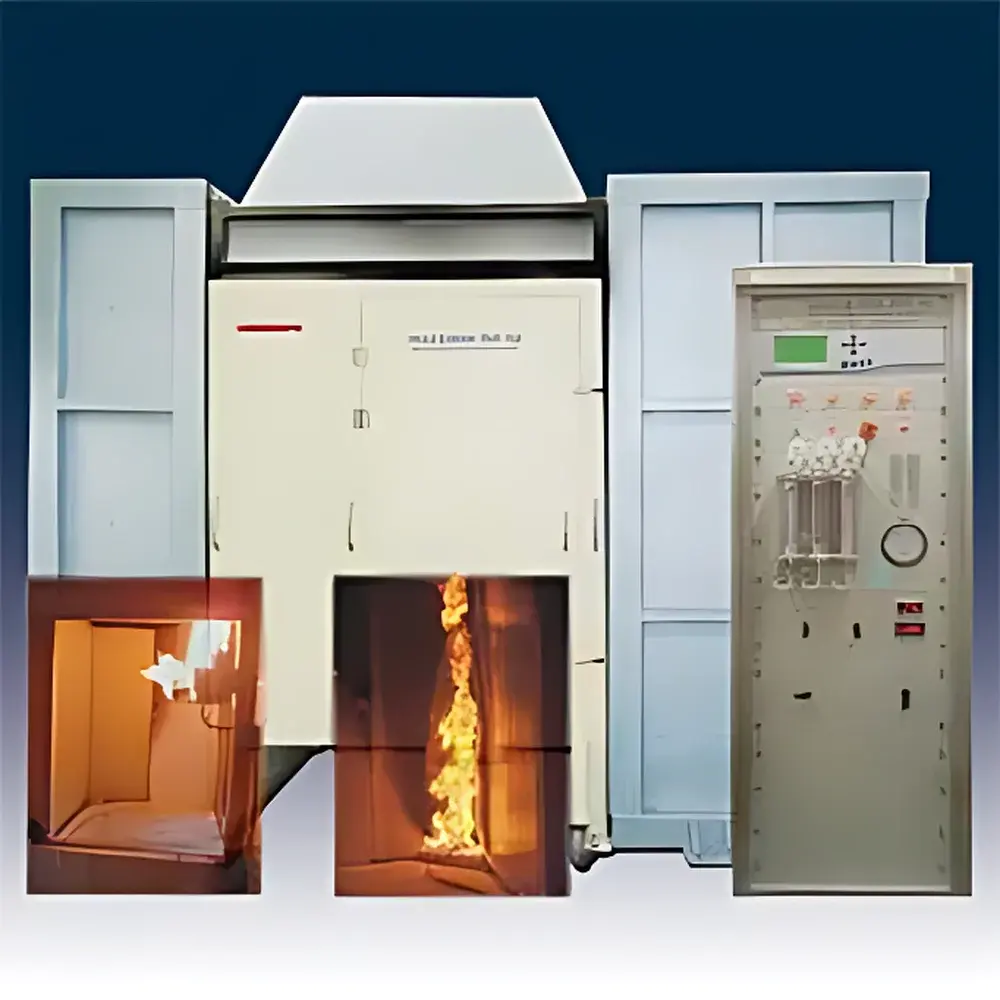
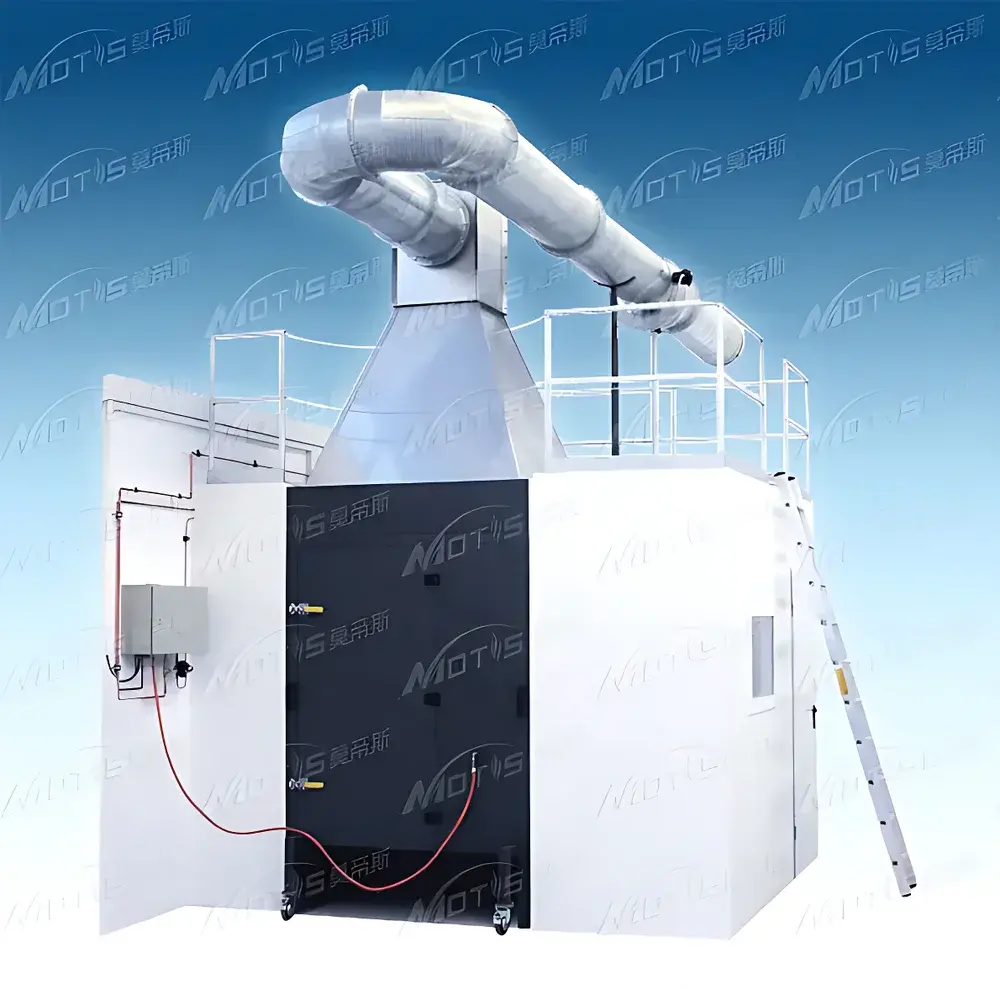
MOTIS SBI Single Burning Item Test System
| Brand | MOTIS |
|---|---|
| Origin | Jiangsu, China |
| Manufacturer Type | Authorized Distributor |
| Country of Origin | China |
| Model | SBI |
| Pricing | Available Upon Request |
| Standards Compliance | EN 13823, GB/T 20284 |
| Core Measurement Principles | Oxygen depletion calorimetry, optical smoke density analysis, flame spread observation, droplet collection |
| Key Outputs | FIGRA, THR, SMOGRA, TSP, LFS, flaming droplets/particles |
Overview
The MOTIS SBI Single Burning Item Test System is a fully integrated, standards-compliant fire testing apparatus engineered for the quantitative assessment of non-load-bearing building products under realistic intermediate-scale fire exposure conditions. Based on the cone calorimeter principle adapted for vertical specimen orientation and localized ignition, the system applies a controlled 31 kW propane burner—configured as a right-angle sand-filled box (250 mm × 250 mm × 80 mm)—to the lower corner of a vertically mounted test specimen. The test chamber (3 m × 3 m floor area, 2.4 m height) features a ceiling-mounted exhaust hood connected to a dedicated sampling duct, enabling real-time quantification of heat release rate (HRR), total heat released (THR), smoke production rate (SPR), total smoke produced (TSP), oxygen consumption, carbon monoxide and carbon dioxide yields, gas temperature, and mass flow rate. Flame spread along the lateral wing (LFS) is monitored visually per EN 13823 Annex B, while molten droplet formation and particle emission are recorded qualitatively and quantitatively using standardized collection trays and thermal imaging support.
Key Features
- Modular combustion chamber with thermally stable refractory lining and calibrated air inlet/outlet geometry to ensure repeatable ventilation conditions
- Dual-stage burner assembly: primary 31 kW propane burner + auxiliary ignition source for consistent flame establishment
- High-precision gas analysis subsystem comprising Siemens OXYMAT 61 paramagnetic oxygen analyzer (0–25% O₂, ±1% FS weekly drift, <3 s response)
- U23 NDIR analyzers for simultaneous CO (0–1%) and CO₂ (0–10%) measurement with trace-level stability and linear error ≤±0.5% FS
- Stainless-steel bidirectional Pitot-static probe coupled with differential pressure transducers for volumetric flow calibration across the exhaust duct
- K-type thermocouples (IEC 60584-2 Class 2) installed at multiple axial positions in the flue for gas temperature profiling
- Corrosion-resistant PTFE sampling lines and cold trap dehumidification unit to preserve analytical integrity during prolonged tests with halogenated or acidic combustion products
- Mass flow controller (MFC)-based gas supply regulation with integrated flashback arrestor and pressure-reducing valve for safe, stoichiometric propane delivery
- Real-time data acquisition via industrial-grade DAQ board supporting synchronized logging of >16 analog channels (temperature, pressure, gas concentrations, voltage signals)
Sample Compatibility & Compliance
The SBI system accommodates specimens up to 1.5 m in height and 1.0 m in width, mounted on a motorized trolley with two perpendicular non-combustible backing plates. It supports rigid, semi-rigid, and flexible materials—including insulation boards, decorative panels, suspended ceiling tiles, and coated substrates—as defined in EN 13823 Clause 4. All hardware, software, and calibration procedures are aligned with the normative requirements of EN 13823:2010+A1:2014 and its national adoption GB/T 20284–2006. The system architecture permits full traceability of measurement uncertainty budgets per ISO/IEC 17025 guidelines, and raw data files include timestamps, instrument serial numbers, calibration certificate references, and environmental condition logs (ambient temperature, humidity, barometric pressure) required for GLP-compliant reporting.
Software & Data Management
The proprietary SBI Control & Analysis Software provides closed-loop burner control, automated sequence execution (pre-test purge, ignition, data capture, post-test cooldown), and real-time visualization of all critical parameters. Calibration routines include zero/span verification for gas analyzers, flow profile mapping using certified orifice plates, and thermocouple linearity checks against reference junctions. Export formats include CSV, XML, and PDF reports compliant with EN 13823 Annex E templates. Audit trail functionality records user actions, parameter modifications, and calibration events with timestamped digital signatures. Data files are structured to support integration into enterprise LIMS environments and satisfy FDA 21 CFR Part 11 electronic record requirements when deployed with validated Windows OS configurations and domain-authenticated login protocols.
Applications
- Classification of construction products under the EU Construction Products Regulation (CPR) and CE marking pathways (e.g., Euroclass B-s1,d0 determination)
- Development and validation of fire-retardant formulations for polymeric composites, foams, and fiber-reinforced panels
- Comparative evaluation of surface flame spread behavior across different substrate/coating combinations
- Smoke toxicity screening in conjunction with FTIR or GC-MS downstream sampling interfaces
- Supporting technical documentation for building code submissions (e.g., International Building Code Chapter 26, NFPA 285 alternative pathways)
- Research into fire dynamics of emerging materials such as bio-based insulations, 3D-printed architectural elements, and nanocomposite claddings
FAQ
What standards does the MOTIS SBI system fully support?
EN 13823:2010+A1:2014 and GB/T 20284–2006 are natively implemented; optional firmware modules enable alignment with ASTM E2058 Annex A3 for comparative research use.
Is third-party certification available for this system?
Yes—MOTIS partners with UKAS-accredited laboratories to provide factory acceptance testing (FAT) and on-site performance qualification (PQ) reports, including uncertainty analysis per GUM (JCGM 100:2008).
Can the system be integrated with existing laboratory infrastructure?
All analog outputs conform to 4–20 mA / 0–10 V industrial standards; digital communication uses Modbus TCP and OPC UA protocols for seamless SCADA or MES connectivity.
What maintenance intervals are recommended for gas analyzers?
Oxygen and IR sensors require biannual span calibration with certified gas mixtures; filter elements in the sampling train should be replaced every 200 test hours or after exposure to heavily sooting samples.
Does the system include provisions for droplet collection and analysis?
A standardized stainless-steel drip tray (EN 13823 Figure 5) is supplied with thermal shielding and optional high-speed imaging mounts for qualitative assessment of flaming droplet generation and fall distance.



