
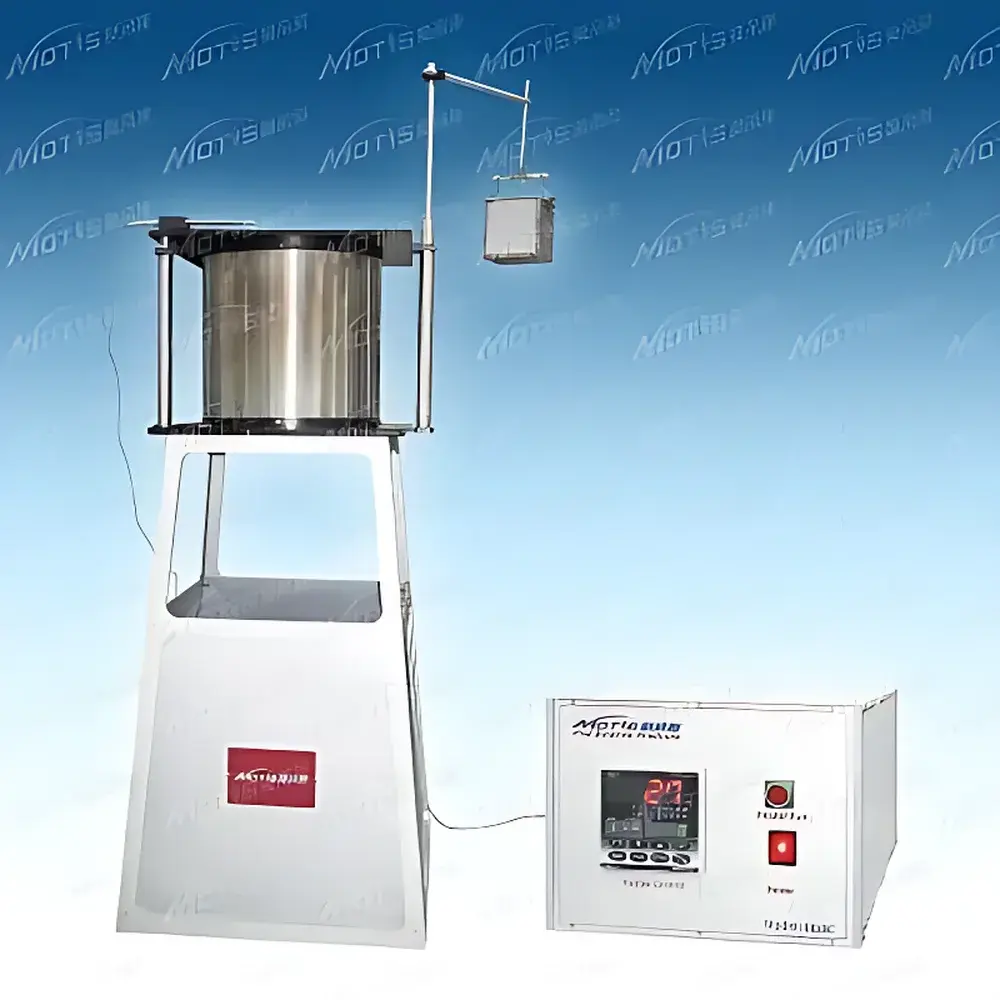
MOTIS GCF Smoldering Characteristics Test Furnace
| Brand | MOTIS |
|---|---|
| Origin | Jiangsu, China |
| Model | GCF |
| Compliance | GB/T 29416–2012 Annex C, BS 8414 |
| Temperature Control | Programmable controller with standardized temperature ramp profile |
| Test Duration | 24 h continuous monitoring |
| Thermocouple Configuration | Internal furnace thermocouples + surface-mounted sample thermocouples |
| Data Logging | Real-time temperature display and curve plotting |
| Pass/Fail Criteria | Based on thermal trajectory divergence (sample center temperature vs. furnace ambient temperature) |
| Software Functionality | Automated test execution, time-synchronized thermal data acquisition, and smoldering propensity classification per GB/T 29416–2012 |
Overview
The MOTIS GCF Smoldering Characteristics Test Furnace is a purpose-built thermal testing system engineered for the quantitative assessment of smoldering ignition propensity in external thermal insulation composite systems (ETICS) and associated building insulation materials. It operates on the principle of controlled, prolonged thermal exposure under defined ambient temperature profiles—mimicking real-world fire exposure scenarios where convective heating dominates and open-flame contact is absent. Unlike flaming combustion tests, this apparatus evaluates the material’s intrinsic tendency to undergo self-sustaining, low-temperature, flameless oxidation—a process governed by heat transfer kinetics, oxygen diffusion limitations, and char-layer formation dynamics. Designed explicitly to execute the test protocol specified in Annex C of GB/T 29416–2012 “Fire Performance Test Methods for External Thermal Insulation Systems of Buildings”, the GCF furnace provides a reproducible, standardized environment for regulatory compliance verification and comparative material screening within fire safety engineering workflows.
Key Features
- Programmable temperature controller calibrated to replicate the standardized heating ramp defined in GB/T 29416–2012 Annex C and aligned with thermal exposure profiles referenced in BS 8414–1:2015 and BS 8414–2:2015.
- 24-hour uninterrupted test cycle with dual-channel thermocouple monitoring: one set embedded in the furnace chamber to track ambient thermal evolution, and another affixed directly to the specimen surface and core to capture localized thermal response.
- High-stability thermal enclosure with insulated chamber walls and precision airflow management to minimize thermal gradients and ensure uniform heat distribution across the test zone.
- Digital data acquisition system synchronized to 1-second intervals, enabling high-resolution temporal tracking of thermal divergence between furnace ambient and sample center temperatures.
- Fail-safe overtemperature protection and emergency shutdown logic integrated into the control architecture to maintain operational integrity during extended-duration testing.
Sample Compatibility & Compliance
The GCF furnace accommodates standard-sized ETICS mock-ups as defined in GB/T 29416–2012—including full-scale wall assemblies composed of insulation layer, adhesive, base coat, reinforcement mesh, and finish coat. Specimen mounting fixtures are designed to replicate realistic boundary conditions, including substrate support and edge exposure configurations required by Annex C. The system fully supports compliance documentation generation for third-party certification bodies and meets the minimum instrumentation and procedural requirements outlined in ISO/IEC 17025-accredited fire testing laboratories. While primarily deployed for national standard validation, its thermal profiling fidelity enables cross-referencing with harmonized European methodologies under EN 13501–1 and supplementary guidance in CEN/TR 15148.
Software & Data Management
The embedded test software provides real-time visualization of both furnace ambient and specimen thermocouple signals, rendering overlayed temperature–time curves with user-adjustable scaling and annotation tools. All raw thermal data are timestamped and stored in CSV-compatible format for traceable post-processing. The software implements automated pass/fail logic per Clause 7.3 of GB/T 29416–2012: if the specimen center temperature remains within ±5 °C of the furnace reference temperature throughout the 24-hour cycle, the material is classified as non-smoldering. A sustained deviation exceeding this threshold—particularly when exhibiting exponential or sigmoidal growth indicative of exothermic feedback—is flagged as evidence of smoldering propensity. Audit trails, user access logs, and electronic signature capability support GLP-compliant operation and FDA 21 CFR Part 11 readiness when configured with validated IT infrastructure.
Applications
- Regulatory qualification of mineral wool, EPS, XPS, phenolic foam, and polyisocyanurate insulation boards used in ETICS applications.
- Comparative evaluation of fire-retardant additive efficacy in organic-based insulants under sub-ignition thermal stress.
- Root-cause analysis of field-reported smoldering incidents in façade systems through controlled replication of suspected thermal exposure histories.
- Supporting technical dossiers for CE marking, CCC certification, and local building code approvals requiring Annex C validation.
- Research into charring kinetics, oxygen depletion thresholds, and thermal runaway onset conditions in heterogeneous polymer–filler composites.
FAQ
What standards does the GCF furnace specifically support?
It is configured and validated for GB/T 29416–2012 Annex C and BS 8414–1/2 thermal exposure protocols.
Can the furnace be used for materials other than ETICS assemblies?
Yes—provided specimens conform to dimensional and mounting constraints; however, interpretation of results must align with applicable test method scope.
Is calibration certification included with the system?
Factory calibration certificates traceable to national metrology institutes are supplied; annual recalibration is recommended per ISO/IEC 17025 guidelines.
Does the software support multi-user role-based access control?
Yes—administrator, operator, and reviewer roles can be assigned with configurable permissions for data modification, report generation, and audit log review.
How is thermal uniformity verified across the test chamber?
Uniformity mapping is performed during commissioning using NIST-traceable thermocouple arrays at nine spatial points; deviation is maintained within ±3 °C at peak test temperature.



