
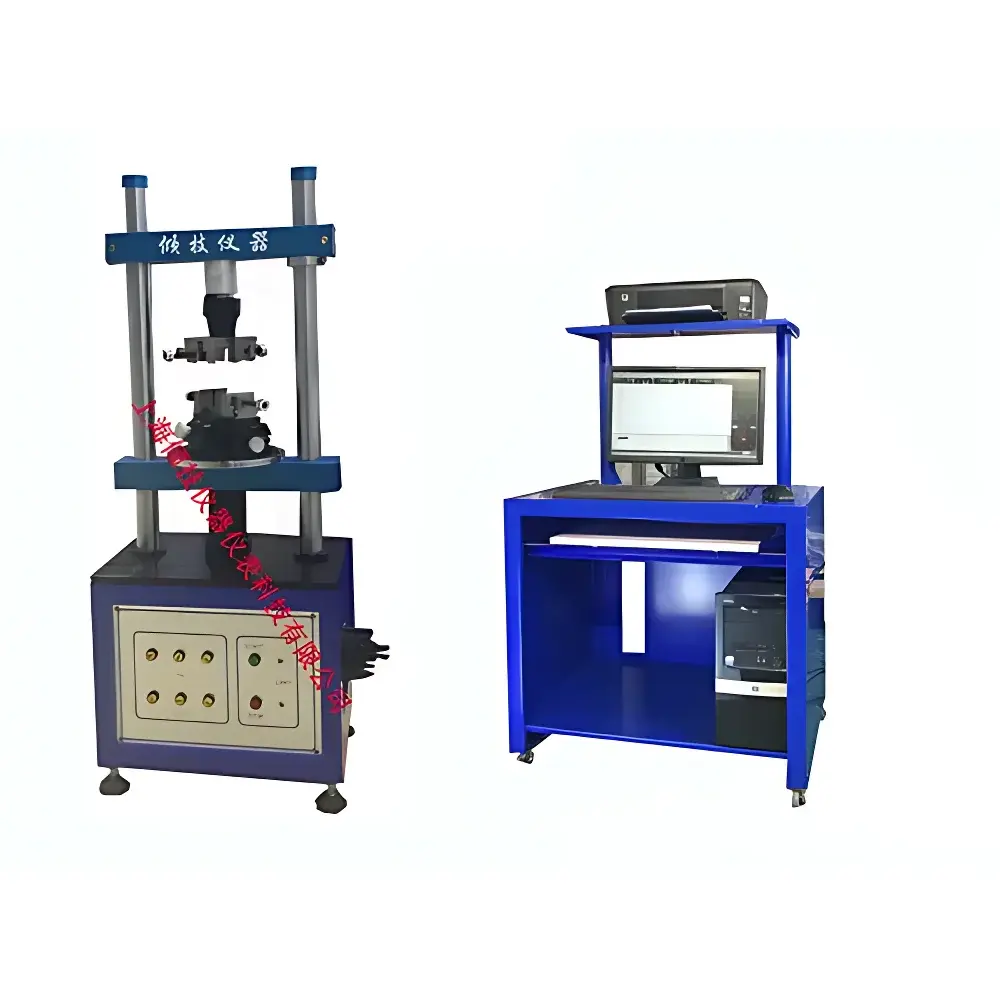
Qinji QJ210-F Fully Automated Connector Insertion and Extraction Tester
| Brand | Qinji |
|---|---|
| Origin | Shanghai, China |
| Manufacturer Type | Authorized Distributor |
| Country of Origin | China |
| Model | QJ210-F |
| Price | USD 7,800 (FOB Shanghai) |
| Max Load Capacity | 200 kgf |
| Force Accuracy Class | Class 1 (per ISO 7500-1) |
| Effective Force Range | 0.2–100% of full scale |
| Force Resolution | 500,000 counts (full-scale, no range switching) |
| XY Axis Travel | 0–75 mm |
| Test Speed | 0–500 mm/min (adjustable in 0.01 mm/min increments) |
| Max Test Height | 150 mm |
| Displacement Accuracy | ±1% of reading |
| Fine Adjustment Resolution | 0.01 mm |
| Drive Motor | 200 W, 220 VAC |
| Dimensions (L×W×H) | 400 × 300 × 1000 mm |
| Net Weight | 65 kg |
Overview
The Qinji QJ210-F Fully Automated Connector Insertion and Extraction Tester is an electromechanical force measurement system engineered for high-reproducibility evaluation of mechanical engagement and disengagement characteristics in electrical and electronic connectors. It operates on the principle of controlled linear actuation combined with high-fidelity load-cell-based force transduction, enabling precise quantification of insertion force (IF), withdrawal force (WF), and associated displacement profiles under standardized test conditions. Designed to meet the functional verification requirements of IEC 60512-2, IPC-TM-650 2.5.5.4, and GB/T 28289–2012, the system delivers traceable, repeatable data essential for quality control in connector manufacturing, automotive electronics assembly, aerospace harness validation, and consumer device R&D labs.
Key Features
- Class 1 force measurement accuracy per ISO 7500-1, supported by a 500,000-count A/D resolution load cell with no internal range switching — ensuring consistent sensitivity across the entire 0.2–100% full-scale measurement envelope.
- Motorized XY-stage with 75 mm travel range and 0.01 mm fine positioning capability, enabling precise alignment of connector mating axes and compensation for minor geometric misalignment during testing.
- Integrated auto-centering mechanism that dynamically corrects lateral offset between plug and receptacle prior to engagement, minimizing parasitic bending moments and improving measurement fidelity.
- Programmable test speed from 0.01 to 500 mm/min, with closed-loop velocity control and real-time feedback to maintain setpoint stability under varying load conditions.
- Rugged monolithic frame construction (65 kg mass) with vibration-damping base and precision-ground linear guides, supporting stable operation at maximum 200 kgf load without resonance or deflection artifacts.
- Windows-based control interface with native Chinese/English language toggle, intuitive graphical workflow builder, and embedded calibration management compliant with ISO/IEC 17025 documentation requirements.
Sample Compatibility & Compliance
The QJ210-F accommodates standard PCB-mounted, wire-to-board, and cable-mounted connectors with housing widths up to 75 mm and total mating height ≤150 mm. Fixture adaptability supports MIL-DTL-38999, USB-C, HDMI, M12, FAKRA, and custom OEM connector families via interchangeable mounting plates and modular grip assemblies. All test protocols adhere to ASTM F1185 (Standard Guide for Testing Electrical Connectors), IEC 60512-2-1 (Insertion/Withdrawal Force Testing), and ISO 80601-2-62 (for medical-grade interconnects). System documentation includes factory calibration certificates traceable to NIM (National Institute of Metrology, China), and optional UKAS-accredited calibration services are available upon request.
Software & Data Management
The embedded Windows 10 IoT software provides comprehensive test configuration, real-time curve visualization (force vs. displacement), automated pass/fail evaluation against user-defined limits, and export-ready reporting in PDF, CSV, and XML formats. All test parameters — including speed profile, dwell time, cycle count, trigger thresholds, and environmental metadata — are stored with timestamped audit trails. The system supports 21 CFR Part 11-compliant user access control (role-based permissions), electronic signatures, and immutable data archiving. Raw datasets retain full-resolution force and position sampling (≥1 kHz), enabling post-hoc analysis of transient events such as snap-in peaks or fretting-induced hysteresis.
Applications
- Quantitative validation of insertion force compliance for automotive sensor connectors subjected to thermal cycling and vibration preconditioning.
- Life-cycle endurance testing of USB-C and Thunderbolt interfaces under repeated mating/unmating (up to 10,000 cycles) with force degradation trending.
- Comparative analysis of lubricant efficacy on terminal contact surfaces using peak force reduction metrics and coefficient-of-friction estimation.
- Root-cause investigation of connector failure modes — including housing fracture, pin deformation, and insulator cracking — through synchronized force-displacement signature analysis.
- Supporting GLP/GMP-regulated environments where instrument qualification (IQ/OQ/PQ), calibration history, and change control logs are mandatory for audit readiness.
FAQ
What standards does the QJ210-F comply with for connector testing?
The system supports test execution and reporting aligned with IEC 60512-2, IPC-TM-650 2.5.5.4, ASTM F1185, and GB/T 28289–2012. Calibration documentation is traceable to national metrology institutes.
Can the system perform multi-cycle wear testing with automatic pass/fail logic?
Yes — programmable cycle sequencing, real-time limit checking, and automated report generation enable unattended endurance testing with configurable pass/fail criteria per cycle.
Is the software compatible with LIMS or MES integration?
The system exports structured data (CSV/XML) and supports OPC UA connectivity for enterprise-level data federation into laboratory information management systems or manufacturing execution systems.
What maintenance is required to sustain measurement accuracy over time?
Annual recalibration is recommended; routine verification using certified reference loads (e.g., 10 kgf, 50 kgf, 100 kgf) is advised before critical test campaigns. Mechanical components require only periodic lubrication of linear guides per the maintenance log.
Does Qinji provide application engineering support for custom fixture design?
Yes — technical pre-sales consultation includes fixture feasibility assessment, CAD-based mounting interface design, and test protocol optimization tailored to your connector geometry and specification requirements.



