
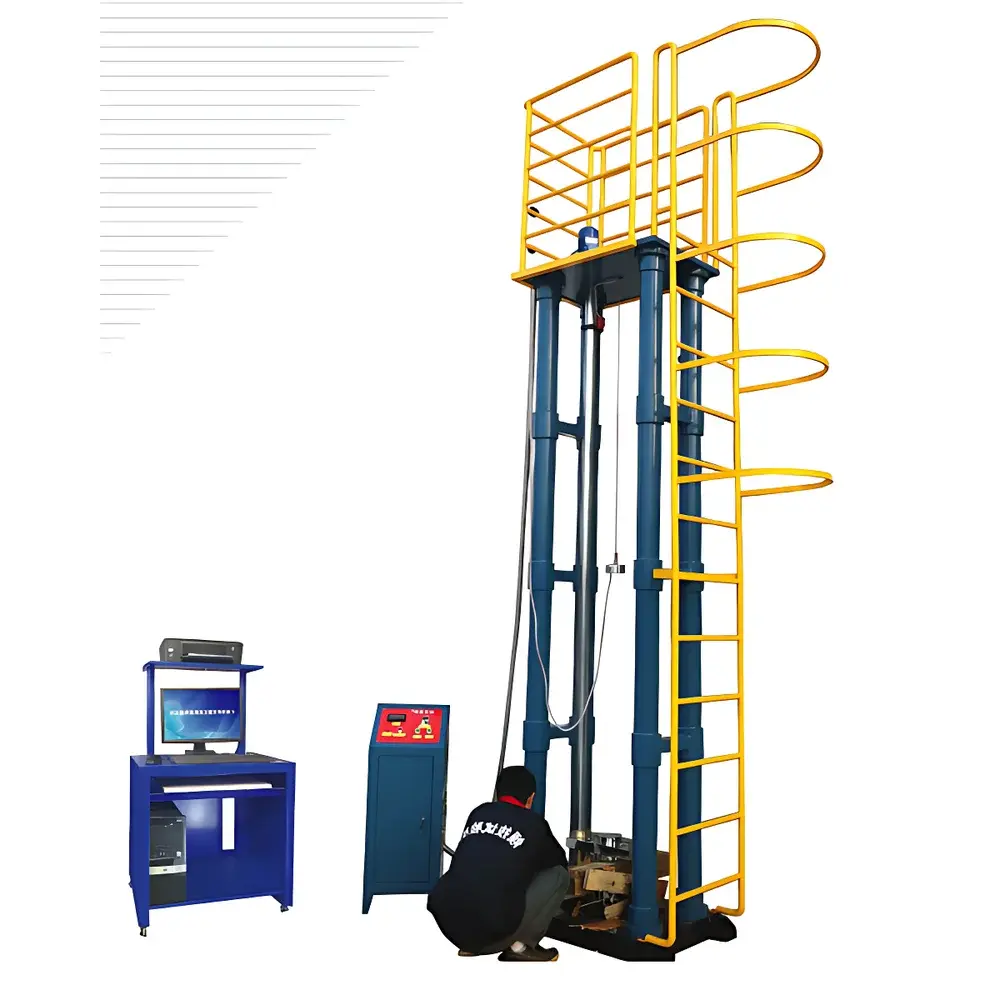
QJLC Mountain Climbing Rope Impact Resistance Tester
| Origin | Shanghai |
|---|---|
| Manufacturer Type | Distributor |
| Origin Category | Domestic |
| Model | QJLC |
| Price | ¥30,000 |
| Instrument Type | Drop-Weight Impact Testing Machine |
| Impact Energy | 300 J |
| Impact Velocity | 1.5 m/s |
| Pendulum Torque (Impact Constant) | 0.5 kg to 6.3 kg |
| Load Cell Range | Φ16 mm to Φ800 mm |
| Maximum Lifting Height | ≤2000 mm |
| Hammer Mass Range | 0.5 kg – 6.3 kg |
| Hammer Nose Radius | R50 (for Ø25 mm and Ø90 mm impact heads) |
| Impact Height Accuracy | ±2 mm |
| Power Supply | 220 V, 50 Hz |
| Dimensions (W×D×H) | 800 × 800 × 4100 mm |
| Weight | 380 kg |
Overview
The QJLC Mountain Climbing Rope Impact Resistance Tester is a purpose-built drop-weight impact testing system engineered for the standardized evaluation of dynamic climbing ropes in accordance with GB/T 23268.1–2009, the Chinese national standard for personal protective equipment — mountaineering ropes. It replicates real-world fall scenarios by releasing calibrated masses from controlled heights onto vertically suspended rope specimens, enabling precise quantification of peak impact force, dynamic elongation, energy absorption capacity, and fatigue resistance under repeated impact loading. The system operates on classical free-fall mechanics, where gravitational potential energy (m·g·h) is converted into kinetic energy prior to rope engagement, allowing direct correlation between impact energy (up to 300 J), mass, and drop height. Its rigid structural frame, precision-guided vertical drop column, and low-friction hammer guidance mechanism ensure high reproducibility and minimal parasitic energy loss—critical for compliance-driven rope certification and quality assurance workflows.
Key Features
- Modular drop-weight configuration supporting hammer masses from 0.5 kg to 6.3 kg, enabling flexible test setup across diverse rope diameter and performance classes.
- Dual-standard impact heads with R50 spherical nose geometry (Ø25 mm and Ø90 mm) compliant with GB/T 23268.1–2009 requirements for uniform stress distribution during impact.
- Electromechanically driven lifting mechanism with ≤2000 mm maximum lift height and ±2 mm positional repeatability—ensuring traceable, height-controlled energy input.
- High-resolution load cell integrated into the anchor fixture (measuring range: Φ16 mm to Φ800 mm rope diameters), capturing transient force-time profiles at sampling rates sufficient for ISO/IEC 17025-compliant data acquisition.
- Computer-controlled operation with embedded real-time data acquisition software, displaying synchronized force vs. time curves, maximum impact force, dynamic elongation percentage, and cumulative drop-cycle count.
- Structural base design includes a dedicated Φ120 mm × 500 mm foundation bore for anchoring; vertical alignment tolerance maintained at ≤1/1000 plumbness to minimize lateral deviation during hammer descent.
Sample Compatibility & Compliance
The QJLC tester accommodates single-strand dynamic climbing ropes ranging from 8 mm to 11 mm nominal diameter (corresponding to the Φ16–Φ800 mm clamping range when accounting for looped test configurations per GB/T 23268.1). It supports both single-rope and twin-rope test modes using standardized knotting and anchoring protocols. All mechanical and metrological parameters—including impact energy calibration, hammer inertia, and height measurement—are traceable to national standards and suitable for inclusion in GLP-compliant test reports. The system meets the essential performance criteria outlined in GB/T 23268.1–2009 Sections 6.3 (impact force), 6.4 (dynamic elongation), and 6.5 (repeated impact endurance), and its operational methodology aligns with principles referenced in EN 892 and UIAA 101 for comparative international validation.
Software & Data Management
The embedded Windows-based control software provides full test sequence automation: height presetting, hammer release triggering, real-time force waveform capture, and post-test parameter extraction (Fmax, ΔL/L0, energy dissipation ratio). Raw data is exported in CSV format with timestamp, test ID, operator ID, and environmental metadata (ambient temperature/humidity if externally logged). Audit trails record all user actions—including parameter modifications and calibration events—in accordance with ISO/IEC 17025 Clause 7.7 and support FDA 21 CFR Part 11 readiness when deployed in regulated manufacturing environments. Data integrity is preserved via automatic file hashing and optional network backup integration.
Applications
- Pre-production validation of dynamic rope prototypes under simulated UIAA-standardized fall conditions (factor-2 falls).
- Batch-release testing for rope manufacturers to verify conformance with GB/T 23268.1 mechanical thresholds (e.g., Fmax ≤ 12 kN for single ropes).
- Fatigue life assessment through controlled multi-cycle impact testing to quantify degradation in energy absorption over successive drops.
- Root-cause analysis of rope failure modes—e.g., sheath slippage, core rupture, or knot-induced stress concentration—via synchronized high-speed video integration (optional).
- Third-party certification lab testing for CE marking, UIAA certification, or domestic CCC compliance documentation.
FAQ
What safety interlocks are implemented to prevent accidental hammer release?
The system incorporates dual-channel optical beam sensors at the release zone and mechanical limit switches on the lifting carriage, requiring simultaneous confirmation before enabling electromagnetic hammer release.
Is the load cell calibrated traceable to CNAS-accredited standards?
Yes—each unit ships with a factory calibration certificate referencing GB/T 7722–2008 (electronic force measuring instruments) and traceable to NIM (National Institute of Metrology, China) standards.
Can the software generate test reports compliant with ISO/IEC 17025 requirements?
Yes—the report template includes mandatory fields: uncertainty budget (based on load cell class C3 and height encoder resolution), equipment identification, environmental conditions, raw data annexes, and digital signature authentication.
What maintenance intervals are recommended for long-term accuracy retention?
Monthly visual inspection of guide rod clearance (0.5–1.0 mm), quarterly lubrication of the lifting screw with ISO VG 68 mineral oil, and annual full recalibration including hammer mass verification and height encoder linearity check.



