
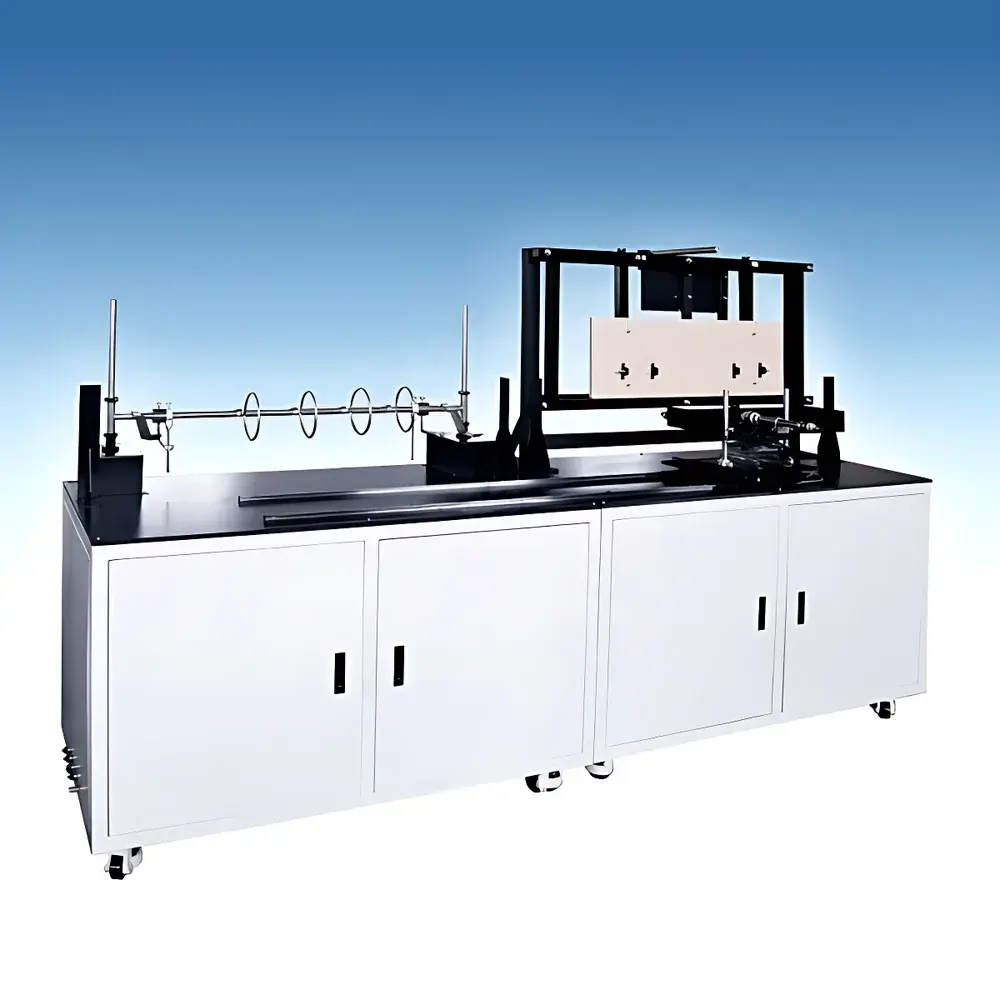
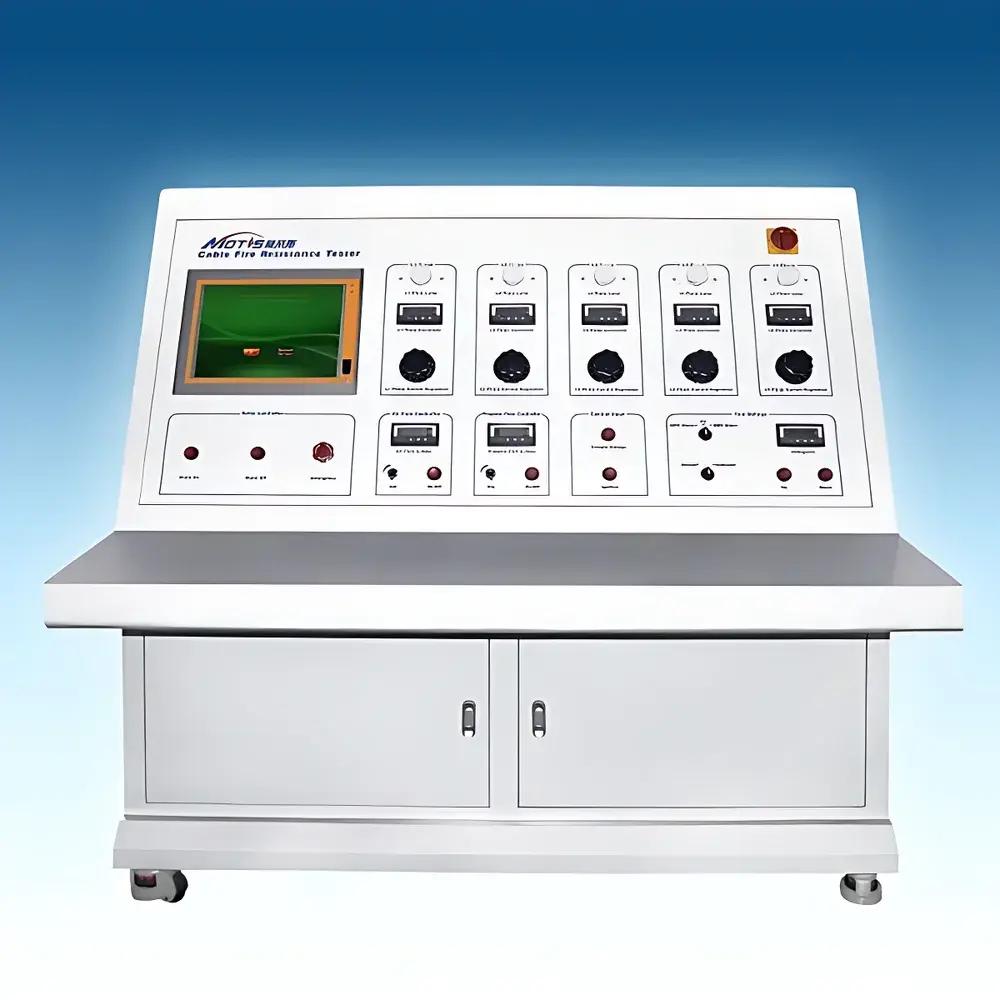
MOTIS CFRT Fire Resistance Tester for Cables and Wires
| Brand | MOTIS |
|---|---|
| Model | CFRT |
| Application | Fire resistance testing of low-voltage power cables (≤ 0.6/1.0 kV) |
| Compliance | GB/T 19216.11 (equivalent to IEC 60331-11) |
| Ignition Source | AGF propane ribbon burner (500 mm length, 15 mm nominal width, triple-row 1.32 mm diameter orifices) |
| Temperature Calibration | Omega 1.5 mm sheathed thermocouple |
| Gas Control | Imported mass flow controllers (accuracy ≥ ±1.5%) |
| Air–Fuel Mixing | Venturi-type premixing system |
| Voltage Control | Programmable via PC interface or front-panel adjustment |
| Continuity Monitoring | 0.25 A DC test current per conductor, LED-based real-time circuit integrity indication |
| Data Acquisition | Digital multichannel logging of voltage, current, gas flow, air flow, and thermocouple temperature |
| Safety Protection | D-II type fuse per GB 13539.5 (2 A), imported miniature circuit breakers per test circuit |
| Flame Stabilization | Automatic closed-loop control of propane/air ratio for stable 750 °C or 950 °C flame profile |
| Software Features | Standard-compliant report generation, pre-test parameter configuration (cable specs, standard selection, max duration), audit-trail-capable data logging, calibration history management (≥10 min stabilized acquisition) |
Overview
The MOTIS CFRT Fire Resistance Tester is an engineered solution for evaluating circuit integrity of electric cables and wires under defined fire exposure conditions, in strict accordance with GB/T 19216.11—China’s national adoption of IEC 60331-11. This apparatus subjects insulated conductors to controlled flame exposure at either 750 °C or 950 °C for a specified duration (typically 90 minutes), while simultaneously monitoring electrical continuity across all active conductors. The test principle relies on maintaining functional current flow through the cable core(s) during and after thermal stress, thereby verifying whether the cable retains its operational capability under fire conditions—a critical requirement for emergency circuits in buildings, transportation systems, and industrial infrastructure. Unlike generic combustion chambers, the CFRT integrates precision thermal profiling, real-time electrotechnical monitoring, and regulatory-grade data traceability into a single validated platform.
Key Features
- AGF-certified propane ribbon burner with precisely engineered orifice geometry (500 mm × 15 mm, triple staggered rows of 1.32 mm holes) ensures reproducible flame envelope and thermal flux distribution.
- Integrated mass flow control system for both propane and combustion air, featuring imported high-accuracy controllers (±1.5% full-scale reading) and Venturi-type premixing to guarantee stoichiometric consistency and flame stability.
- Dual-mode thermal calibration using a calibrated 1.5 mm Omega sheathed thermocouple, with automated 10-minute stabilization and statistical averaging for certified flame temperature verification prior to each test.
- Programmable electrical continuity assessment: 0.25 A DC test current applied across all conductors via a three-phase star-connected transformer; real-time LED status per circuit and automatic acoustic-optical alarm upon interruption.
- Digitally synchronized multi-parameter acquisition: voltage, current, gas flow rates, air flow rates, and thermocouple temperature are logged at configurable intervals and stored in a structured relational database.
- Front-panel and PC-based dual-control interface: voltage setpoints adjustable manually or via software; test duration, standard selection (e.g., GB/T 19216.11, IEC 60331-21), and pass/fail thresholds fully configurable before run initiation.
- Compliance-grade protection architecture: D-II type fuses per GB 13539.5 (2 A rating), supplemented by imported miniature circuit breakers for independent overcurrent protection of each test channel.
Sample Compatibility & Compliance
The CFRT accommodates single-core and multicore cables rated up to 0.6/1.0 kV, including PVC, XLPE, EPR, and mineral-insulated varieties. Specimens are mounted horizontally using standardized support fixtures: fixed clamping at one end, free suspension at the other, and two grounded 150 mm inner-diameter metal rings spaced 300 mm apart—fully aligned with GB/T 19216.11 mechanical setup requirements. All metallic components—including rings, brackets, and grounding terminals—are electrically bonded to earth potential to eliminate stray potentials during continuity measurement. The system is designed to meet GLP-aligned documentation practices and supports audit-ready traceability for ISO/IEC 17025-accredited laboratories. While primarily aligned with GB/T 19216.11 and IEC 60331 series, its modular gas control and thermal calibration architecture allows adaptation to supplementary standards such as BS 6387 (Category CWZ) and EN 50200 upon procedural validation.
Software & Data Management
The embedded test software provides full lifecycle data governance: pre-test entry of laboratory metadata, cable specifications (diameter, conductor count, insulation type), selected standard, and test parameters; real-time visualization of all measured variables on synchronized time axes; post-test automated report generation conforming to GB/T 19216.11 Annex B formatting requirements. All raw data—including thermocouple voltage traces, flow controller output signals, and continuity status flags—are timestamped and archived with SHA-256 checksums. Calibration records, user login logs, and parameter change histories are retained with immutable timestamps, satisfying FDA 21 CFR Part 11 and ISO/IEC 17025 electronic record retention expectations. Export options include CSV, PDF, and XML formats compatible with LIMS integration.
Applications
This instrument serves quality assurance laboratories in wire and cable manufacturing, third-party certification bodies (e.g., CNAS, CQC, TÜV), and fire safety R&D centers. Typical use cases include qualification testing of fire-resistive cables for emergency lighting, fire alarm systems, and life-safety communication circuits; comparative evaluation of intumescent coatings or mica tape performance; validation of new insulation formulations under standardized thermal stress; and production-line conformance screening where batch-level circuit integrity verification is mandated. Its deterministic flame control and metrologically traceable measurements make it suitable for regulatory submissions requiring documented repeatability and inter-laboratory comparability.
FAQ
What standards does the CFRT comply with?
The system is configured and validated for GB/T 19216.11 (identical to IEC 60331-11); optional procedural adaptations support BS 6387 and EN 50200 upon customer-requested validation.
Can the CFRT test cables above 0.6/1.0 kV?
No—the electrical subsystem and safety interlocks are engineered exclusively for low-voltage cables ≤ 0.6/1.0 kV, consistent with the scope of GB/T 19216.11.
Is flame temperature calibration mandatory before every test?
Yes—automated 10-minute thermal stabilization and statistical validation of burner temperature are enforced by software prior to ignition, ensuring compliance with clause 7.2 of GB/T 19216.11.
How is data integrity ensured during long-duration tests?
All sensors feed into a hardened industrial controller with redundant non-volatile memory; power-fail recovery preserves unsaved buffers, and database writes include cyclic redundancy checks.
Does the system support remote operation or networked lab integration?
Yes—Ethernet-enabled architecture supports secure remote monitoring, LIMS API connectivity (RESTful JSON), and centralized fleet management via optional MOTIS LabLink server module.



