
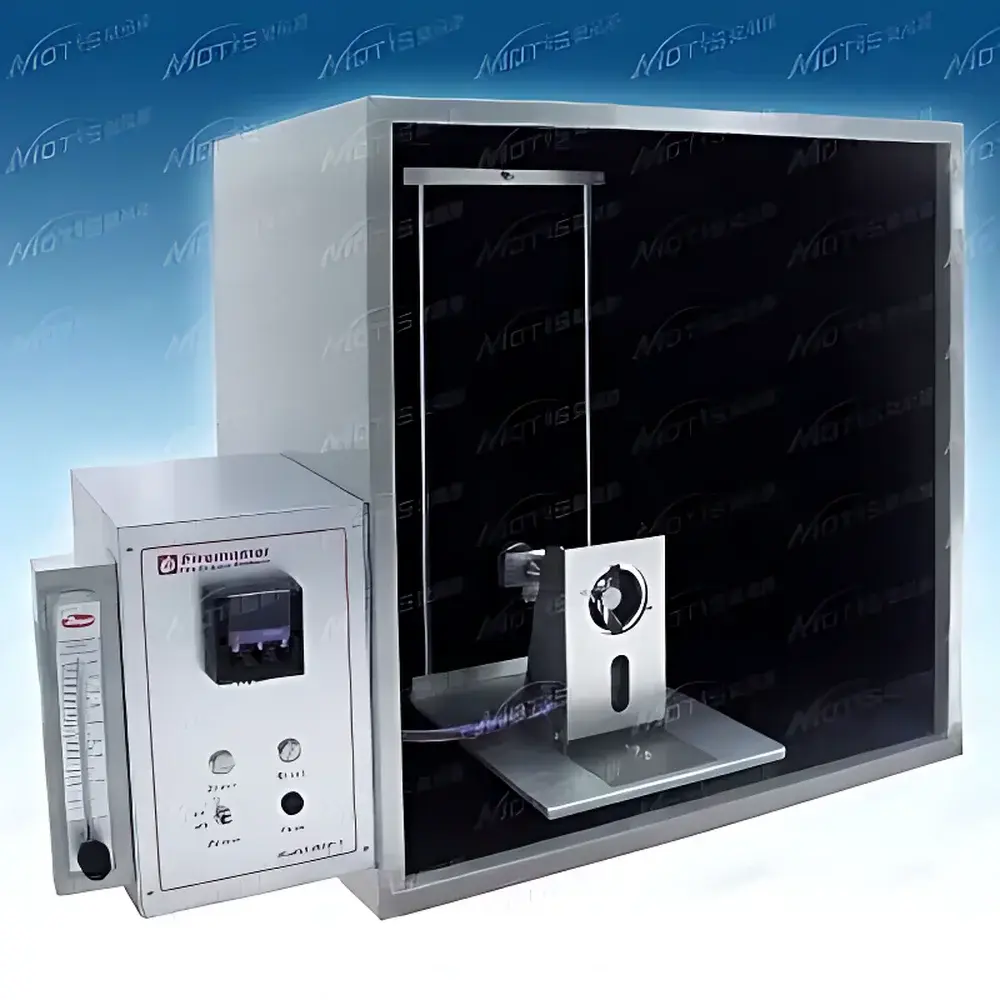
NFPA 701 Curtain Flame Resistance Tester – MOTIS NFP-1
| Brand | MOTIS |
|---|---|
| Origin | Shanghai, China |
| Model | NFP-1 |
| Compliance | NFPA 701 (2004 & 2009 Ed.), Test Method 1 |
| Burner Type | Meker Burner |
| Heat Output | 10,500 BTU/hr |
| Ignition | Automatic spark ignition |
| Burn Duration | Fixed 20 s ± 0.1 s |
| Timer Resolution | 0.1 s |
| Sample Holder | Standard ASTM/NFPA-compliant specimen clamp |
| Max Fabric Areal Density | 700 g/m² (21 oz/yd²) |
| Chamber Construction | Calcium silicate board lined with stainless steel exterior |
| Configuration | Open-top vertical combustion chamber |
Overview
The MOTIS NFP-1 NFPA 701 Curtain Flame Resistance Tester is a purpose-engineered combustion test apparatus designed exclusively for evaluating the flame propagation resistance of vertically oriented, suspended textile materials in accordance with NFPA 701 Test Method 1 (2004 and 2009 editions). Unlike horizontal flammability testers or radiant panel systems, this instrument implements a defined open-flame impingement protocol: a calibrated Meker burner delivers a reproducible thermal flux to the lower edge of a vertically clamped fabric specimen for precisely 20 seconds. The resulting flame spread distance, afterflame time, afterglow duration, and hole formation are quantitatively assessed to determine compliance with NFPA 701 pass/fail criteria. Its open-top chamber architecture eliminates convective confinement artifacts, ensuring measurement fidelity aligned with real-world curtain-hanging configurations. The system operates without forced airflow or pressure regulation—relying instead on natural convection and geometric standardization to maintain test repeatability across laboratories.
Key Features
- Vertically oriented open combustion chamber constructed from high-density calcium silicate board, thermally insulated and fully encased in brushed stainless steel for structural integrity and long-term dimensional stability.
- Integrated Meker burner delivering a stable, laminar flame at 10,500 BTU/hr—calibrated to meet NFPA 701 specified heat release rate and flame geometry requirements.
- Microprocessor-controlled gas solenoid valve enabling precise 20.0 ± 0.1 second fuel delivery window, synchronized with automatic spark ignition to eliminate operator-dependent timing variance.
- Digital timer with 0.1-second resolution and audible end-of-test signal, compliant with NFPA documentation traceability requirements.
- Standardized sample holder assembly fabricated to ASTM E84/NFPA 701 dimensional tolerances, accommodating single- or multi-layer specimens up to 700 g/m² areal density.
- No internal fans, blowers, or draft shields—ensuring test conditions reflect ambient laboratory air dynamics as stipulated in Clause 6.2 of NFPA 701.
Sample Compatibility & Compliance
The NFP-1 accommodates flat, non-rigid textile specimens measuring 305 mm × 760 mm (12 in × 30 in), mounted vertically with a 152 mm (6 in) free-hanging lower edge. It supports woven, knitted, coated, laminated, and layered curtain fabrics—including sheer overlays, blackout linings, and flame-retardant treated substrates—provided their combined mass does not exceed 700 g/m². Excluded materials include rigid composites, foams, vinyl wallcoverings, and metallized films, which fall outside the scope of NFPA 701 Method 1. All operational parameters—including burner standoff distance (25 mm), gas pressure (natural gas: 7–10 kPa; propane: 10–14 kPa), and ambient temperature/humidity monitoring requirements—are preconfigured to satisfy NFPA 701 Section 7 verification protocols. The system supports GLP-aligned recordkeeping when paired with external lab notebooks or LIMS-integrated data capture.
Software & Data Management
The NFP-1 operates as a standalone electromechanical test platform with no embedded firmware or proprietary software. All timing, ignition, and gas control functions are managed via hardened industrial relays and analog circuitry—eliminating cybersecurity vulnerabilities and ensuring uninterrupted operation during regulatory audits. Test logs—including date/time stamps, operator ID, specimen ID, observed flame spread (mm), afterflame time (s), afterglow time (s), and pass/fail determination—are manually recorded per NFPA 701 reporting conventions. For laboratories requiring digital traceability, the unit interfaces seamlessly with third-party electronic lab notebooks (ELNs) or LIMS platforms via optional RS-232 or dry-contact trigger outputs. Audit trails comply with FDA 21 CFR Part 11 principles when implemented with appropriate procedural controls and user authentication.
Applications
This tester serves critical quality assurance and regulatory validation workflows across commercial interior textile supply chains. Primary use cases include pre-shipment testing of theatrical drapery for Broadway venues, fire-code certification of hospitality curtains in LEED-certified buildings, validation of flame-retardant finishes applied to contract-grade upholstery fabrics, and routine surveillance testing by municipal fire prevention bureaus. It is routinely referenced in specifications governed by IBC Chapter 8, NFPA 101 Life Safety Code, and local fire marshal ordinances requiring “NFPA 701-compliant” labeling. Research applications include comparative evaluation of intumescent coatings, plasma-treated fiber surfaces, and bio-based flame retardants under standardized thermal insult conditions.
FAQ
Does the NFP-1 support NFPA 701 Test Method 2?
No. The NFP-1 is engineered specifically for Method 1 (small-scale vertical flame test). Method 2 requires a radiant panel apparatus and is not physically or functionally supported by this configuration.
Can it be used for testing carpets or floor coverings?
No. NFPA 701 applies solely to hanging textiles. Floor coverings are evaluated under ASTM D2859 (Limiting Oxygen Index) or NFPA 253 (Radiant Panel Test).
Is calibration certification included with shipment?
Yes. Each unit ships with a factory-verified calibration report documenting burner output (BTU/hr), timer accuracy (±0.05 s), and dimensional conformity to NFPA 701 Annex A specifications.
What gas types are compatible?
Natural gas (methane) and propane are both supported; gas-specific pressure regulators and orifice plates are supplied with the system.
Does it meet ISO/IEC 17025 accreditation requirements?
Yes—when operated within documented SOPs, maintained per manufacturer guidelines, and verified annually using traceable reference standards, the NFP-1 satisfies technical competence criteria outlined in ISO/IEC 17025:2017 Clause 6.4.
Related Products



