
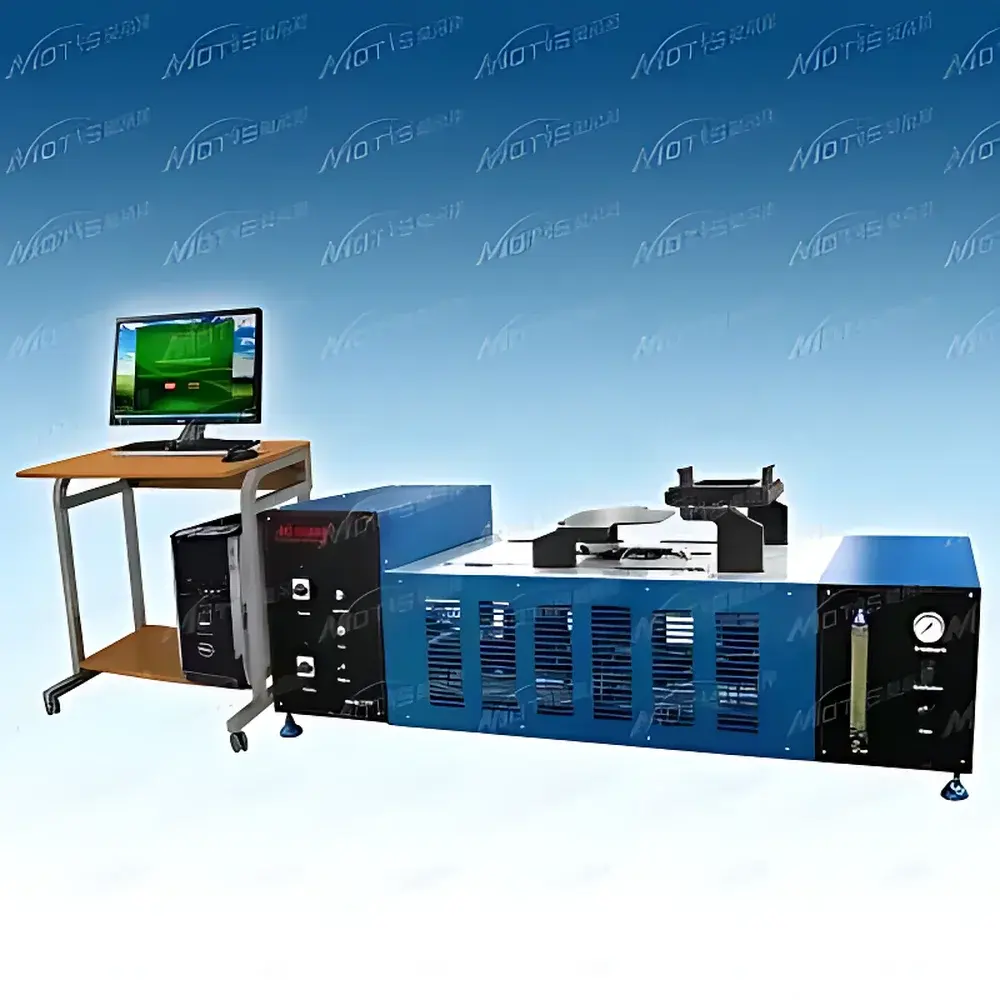
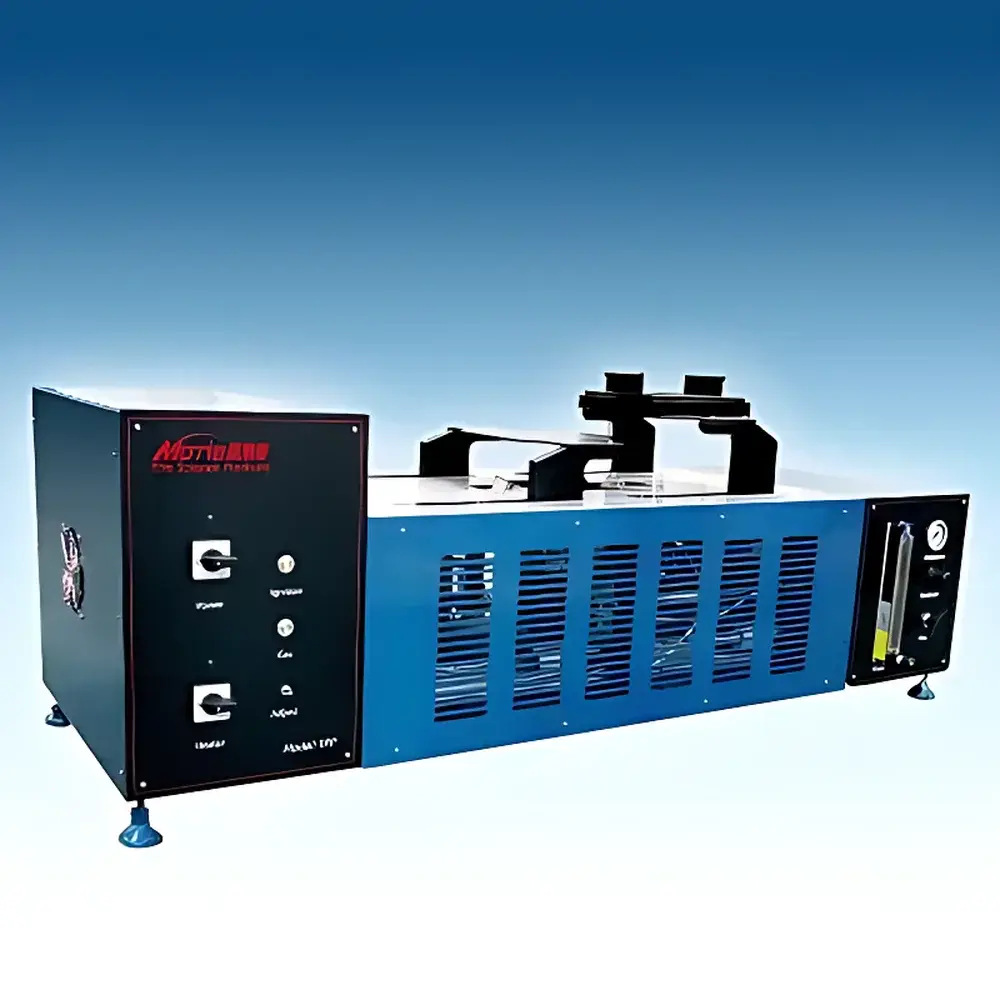
MOTIS TPP Thermal Protective Performance Tester
| Brand | MOTIS |
|---|---|
| Model | TPP |
| Origin | Shanghai, China |
| Compliance | NFPA 1971, ASTM D4018, GB 8965.1–2009, ISO 12749 |
| Heat Source | Dual Meker burners (38 mm, 5/16″ orifice) + 9× T150 quartz IR tubes |
| Total incident heat flux | 83 kW/m² ± 2 kW/m² |
| Radiant flux range | 13–40 kW/m² ± 4 kW/m² |
| Convection source | 800–1200 BTU/h per burner |
| Calibrated water-cooled heat flux sensor | 0–100 kW/m², response <200 ms, emissivity >0.95 |
| Data acquisition | 20 Hz (50 ms interval), 0.1 °C resolution, ±0.75 °C accuracy, cold-junction compensation |
| Gas control | Rotameter (±2% accuracy, >3 L/min), pressure regulator (0–15 psi), quarter-turn shutoff valve |
Overview
The MOTIS TPP Thermal Protective Performance Tester is an engineered test system designed to quantify the thermal protective performance (TPP) of flame-resistant textiles and composite materials used in personal protective equipment (PPE), including structural firefighting turnout gear, wildland firefighter clothing, safety footwear uppers, gloves, and helmet shells. It operates on the principle of controlled exposure to combined convective and radiant heat flux—simulating flash fire or short-duration flame impingement scenarios—and measures the time-to-second-degree-burn threshold using a copper calorimeter calibrated to the Stoll curve (ASTM F1930). The instrument delivers reproducible, standardized thermal insult per NFPA 1971, ASTM D4018, ISO 12749, and GB 8965.1–2009, enabling objective pass/fail evaluation against regulatory and procurement specifications.
Key Features
- Dual 38 mm Meker burners with 5/16″ orifices and metal mesh caps, each delivering 800–1200 BTU/h; air/gas mixture adjustable via bottom-mounted air shutter for stable convection profile
- Nine T150 quartz infrared tube array generating calibrated radiant heat flux between 13–40 kW/m² ± 4 kW/m², independently controllable and spatially uniform across specimen area
- Integrated total heat flux configuration: simultaneous convection + radiation yields 83 kW/m² ± 2 kW/m² at specimen plane—verified via NIST-traceable water-cooled heat flux sensor (0–100 kW/m², 0.95)
- Motorized stainless-steel movable shield for flame containment and operator safety; reduces ambient interference and improves repeatability during sequential testing
- Copper disk calorimeter assembly mounted behind specimen holder, equipped with embedded thermocouples to monitor backside temperature rise in real time
- High-speed data acquisition system sampling at 20 Hz (50 ms intervals), with automatic cold-junction compensation and 0.1 °C resolution (±0.75 °C accuracy) for all thermocouple inputs
- Gas delivery subsystem featuring precision rotameter (±2% full-scale accuracy, range >3 L/min), adjustable pressure regulator (0–15 psi), and quarter-turn manual shutoff valve for rapid emergency isolation
- Onboard digital heat flux display for immediate verification of incident energy prior to test initiation
Sample Compatibility & Compliance
The TPP tester accommodates flat, rigid, or semi-rigid specimens up to 150 mm × 150 mm, including multilayer fabric laminates, coated leathers, aluminized composites, and nonwovens. Mounting fixtures ensure consistent clamping pressure and zero gap between specimen and calorimeter surface. All mechanical and thermal components meet dimensional and performance tolerances specified in ASTM D4018 Annex A1 and ISO 12749 Clause 6. The system is validated for use in laboratories operating under GLP conditions and supports audit-ready documentation for FDA 21 CFR Part 11–compliant environments when paired with approved software configurations. Each unit ships with a NIST-traceable calibration certificate covering heat flux sensor, thermocouples, and gas flow instrumentation.
Software & Data Management
Bundled Windows-based test software provides guided workflow execution—from pre-test setup and calibration verification to real-time thermal curve visualization and automated TPP value calculation per the Stoll criterion (tburn = 1.99 × t1.26). Raw time-series data (heat flux, front/back surface temperatures, gas pressure/flow) are logged in CSV and binary formats with embedded metadata (operator ID, test date, standard reference, calibration expiry). Software supports multi-curve overlay, statistical batch reporting (mean, SD, CV%), and export to LIMS-compatible templates. Audit trails record all parameter changes, user logins, and report generation events—enabling compliance with ISO/IEC 17025 documentation requirements and internal QA review protocols.
Applications
- Qualification testing of structural firefighting turnout coat and pant shell fabrics per NFPA 1971 Section 7.10
- Comparative evaluation of thermal barrier layer efficacy in multilayer PPE systems
- R&D validation of novel flame-retardant finishes, nanocoatings, and aerogel-integrated composites
- Quality control screening for batch-to-batch consistency in FR textile manufacturing
- Regulatory submission support for CE marking (EN ISO 11612), UL certification, and military specification compliance (e.g., MIL-STD-2020)
- Failure analysis of degraded or laundered PPE after repeated thermal exposure cycles
FAQ
What standards does the MOTIS TPP tester fully comply with?
The system is configured and validated to meet the physical architecture, operational parameters, and reporting requirements of ASTM D4018, NFPA 1971 (2022 edition), ISO 12749:2015, and GB 8965.1–2009. Calibration procedures follow ISO/IEC 17025 guidelines.
Is the heat flux sensor recalibration required annually?
Yes. Annual recalibration of the water-cooled heat flux sensor and thermocouple array against NIST-traceable references is recommended to maintain measurement uncertainty within ±3% as defined in ASTM E799. MOTIS provides certified recalibration services with documented uncertainty budgets.
Can the system be integrated into an existing laboratory network for centralized data archiving?
Yes. The data acquisition engine supports OPC UA and Modbus TCP protocols. Raw datasets and summary reports can be routed directly to network file shares, SQL databases, or enterprise LIMS platforms via configurable export modules.
Does the TPP tester support modified heat flux profiles—for example, ramped or pulsed exposures?
Standard operation follows the fixed 83 kW/m² combined flux protocol. Custom waveform generation (e.g., time-varying radiant/convection ratios) requires optional firmware upgrade and third-party controller integration—not included in base configuration.
What maintenance is required between tests?
Post-test cleaning includes removal of soot deposits from quartz tubes and burner caps using non-abrasive ceramic cleaner; inspection of gas line seals and thermocouple integrity; and verification of calorimeter surface flatness and thermal contact. MOTIS supplies a quarterly preventive maintenance checklist aligned with ISO 5725 repeatability targets.



