
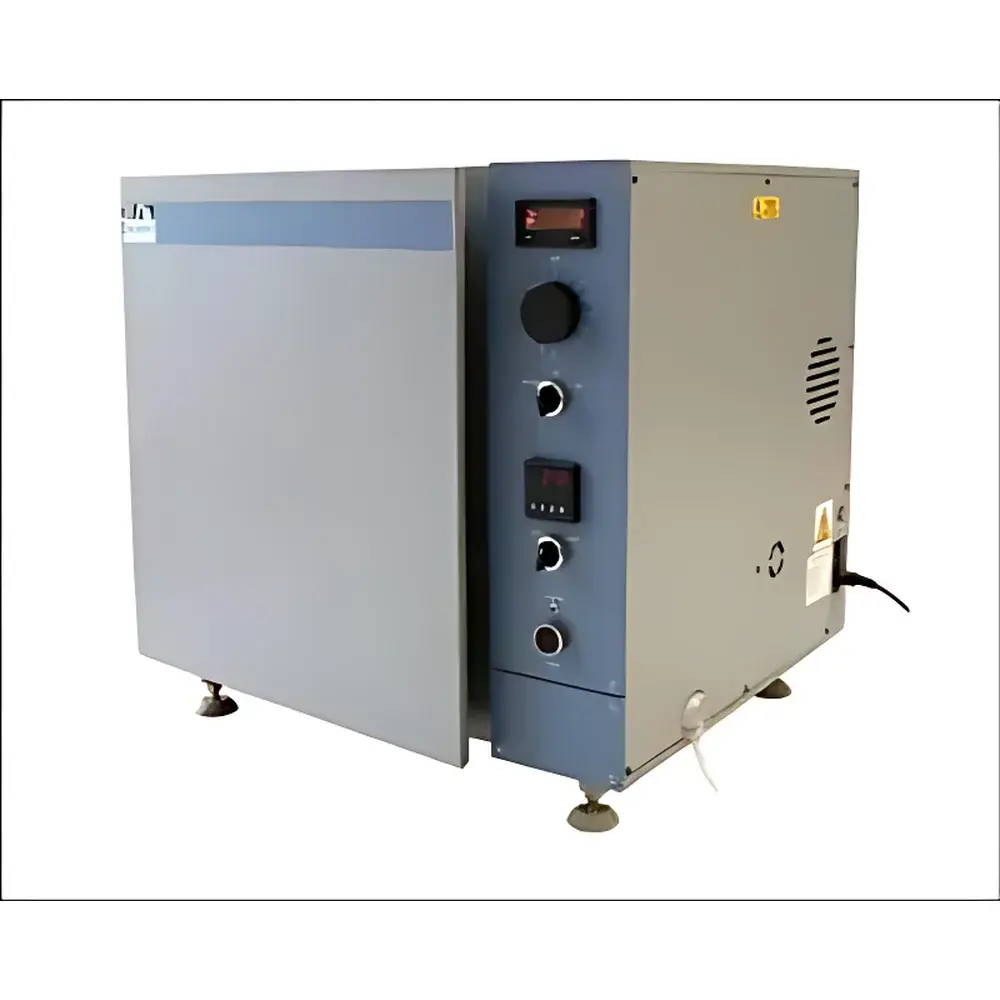
DE Midi HPCCC High-Speed Counter-Current Chromatography System
| Brand | DE |
|---|---|
| Origin | United Kingdom |
| Model | DE Midi HPCCC |
| Configuration | Analytical-to-Preparative Scale |
| Column Volume | 22–960 mL |
| Sample Loading Capacity | 0–25 g per run |
| Mobile Phase Flow Rate | 0–80 mL/min |
| Rotational Speed | 1400 rpm |
| Stationary Phase Retention | >75% (typical, solvent system dependent) |
| Solvent Consumption | ~10% of crude sample mass (by weight) |
Overview
The DE Midi HPCCC is a high-performance High-Speed Counter-Current Chromatography (HPCCC) system engineered for scalable, solvent-efficient, and phase-loss-free liquid–liquid partition chromatography. Unlike conventional solid-phase chromatographic techniques—such as HPLC or flash chromatography—HPCCC operates without a solid stationary phase. Instead, it relies on the differential partitioning of analytes between two immiscible liquid phases under controlled centrifugal force in a precisely wound coil column. The system utilizes a planetary motion mechanism to generate a stable, high-retention stationary phase while enabling continuous elution of the mobile phase. This principle eliminates irreversible adsorption, column fouling, and sample degradation commonly associated with silica- or polymer-based supports—making it especially suited for labile natural products, peptides, glycosides, and unpurified crude extracts where structural integrity and quantitative recovery are critical.
Key Features
- Zero Solid Support Architecture: Eliminates irreversible binding, peak tailing, and sample loss—enabling 100% recovery of injected material across all polarity ranges.
- Scalable Analytical-to-Preparative Operation: Adjustable column volume (22–960 mL) and loading capacity (0–25 g) support method development at analytical scale and direct transfer to milligram-to-gram purification without re-optimization.
- High Stationary Phase Retention: Optimized rotor geometry and rotational stability ensure >75% stationary phase retention under standard operating conditions, delivering reproducible retention times and resolution.
- Low Solvent Intensity: Typical solvent consumption is approximately 10% of the dry mass of crude feedstock—reducing disposal costs, environmental impact, and operational overhead compared to conventional preparative LC.
- Robust Mechanical Design: Precision-machined stainless-steel frame, brushless DC motor drive, and integrated speed/flow synchronization ensure long-term mechanical stability and minimal vibration-induced phase emulsification.
- Modular Fluid Path: Chemically resistant PTFE and PEEK tubing, dual-piston high-pressure pump, and inert solvent selection valves accommodate aggressive solvent systems including chlorinated, acidic, or basic mobile phases.
Sample Compatibility & Compliance
The DE Midi HPCCC accommodates a broad spectrum of sample matrices—including plant extracts, fermentation broths, synthetic reaction mixtures, and biopolymer hydrolysates—without prior desalting or filtration beyond standard particulate removal. Its liquid–liquid partition mechanism tolerates high-viscosity, particulate-laden, or highly polar/non-polar samples that would clog or deactivate solid-phase columns. From a regulatory standpoint, the system supports GLP-compliant workflows when paired with audit-trail-enabled software (see Software & Data Management). Method parameters—including flow rate, rotation speed, temperature, and solvent composition—are fully documentable and traceable per ICH Q5A, USP , and ISO/IEC 17025 requirements. No component contacts sample in a manner requiring FDA 21 CFR Part 11 validation; however, electronic records generated via optional software modules comply with ALCOA+ data integrity principles.
Software & Data Management
The DE Midi HPCCC integrates with DE’s proprietary ChromaControl Suite (v3.2+), a Windows-based platform supporting real-time monitoring of rotational speed, flow rate, pressure, UV absorbance (via optional inline detector), and fraction collector triggers. All acquisition parameters are timestamped and stored in encrypted SQLite databases with configurable backup intervals. The software enables method cloning, batch sequencing, and export of raw data in ASTM E1381-compliant .csv and .cdf formats. Audit trails record user logins, parameter changes, and run completions—meeting minimum requirements for GMP-aligned process documentation. Optional PDF report generation includes chromatograms, fraction maps, and metadata headers compliant with internal SOP templates.
Applications
- Purification of thermally labile natural products (e.g., flavonoids, alkaloids, terpenoids) from botanical extracts without decomposition.
- Isolation of chiral intermediates directly from asymmetric synthesis reaction mixtures—bypassing derivatization or chiral column screening.
- Downstream processing of monoclonal antibody fragments and peptide conjugates where silica-induced aggregation must be avoided.
- Rapid fractionation of marine-derived metabolites for dereplication prior to NMR or HRMS analysis.
- Process development for API purification routes where regulatory filing requires demonstration of scalability and phase consistency across pilot and commercial equipment.
FAQ
How does HPCCC differ fundamentally from HSCCC or CPC?
HPCCC (High-Performance CCC) denotes an evolution of classical HSCCC, incorporating enhanced rotor design, improved phase retention control, and tighter integration of fluidic and mechanical subsystems—resulting in higher resolution, better reproducibility, and broader solvent system compatibility.
Can I use the same solvent system across analytical, semi-prep, and prep scales?
Yes—the absence of solid packing allows direct method translation; retention factor (K) and selectivity (α) remain consistent if temperature, flow, and rotation are proportionally maintained.
What maintenance is required for long-term stationary phase stability?
Routine verification of coil integrity, seal integrity at rotary unions, and calibration of flow/rotation synchronization every 200 hours of operation is recommended. No column regeneration or replacement is necessary.
Is UV detection integrated or optional?
UV-Vis detection is optional and available as a modular add-on (200–400 nm range, 1 mm pathlength flow cell); native system operation is detector-agnostic and compatible with ELSD, CAD, or MS interfaces.
Does the system support temperature control?
Ambient operation is standard; an external recirculating chiller interface (±0.5 °C stability) is available as an accessory for temperature-sensitive separations.




