
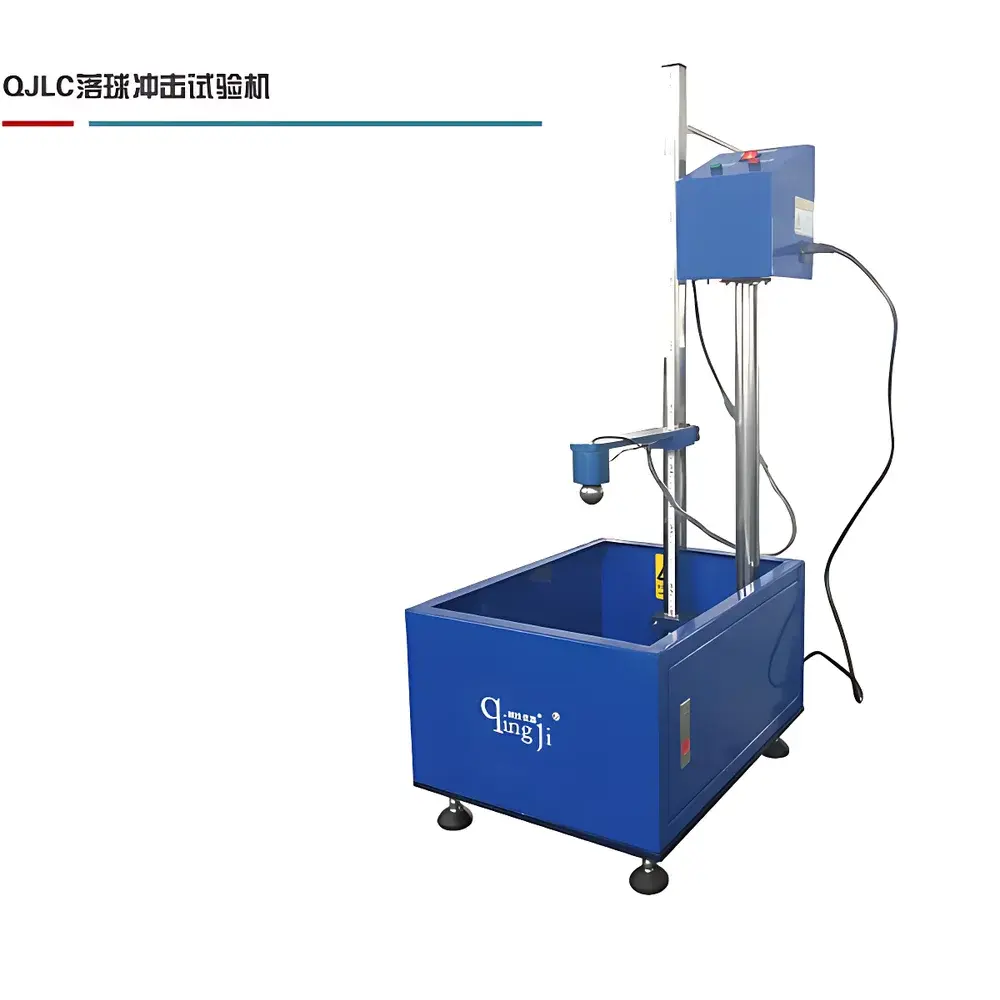
QJLC Drop Ball Impact Tester
| [Origin | Shanghai, China |
|---|---|
| Manufacturer Type | Authorized Distributor |
| Product Origin | Domestic (China) |
| Model | QJLC |
| Impact Energy Range | Configurable via mass (5–50 g) and drop height (0–2000 mm) |
| Drop Height Resolution | 1 mm |
| Max Drop Height | 2000 mm |
| Ball Mass Options | 5, 10, 20, 30, 50 g (±5 g tolerance) |
| Power Supply | AC 220 V, 50 Hz |
| Overall Dimensions (L×W×H) | 500 × 400 × 2200 mm |
| Net Weight | 30 kg |
| Safety Enclosure | Full-height welded wire mesh guard cage |
| Drop Rod | Precision-ground square-section stainless steel rod |
| Compliance Basis | GB/T 9963 (Tempered Glass), JIS R 3206 (Tempered Soda-Lime Silicate Glass), aligned with ISO 179-1 (Plastics – Izod impact resistance) principles for free-fall impact assessment] |
Overview
The QJLC Drop Ball Impact Tester is an engineered precision instrument designed for standardized free-fall impact evaluation of brittle and semi-rigid materials used in consumer electronics, optical components, protective coatings, and polymer-based substrates. It operates on the fundamental principle of gravitational potential energy conversion: a calibrated spherical impactor (steel ball) is elevated to a defined height within a vertically constrained guide system and released under controlled electromagnetic actuation. Upon release, the ball undergoes true free-fall acceleration (g ≈ 9.80665 m/s²), striking the test specimen with kinetic energy E = m·g·h — where mass (m) and height (h) are independently adjustable parameters. This method provides traceable, repeatable impact energy delivery essential for comparative material qualification, quality control screening, and durability benchmarking in accordance with internationally referenced mechanical testing frameworks.
Key Features
- Electromagnetically actuated release mechanism ensures zero pre-impact interference and high temporal reproducibility (< ±2 ms release jitter).
- Precision-machined square-section stainless steel drop rod with integrated 1-mm resolution engraved steel scale and orthogonal alignment reference for unambiguous height setting.
- Modular steel ball set (5 g, 10 g, 20 g, 30 g, 50 g) supplied with certified mass tolerance of ±5 g, enabling systematic energy variation across 0.098–980 mJ range at full 2000 mm height.
- Full-height welded wire mesh safety enclosure (mesh aperture ≤ 10 mm) compliant with ISO 13857:2019 guarding requirements for low-energy impact zones.
- Static powder-coated structural frame with vibration-damped base plate and non-slip rubber feet for stable operation on standard laboratory benches.
- No external air supply or hydraulic systems required — fully self-contained electromechanical architecture with minimal maintenance footprint.
Sample Compatibility & Compliance
The QJLC tester accommodates flat, rigid specimens up to 150 mm × 150 mm × 25 mm in dimension and ≥ 0.5 mm thickness, including tempered soda-lime glass (e.g., smartphone cover lenses), acrylic sheets (PMMA), polycarbonate films, anodized aluminum panels, and cured epoxy or UV-curable coating layers on rigid substrates. Test protocols align with core principles of GB/T 9963-1998 (Chinese national standard for tempered glass impact resistance), JIS R 3206:2017 (Japanese industrial standard for heat-treated glass), and ISO 179-1:2010 Annex A (non-pendulum free-fall impact for plastics). While not a pendulum-type Charpy/Izod tester, its energy-controlled drop methodology satisfies internal QC specifications for scratch/impact threshold mapping and fulfills preliminary GLP-aligned documentation requirements when paired with validated SOPs.
Software & Data Management
The QJLC Drop Ball Impact Tester is a manually operated, hardware-only platform with no embedded microcontroller or digital interface. All operational parameters — drop height, ball mass, specimen identification, ambient temperature, and observed failure mode (e.g., crack initiation, radial fracture, spalling, delamination) — are recorded manually in laboratory notebooks or LIMS-integrated spreadsheets. For audit readiness, users are advised to implement standardized test record templates referencing ISO/IEC 17025:2017 clause 7.8 (Reporting of results) and maintain calibration logs for steel balls and height scale verification per ISO 9001:2015 clause 7.1.5. Optional third-party high-speed imaging (≥ 1000 fps) or piezoelectric force sensor integration (e.g., PCB Piezotronics 208C02) may be deployed externally to quantify peak impact force and contact duration, provided mechanical coupling does not compromise drop kinematics.
Applications
- Qualification testing of chemically strengthened and thermally tempered display cover glasses for smartphones, tablets, and wearables.
- Evaluation of anti-scratch coating adhesion and cohesive integrity on plastic optical components under localized dynamic loading.
- Comparative impact resistance screening of injection-molded housings (ABS, PC/ABS blends) during new product introduction (NPI) phases.
- Process validation of plasma-enhanced chemical vapor deposition (PECVD) hard coatings on acrylic substrates.
- Failure mode analysis (FMA) of laminated safety glazing interlayers subjected to low-velocity impact events.
- Internal R&D benchmarking of novel transparent ceramics (e.g., ALON, spinel) against conventional soda-lime silicate references.
FAQ
What standards does the QJLC Drop Ball Impact Tester directly comply with?
It is engineered to support testing protocols derived from GB/T 9963 and JIS R 3206, and its operational methodology conforms to the physical principles outlined in ISO 179-1 for free-fall impact assessment.
Is the drop height digitally measured or manually read?
Height is manually set and verified using the integrated 1-mm-resolution engraved steel scale and orthogonal alignment tool; no digital encoder or laser height sensor is included in the base configuration.
Can the tester accommodate specimens thicker than 25 mm?
Specimen thickness is constrained by the vertical clearance between the impact point and the base anvil; maximum usable thickness is 25 mm for full-height (2000 mm) drops to prevent premature rod contact.
Are calibration certificates provided for the steel balls?
Certified mass calibration documentation (traceable to NIM, China) is available upon request at time of order; standard delivery includes manufacturer’s nominal mass labeling only.
Does the unit meet CE or UL safety certification requirements?
The QJLC tester is not CE-marked or UL-listed; it is intended for use in controlled laboratory environments under operator supervision and requires local electrical safety inspection prior to commissioning.



