
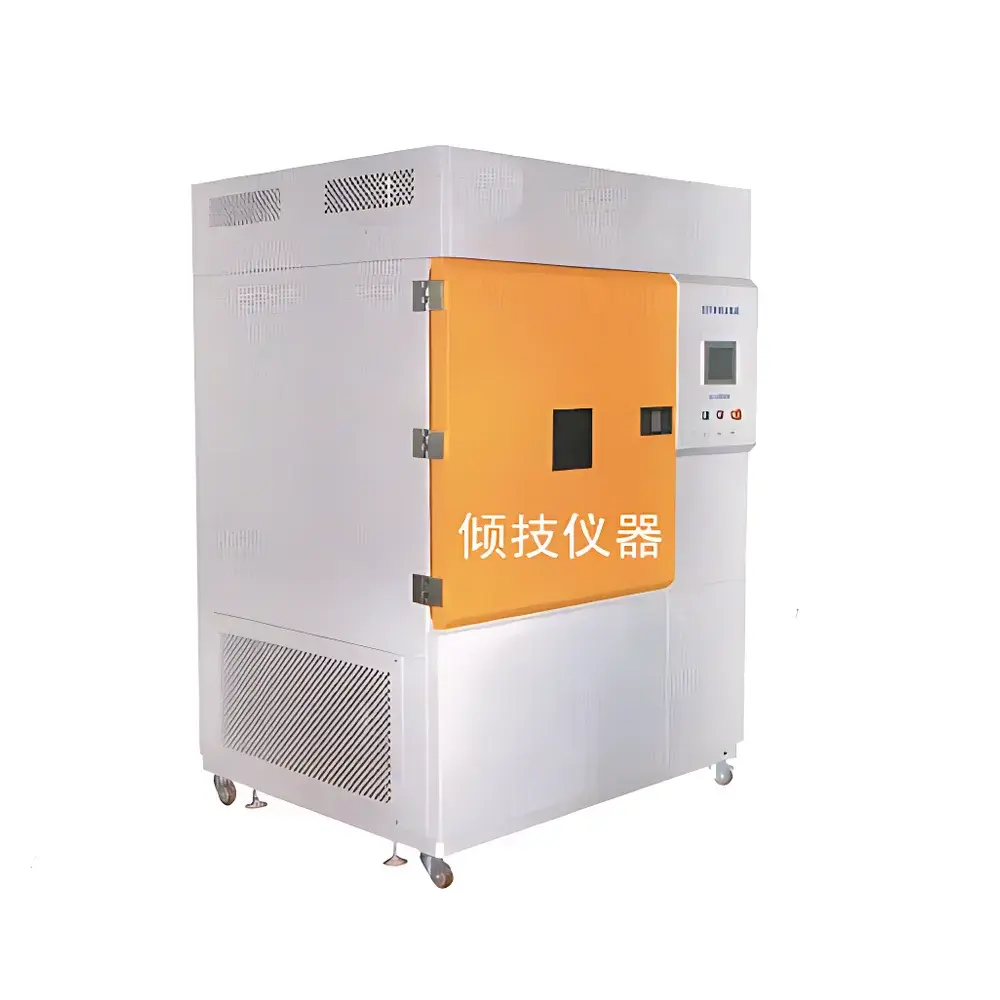
Qinji QJXDW3541 Xenon Arc Weathering Test Chamber
| Brand | Qinji |
|---|---|
| Origin | Shanghai, China |
| Manufacturer Type | Authorized Distributor |
| Country of Manufacture | China |
| Model | QJXDW3541 |
| Price | Upon Request |
| Light Source | 6 kW Air-Cooled/Water-Cooled Xenon Arc Lamp |
| Spectral Range | 290–800 nm |
| Irradiance (300–800 nm) | 550 W/m² |
| Temperature Range | RT+10°C to 80°C ±1°C |
| Temp. Uniformity | ≤2°C |
| Sample Rack Radius (inner/outer) | 100/220 mm |
| Rack Rotation Speed | 5 rpm |
| Center Distance to Lamp | 165 mm |
| Rack Height | 420 mm |
| Chamber Dimensions (W×D×H) | 500×500×600 mm |
| Rainfall Duration | 0–9999 min (adjustable) |
| Rainfall Cycle Interval | 0–240 min (adjustable) |
| Irradiance Monitoring & Integrated Dose Display | Yes |
Overview
The Qinji QJXDW3541 Xenon Arc Weathering Test Chamber is an engineered environmental simulation system designed to replicate the complex degradative effects of natural outdoor exposure—primarily solar radiation, thermal cycling, and moisture ingress—in a controlled laboratory setting. It operates on the principle of xenon arc irradiation, where a high-intensity 6 kW xenon lamp emits a spectral power distribution closely matching terrestrial sunlight (290–800 nm), including critical UV-B, UV-A, visible, and near-infrared regions. Combined with precise temperature control (RT+10°C to 80°C ±1°C) and programmable water exposure via calibrated rainfall and condensation cycles, the chamber enables accelerated aging protocols compliant with internationally recognized standards such as ISO 4892-2, ASTM G155, SAE J2527, and GB/T 16422.2. This system is not intended for pass/fail certification alone but serves as a quantitative tool for comparative material screening, formulation optimization, and predictive durability assessment across multi-year service lifetimes.
Key Features
- High-fidelity 6 kW xenon arc lamp with dual cooling options: air-cooled (3 kW) and water-cooled (4.5 kW) configurations—ensuring stable irradiance output and extended lamp life (~2000 h).
- Real-time irradiance monitoring and integrated dose accumulation display (W·h/m²) across the 300–800 nm band, enabling traceable, repeatable exposure dosimetry.
- Precise black-panel or black-standard thermometer (BST) temperature control with ±1°C accuracy and ≤2°C uniformity across the sample plane—critical for correlating thermal stress with photochemical degradation kinetics.
- Motor-driven rotating sample rack (5 rpm) with configurable inner/outer radii (100/220 mm) and fixed center-to-lamp distance (165 mm), ensuring uniform angular irradiance distribution per ISO 4892-2 requirements.
- Programmable wet/dry cycling: independent control of rainfall duration (0–9999 min) and inter-cycle interval (0–240 min), supporting both continuous spray and intermittent condensation modes to simulate dew, rain, and humidity-driven hydrolysis.
- Modular sample tray design accommodates standard specimen holders (e.g., ISO 11341, ASTM D6695) and custom fixtures—including flat panels up to 420 mm height—without compromising airflow or irradiance homogeneity.
Sample Compatibility & Compliance
The QJXDW3541 accommodates rigid and semi-rigid flat specimens—including coatings, automotive safety glass laminates, polymer composites, architectural cladding (e.g., aluminum composite panels), and exterior-grade plastics—within its 500×500×600 mm test chamber. Its optical geometry and thermal management comply with the spatial constraints and irradiance uniformity criteria defined in ISO 4892-2 Annex A. All operational parameters—including irradiance setpoints, temperature profiles, and wet/dry sequencing—are fully programmable and auditable, supporting GLP-compliant test documentation. While the system itself does not carry CE or UL certification, it is configured to meet functional safety expectations for Class II laboratory equipment when installed per local electrical codes and ventilation guidelines.
Software & Data Management
The chamber integrates a microprocessor-based controller with a backlit LCD interface supporting multistep exposure programs (up to 99 segments), real-time parameter logging (irradiance, chamber temperature, BST temperature, rainfall status), and USB data export in CSV format. No proprietary software installation is required; raw logs are compatible with common statistical analysis platforms (e.g., JMP, Minitab) and LIMS integration via MODBUS RTU (optional RS485 module). Audit trails include operator ID (via keypad entry), timestamped parameter changes, and automatic detection of lamp aging-related irradiance drift—facilitating 21 CFR Part 11–aligned review workflows when paired with institutional electronic signature policies.
Applications
- Formulation development for UV-stabilized polyolefins, acrylic paints, and silicone-based sealants.
- Comparative evaluation of pigment fade resistance in automotive OEM coatings under SAE J2527-specified irradiance and temperature profiles.
- Validation of weatherability claims for building envelope materials per EN 927-6 and ISO 11341.
- Accelerated corrosion testing of coated metal substrates where UV-induced polymer binder degradation precedes electrochemical failure.
- Supporting ICH Q1B photostability testing for pharmaceutical packaging materials—when operated within validated irradiance and temperature bounds.
FAQ
What spectral range does the xenon lamp cover, and how is it filtered?
The lamp emits broadband radiation from 290 nm to 800 nm. Optional daylight (Daylight-Q/B) and window-glass (Window-Q/B) filters are available to match specific solar transmission profiles per ISO 4892-2.
Is the chamber suitable for testing three-dimensional parts?
It is optimized for flat, planar specimens mounted on the rotating rack. Non-planar geometries require custom jigs and may compromise irradiance uniformity—validation per ISO 4892-2 Annex C is recommended.
How is lamp output stability maintained over time?
The system includes closed-loop irradiance feedback control. Lamp voltage and current are continuously monitored; automatic power compensation maintains target irradiance until end-of-life (typically ~2000 h at rated power).
Can test parameters be exported for regulatory submission?
Yes—CSV-formatted logs include all setpoints, measured values, timestamps, and system status flags, supporting audit-ready documentation for ISO/IEC 17025-accredited laboratories.
What maintenance intervals are recommended?
Lamp replacement every ~2000 h; quartz filter cleaning every 100 h; calibration of BST sensor and irradiance meter annually or per internal QA schedule.



