
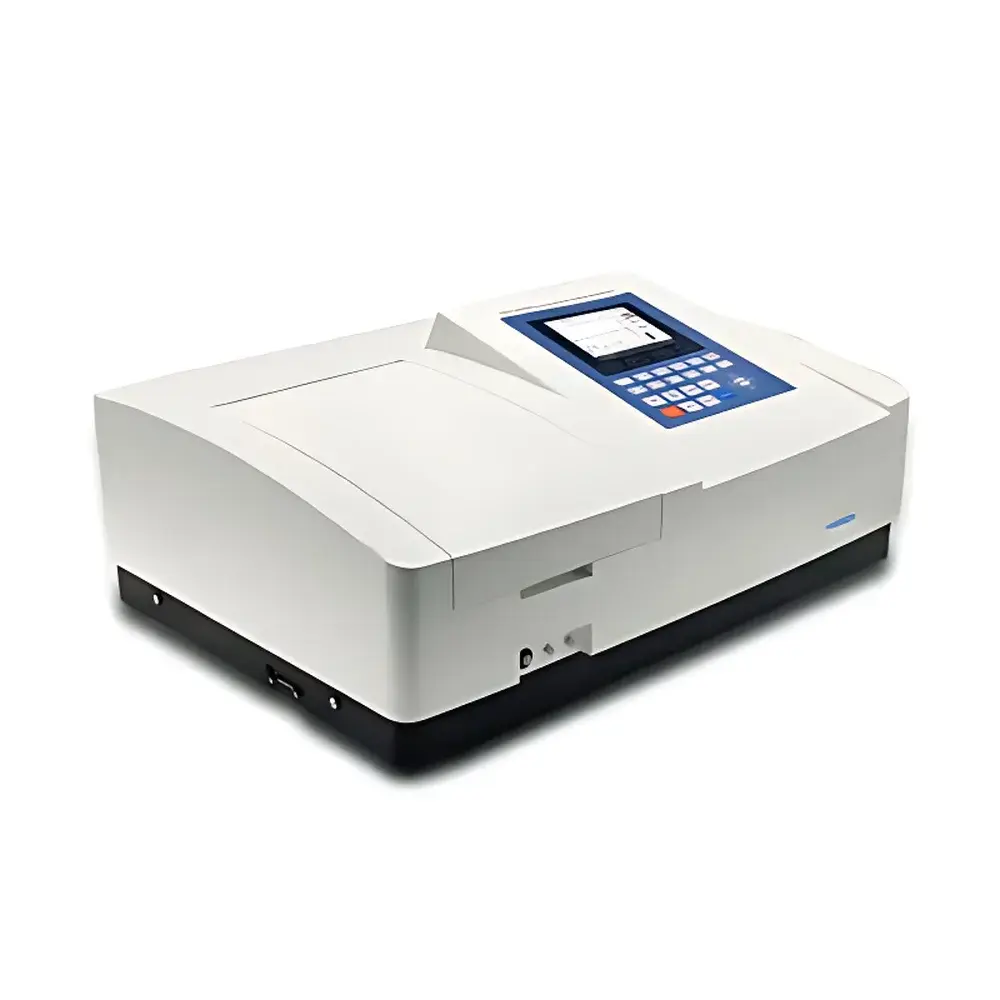
Mapada UV-3000 Scanning Ultraviolet-Visible Spectrophotometer
| Brand | Mapada |
|---|---|
| Origin | Shanghai, China |
| Manufacturer Type | Original Equipment Manufacturer (OEM) |
| Product Category | Domestic |
| Model | UV-3000 |
| Optical System | Pseudo-Double-Beam |
| Detector | Silicon Photodiode |
| Wavelength Range | 190–1100 nm |
| Spectral Bandwidth | 4 nm |
| Wavelength Accuracy | ±0.5 nm |
| Display | 320 × 240 LCD (5-inch) |
| Measurement Modes | Transmittance (T), Absorbance (A), Concentration (C), Energy (E) |
| Scan Speed Options | High/Medium/Low (up to 3800 nm/min) |
| Wavelength Setting | Motorized Auto-Positioning |
| Photometric Range | 0–200% T, –4.0 to +4.0 A |
| Light Sources | Imported long-life deuterium lamp & tungsten-halogen lamp |
| Data Interface | USB port |
| Print Interface | Parallel port |
| Power Supply | AC 220 V/50 Hz or AC 110 V/60 Hz |
| Dimensions | 470 × 370 × 180 mm |
| Net Weight | 14 kg |
Overview
The Mapada UV-3000 Scanning Ultraviolet-Visible Spectrophotometer is a precision optical instrument engineered for quantitative and qualitative analysis across research laboratories, quality control environments, and educational institutions. Operating on the principle of absorption spectroscopy, the UV-3000 measures the intensity of light transmitted through or reflected from a sample as a function of wavelength—spanning the ultraviolet (190 nm), visible (400–700 nm), and near-infrared (700–1100 nm) spectral regions. Its pseudo-double-beam optical architecture minimizes baseline drift caused by source instability or detector thermal noise, delivering high reproducibility in absorbance measurements over extended acquisition periods. The system integrates a 1200 lines/mm holographic grating for efficient dispersion and resolution, coupled with imported silicon photodiode detection technology to ensure linearity and low stray light performance (<0.05% at 220 nm). Designed for compliance with routine analytical workflows, the UV-3000 supports method validation protocols aligned with ISO/IEC 17025 and ASTM E275 for spectrophotometer performance verification.
Key Features
- 5-inch high-resolution monochrome LCD (320 × 240 pixels) with intuitive Chinese-English bilingual interface—enables real-time visualization of absorption spectra, kinetic time-course plots, and calibration curves without external software.
- Pseudo-double-beam optical path design with automatic reference beam compensation improves measurement stability during long-duration scans or temperature-sensitive assays.
- Imported deuterium and tungsten-halogen lamps provide continuous spectral output from 190 to 1100 nm; ozone-reduced deuterium lamp housing enhances laboratory safety and extends lamp service life.
- Modular lamp socket design allows rapid source replacement without manual optical alignment—reducing downtime and eliminating post-replacement recalibration.
- Motorized wavelength drive enables precise, repeatable positioning with ±0.5 nm accuracy across the full spectral range—verified via built-in GLP self-diagnostic routines.
- Spacious sample compartment accommodates cuvettes from 5 mm to 100 mm pathlength, including standard 10 mm quartz, glass, or plastic cells—compatible with flow-through and solid-sample accessories (optional).
- Integrated lamp usage monitoring tracks cumulative operating hours for both deuterium and tungsten sources—supporting predictive maintenance planning per GMP documentation requirements.
Sample Compatibility & Compliance
The UV-3000 accepts liquid, solution-based, and transparent solid samples in standard cuvette formats. It complies with core regulatory expectations for analytical instrumentation used in pharmaceutical QC, environmental testing, and food safety labs—including adherence to USP , EP 2.2.25, and ISO 6059 for spectrophotometric measurement validity. Its GLP self-assessment function permits on-demand verification of wavelength accuracy (using holmium oxide or didymium filters) and photometric linearity (via neutral density filters), generating timestamped audit logs suitable for internal QA review or regulatory inspection. All firmware operations retain immutable event records—including lamp ignition cycles, calibration timestamps, and user-initiated diagnostics—meeting traceability criteria under FDA 21 CFR Part 11 when paired with validated Mapada scanning software.
Software & Data Management
While the UV-3000 operates autonomously via front-panel controls, optional Mapada Professional Scan Software (v3.2+) enables full PC-based instrument control, advanced data processing, and report generation. The software supports multi-curve overlay, derivative spectroscopy, peak identification, and concentration mapping using up to 10-point calibration tables. Raw spectral data exports in CSV and JCAMP-DX formats ensure interoperability with third-party platforms such as OriginLab, MATLAB, or LabArchives ELN. USB connectivity facilitates direct firmware updates and secure data transfer without network exposure—critical for air-gapped lab environments. All stored spectra and method files are encrypted at rest and include metadata tags (operator ID, date/time stamp, instrument serial number) to satisfy ALCOA+ data integrity principles.
Applications
The UV-3000 serves diverse analytical functions across multiple sectors: quantification of nucleic acids and proteins (e.g., A260/A280 ratio analysis); determination of enzyme kinetics via NADH/NADPH absorbance shifts at 340 nm; verification of dye concentrations in textile and ink formulations; assessment of water quality parameters (nitrate, phosphate, COD); validation of sunscreen UV-filter transmittance profiles per ISO 24443; and routine assay development in academic teaching labs. Its robust construction and stable photometric response make it particularly suited for batch-release testing where repeatability across operators and shifts is essential.
FAQ
What wavelength calibration standards are recommended for routine verification?
Holmium oxide solution (in 10% perchloric acid) is recommended for wavelength accuracy checks at 241.1, 279.4, 287.5, 333.7, 360.9, 418.5, 460.0, 484.5, 536.2, and 637.5 nm per NIST SRM 2034.
Can the UV-3000 perform kinetic measurements over time?
Yes—the instrument supports time-scan mode with user-defined interval durations (0.1–600 s) and total scan duration up to 2 hours, storing up to 1000 data points per run.
Is the photometric accuracy verified per ASTM E275?
The system meets ASTM E275 Class B specifications for photometric accuracy (±0.005 A at 1.0 A) when operated with certified reference materials and maintained within specified ambient conditions (20–25°C, <60% RH).
Does the UV-3000 support 21 CFR Part 11-compliant electronic signatures?
When used with validated Mapada Professional Scan Software and configured with role-based access control, audit trail logging, and digital signature modules, the system satisfies technical controls outlined in 21 CFR Part 11 Subpart B.
What is the typical lifetime of the deuterium and tungsten lamps?
Under normal usage (≤8 h/day), the imported deuterium lamp achieves ≥2000 hours; the tungsten-halogen lamp exceeds 5000 hours—both monitored in real time via the onboard lamp-hour counter.




