
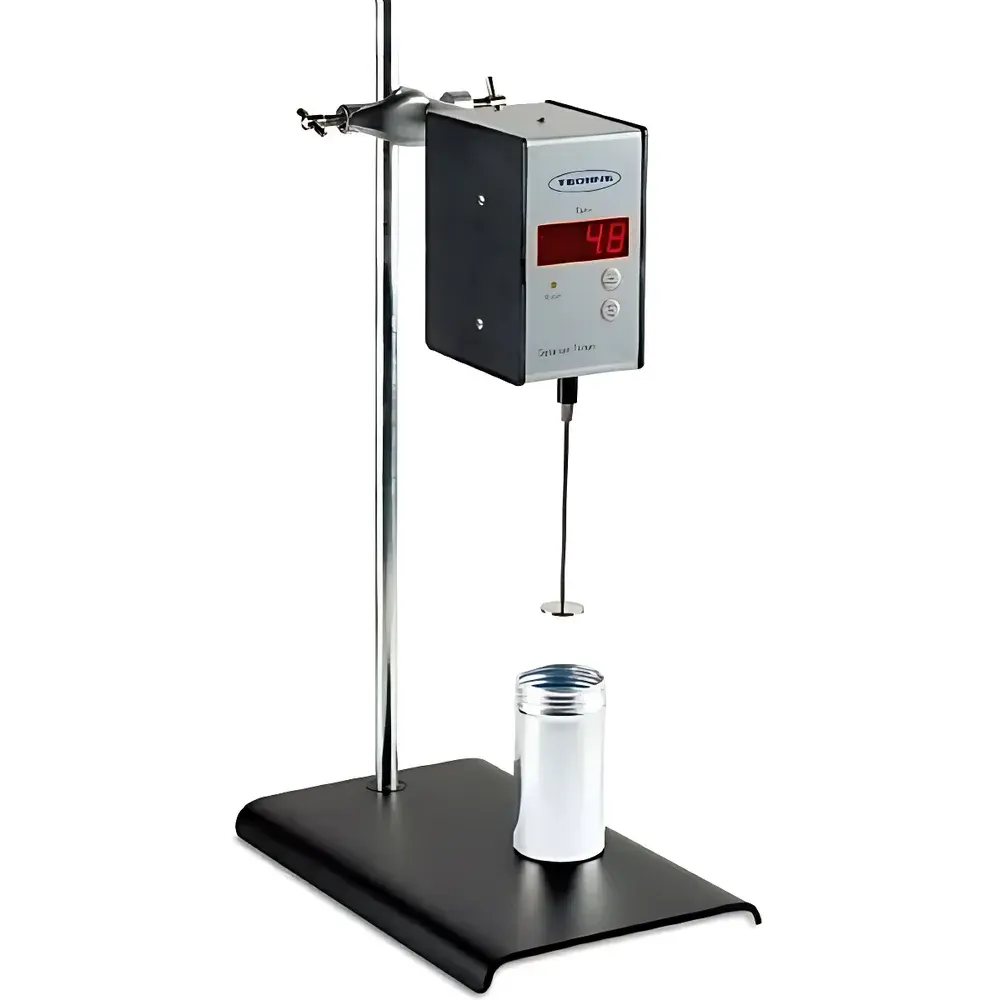
Techne GT-5 and GT-6 Gelation Timers
| Brand | Techne |
|---|---|
| Origin | United Kingdom |
| Model | GT-5 (1 rpm), GT-6 (10 rpm) |
| Timer Resolution | 1 min (GT-5) or 0.1 min (GT-6) |
| Maximum Timing Duration | 9999 min (GT-5) / 999.9 min (GT-6) |
| Drive Speed | 1 rpm (GT-5), 10 rpm (GT-6) |
| Detection Method | Mechanical gel-point endpoint via plunger immobilization |
| Compliance | Fully compliant with BS EN ISO 2535, ASTM D2471, and BS 2782-5 for gel time determination |
| Warranty | 3-year limited warranty including factory calibration certificate |
| Sample Holder Compatibility | Standard 22 mm, 19 mm, and 16 mm stainless-steel plungers |
| Mounting | Compatible with standard distillation flask stands (e.g., Claisen or Graham condenser supports) |
Overview
The Techne GT-5 and GT-6 Gelation Timers are precision-engineered laboratory instruments designed for the objective, reproducible measurement of gel time—the critical interval between the initiation of polymer crosslinking and the onset of solid-like mechanical behavior in thermosetting resins, adhesives, and reactive coatings. Operating on the principle of rotational mechanical impedance detection, these timers apply a constant, low-torque rotational drive (1 rpm for GT-5, 10 rpm for GT-6) to a vertically suspended plunger immersed in the test sample. As polymerization progresses and viscosity rises exponentially, the material transitions from Newtonian flow to viscoelastic solid behavior; at the gel point, the plunger ceases rotation due to torque overload, triggering an automatic timer halt. This endpoint is detected via high-sensitivity mechanical feedback—not optical or thermal proxies—ensuring direct correlation with rheological network formation. Developed over nearly six decades of industrial collaboration, the GT series forms the physical basis for multiple British Standards (including BS 2782-5 and BS EN ISO 2535) and remains referenced in ASTM D2471 for epoxy, phenolic, and unsaturated polyester systems.
Key Features
- Two calibrated models optimized for distinct kinetic regimes: GT-5 for slow-curing systems (e.g., high-Tg epoxies, latent catalysts) with 1-minute resolution up to 9999 minutes; GT-6 for rapid gelation (e.g., UV-curable acrylates, fast-set polyurethanes) with 0.1-minute resolution up to 999.9 minutes
- True mechanical endpoint detection—no reliance on subjective visual assessment or arbitrary viscosity thresholds
- LED digital display with dual-range timing capability and audible/visual alarm upon gel-point termination
- Modular plunger system: Interchangeable stainless-steel plungers (16 mm, 19 mm, 22 mm diameters) and certified disposable plunger kits (100 units per pack) ensure contamination-free, repeatable geometry
- Standardized sample cup format (240 units per pack) compatible with ISO/ASTM-compliant specimen volume requirements
- Robust benchtop design with universal mounting interface for integration into existing distillation or reaction apparatus (e.g., Claisen adapter stands)
- Factory-calibrated prior to shipment; each unit supplied with a traceable calibration certificate compliant with ISO/IEC 17025 practices
Sample Compatibility & Compliance
The GT-5 and GT-6 support a broad range of thermoset formulations, including epoxy, vinyl ester, polyester, phenolic, and polyurethane resins—both solvent-borne and 100% solids systems. Plunger geometry and rotational speed are selected based on expected gel time and initial viscosity to maintain laminar flow conditions pre-gel and avoid shear-induced premature network disruption. All configurations adhere strictly to the test protocols defined in BS EN ISO 2535:2021 (Plastics — Determination of gel time of thermosetting resins), ASTM D2471-20 (Standard Test Method for Gel Time of Thermosetting Resins), and BS 2782-5:1991 (Methods of testing plastics — Part 5: Thermal properties). Instrument design incorporates passive thermal stability features to minimize ambient drift during extended tests; however, external temperature control (e.g., environmental chamber or heated bath) is recommended when evaluating temperature-dependent kinetics per ISO 295 and ASTM E2070.
Software & Data Management
While the GT-5 and GT-6 operate as standalone analog-digital hybrid instruments without embedded microprocessors or USB connectivity, their deterministic mechanical endpoint and high-resolution timing output enable full traceability under GLP and GMP frameworks. Each unit ships with a factory-issued calibration certificate documenting serial-numbered verification against NPL-traceable time standards. For regulated environments requiring electronic data capture, optional third-party data loggers (e.g., Omega OM-DAQPRO-5300 series) may be interfaced via TTL-level pulse output triggered at gel-point termination. Audit trails, user access logs, and electronic signatures fall outside native functionality but can be implemented through validated LIMS integrations where instrument output is treated as raw observational data per FDA 21 CFR Part 11 Annex 11 principles.
Applications
- Quality control of incoming resin batches in composites manufacturing (aerospace, wind energy, automotive)
- Formulation development of curatives, accelerators, and latent hardeners
- Stability assessment of shelf-life and storage-condition effects on prepreg tack and drape
- Validation of cure cycle parameters in autoclave and oven processing
- Comparative kinetic analysis across catalyst types, filler loadings, and moisture content variations
- Teaching laboratories for polymer science courses demonstrating Flory–Stockmayer gelation theory
FAQ
What distinguishes the GT-5 from the GT-6 beyond rotational speed?
The GT-5 uses 1 rpm drive with minute-level timing resolution (up to 9999 min), suited for slow-reacting systems; the GT-6 employs 10 rpm with 0.1-min resolution (up to 999.9 min), enabling precise endpoint capture in rapid gelation scenarios.
Is temperature control integrated into the instrument?
No—temperature regulation must be provided externally (e.g., thermostatic bath or climate-controlled lab), as specified in ISO 2535 and ASTM D2471 test methods.
Can the same plunger be reused across multiple samples?
Yes, stainless-steel plungers are fully cleanable and autoclavable; disposable plungers are recommended for highly filled, abrasive, or cross-contaminating formulations.
Does the timer meet FDA or EU regulatory requirements for pharmaceutical excipients?
While not specifically validated for pharma use, its compliance with ISO 2535 and mechanical endpoint detection aligns with ICH Q5C and USP guidance for characterization of polymeric excipients undergoing sol-gel transitions.
How is calibration verified during routine operation?
Users perform daily functional checks using certified reference gels or timed mechanical stoppers; full recalibration is recommended every 12 months or after impact events, per ISO/IEC 17025 maintenance guidelines.
Related Products



