
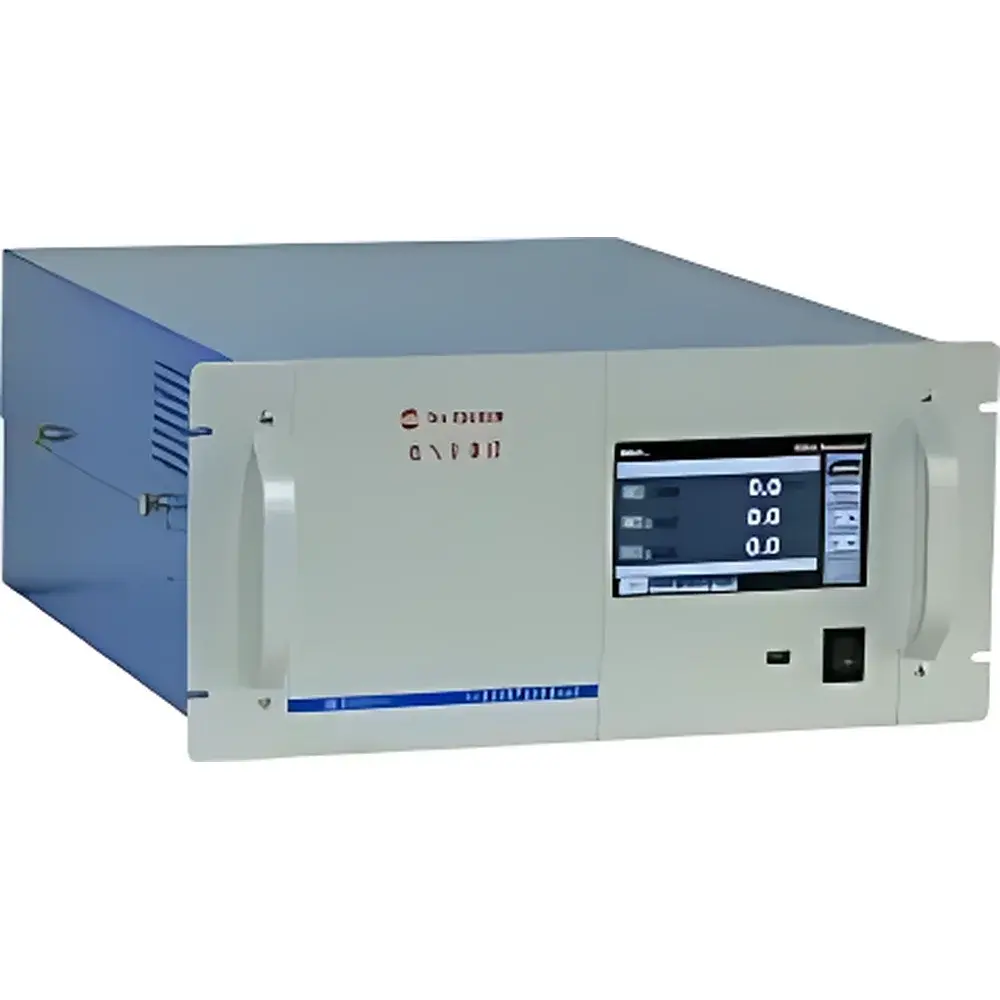
Tianhong TH-2001B Ammonia (NH₃) and Nitrogen Oxides (NOₓ) Dual-Mode Chemiluminescence Analyzer
| Brand | Tianhong |
|---|---|
| Model | TH-2001B |
| Measurement Principle | Chemiluminescence Detection |
| Target Analytes | NH₃, NO, NO₂, NOₓ (via thermal conversion), SO₂, O₃, CO |
| Compliance | Q/WTH 10–2016, GB 3095–2012, HJ 654–2013 |
| Communication Interface | RS-485 |
| System Integration | Standalone or Substation Node in Automatic Air Quality Monitoring Network |
| Operating Mode | Dual-path, time-shared single-channel sampling with software-controlled pneumatic switching |
Overview
The Tianhong TH-2001B is a dual-mode, chemiluminescence-based gas analyzer engineered for continuous, trace-level quantification of ammonia (NH₃) and nitrogen oxides (NOₓ) in ambient air. Its core measurement principle relies on the gas-phase chemiluminescent reaction between nitric oxide (NO) and ozone (O₃), generating light in the near-UV to visible range (peak ~1200 nm), which is detected by a photomultiplier tube (PMT). For NH₃ analysis, the TH-2001B operates in conjunction with the TH-2000H catalytic thermal converter: ambient NH₃ is oxidized to NO at high temperature (~650 °C), and the resulting NO is quantified via the standard chemiluminescence reaction. In standalone mode—without the converter—the instrument functions as a certified NOₓ analyzer per HJ 654–2013, measuring NO directly and NO₂ after molybdenum-converter reduction. Designed as a modular subsystem for regulatory-grade automatic air quality monitoring stations, the TH-2001B delivers high reproducibility, low detection limits (<0.5 ppb for NO), and long-term stability under unattended operation. It conforms to China’s national ambient air quality standards (GB 3095–2012) and technical specifications for gaseous pollutant monitoring systems (HJ 654–2013), supporting compliance with routine environmental reporting and networked data aggregation frameworks.
Key Features
- Dual operational configuration: NH₃ analysis (with TH-2000H thermal converter) and NOₓ analysis (standalone)
- Time-shared, single-channel sampling architecture with software-actuated dual-inlet pneumatic switching—eliminates cross-channel calibration drift and reduces optical/mechanical complexity versus conventional dual-channel designs
- Integrated PMT detector and optimized reaction chamber geometry for enhanced signal-to-noise ratio and reduced ozone consumption
- Modular hardware architecture enabling field-replaceable functional units (ozone generator, converter module, flow control board, PMT assembly)
- Onboard microprocessor with real-time signal processing, automatic zero/span calibration scheduling, and fault diagnostics
- RS-485 serial interface compliant with Modbus RTU protocol for seamless integration into substation-level data acquisition systems
- Embedded non-volatile memory for ≥30 days of 1-minute averaged concentration data, event logs, and calibration history
Sample Compatibility & Compliance
The TH-2001B is validated for use with ambient air matrices across urban, suburban, and rural environments. It accommodates particulate-loaded samples up to 50 µg/m³ PM₁₀ without filter clogging when equipped with standard 2.5 µm inlet particulate filters. Gas-phase interferences from hydrocarbons and VOCs are minimized via selective thermal conversion kinetics and ozone excess optimization. The analyzer meets the performance requirements of HJ 654–2013 for NO₂, SO₂, O₃, and CO co-monitoring—though these parameters are derived from integrated companion analyzers within the same substation (not measured internally by the TH-2001B). All firmware and data handling routines support audit-ready operation under GLP-aligned quality management systems. While not FDA 21 CFR Part 11-certified out-of-the-box, its data logging structure—including timestamped operator actions, calibration events, and system status flags—facilitates validation for regulated environmental monitoring programs requiring traceability.
Software & Data Management
The TH-2001B runs embedded firmware with a dedicated NH₃ analysis interface, accessible via local LCD keypad or remote terminal emulation (VT100). Configuration parameters—including sample flow rate (0.8–1.2 L/min), reaction chamber temperature setpoint, ozone generator output, and switching cycle timing—are programmable and password-protected. Data output includes second-by-second raw PMT counts, 1-, 5-, and 60-minute rolling averages, and diagnostic codes (e.g., low ozone pressure, converter temperature deviation). All records are time-stamped with UTC-synchronized internal clock and exported via RS-485 to substation host controllers using standardized ASCII frame formatting. The device supports automated remote command execution—including forced zero/span, purge initiation, and firmware update triggers—as defined in the national air monitoring network communication protocol (HJ 212–2017). Historical datasets are exportable in CSV format for post-processing in third-party QA/QC tools.
Applications
- Regulatory ambient air quality monitoring networks operated by provincial and municipal ecological environment bureaus
- Industrial fence-line and community air monitoring near ammonia-emitting sources (e.g., fertilizer plants, livestock facilities, wastewater treatment centers)
- Scientific field campaigns investigating atmospheric NH₃–HNO₃–NH₄⁺ aerosol formation pathways
- Calibration verification and intercomparison studies with quantum cascade laser absorption spectrometers (QCLAS) or cavity ring-down spectroscopy (CRDS) systems
- Long-term trend analysis of reactive nitrogen deposition in ecologically sensitive zones (e.g., nature reserves, alpine meadows)
FAQ
Does the TH-2001B measure NH₃ directly, or only indirectly via thermal conversion?
It measures NH₃ indirectly: the TH-2000H thermal converter oxidizes NH₃ to NO, which is then quantified by chemiluminescence. No direct NH₃ optical absorption path is implemented.
Can the TH-2001B operate independently of the TH-2000H converter?
Yes—when disconnected from the converter, it functions as a compliant NO/NO₂/NOₓ analyzer per HJ 654–2013.
What is the minimum detectable NH₃ concentration under typical field conditions?
At 1-hour averaging, the practical lower limit of detection is ≤0.8 ppb (signal-to-noise ratio ≥3), assuming optimal converter efficiency and stable ozone generation.
Is the instrument suitable for indoor or workplace air monitoring?
No—it is designed exclusively for ambient outdoor air monitoring; its flow control, calibration protocols, and interference rejection are optimized for atmospheric dilution conditions, not confined-space occupational exposure assessment.
How is calibration traceability maintained?
Primary calibration uses NIST-traceable NO and NH₃ permeation tubes or dynamic dilution systems certified to ISO/IEC 17025-accredited laboratories; field calibrations follow GB/T 35215–2017 procedures.







