
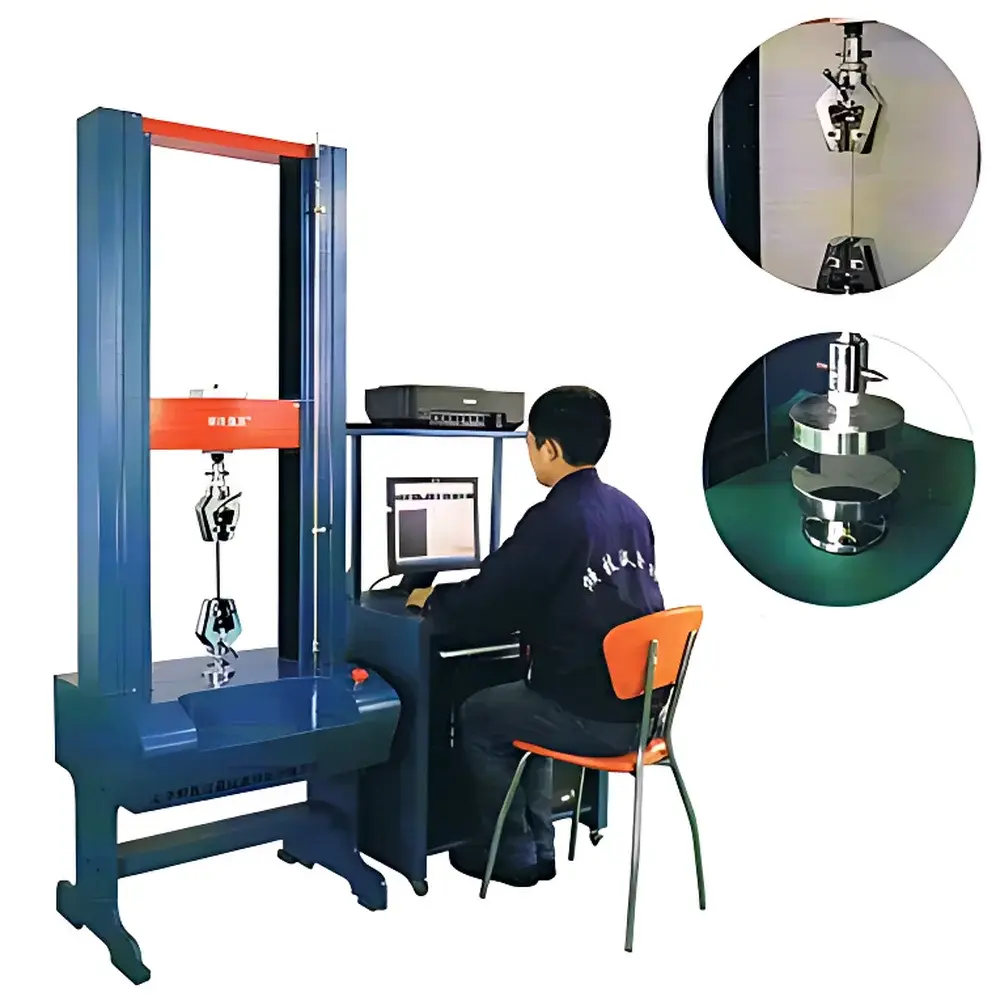
Qinsun QJ2112 Advanced Electronic Tensile Testing Machine for Composite Materials
| [Brand | Qinsun |
|---|---|
| Origin | Shanghai, China |
| Model | QJ2112 |
| Max Test Load | 30 kN |
| Force Measurement Range | 0.2–100% of Full Scale |
| Force Accuracy | ±0.5% of reading |
| Crosshead Travel | 800 mm |
| Displacement Resolution | 500,000 counts at maximum load |
| Test Speed Range | 0.001–500 mm/min |
| Speed Accuracy | ±0.5% of set value |
| Position Accuracy | ±0.5% of reading |
| Strain Measurement Accuracy | ±0.5% of reading |
| Load Cell | High-precision U.S.-sourced sensor |
| Control System | Panasonic full-digital AC servo controller |
| Software | Full-closed-loop digital control system supporting constant stress, constant strain, and constant displacement modes |
| Effective Test Width | 420 mm |
| Dimensions (L×W×H) | 690 × 465 × 1970 mm |
| Weight | 280 kg |
| Power Supply | 220 V, 50 Hz, 750 W] |
Overview
The Qinsun QJ2112 Advanced Electronic Tensile Testing Machine is engineered for high-fidelity mechanical characterization of composite materials and heterogeneous structural specimens under uniaxial loading conditions. Operating on the principle of controlled crosshead displacement and real-time force feedback via precision load cell transduction, the system delivers traceable, repeatable measurements compliant with ASTM D3039 (tensile properties of polymer matrix composites), ISO 527-4/5 (plastics—determination of tensile properties), and GB/T 1040.2 (Chinese national standard for plastics tensile testing). Its modular architecture supports standardized test configurations—including tension, compression, bending, peel (90° and 180°), shear, and adhesion pull-out—enabling laboratories to execute multi-modal mechanical assessments within a single platform. Designed for integration into quality assurance workflows and academic research environments, the QJ2112 meets the functional requirements of GLP-compliant material validation protocols and supports audit-ready data generation.
Key Features
- Full-scale load capacity up to 30 kN, with interchangeable load cells enabling seamless transition across 3 kN, 5 kN, 10 kN, 20 kN, and 30 kN ranges without recalibration
- High-resolution force measurement system with 500,000-count A/D conversion, maintaining consistent resolution across the entire force range—no internal range switching or signal degradation
- Panasonic全数字 AC servo motor drive ensures precise speed control from 0.001 mm/min to 500 mm/min, with velocity accuracy maintained at ±0.5% of setpoint
- Dual-speed manual and automatic crosshead return functionality, including programmable post-test return to origin and emergency electronic limit protection
- Integrated safety architecture: software-based overload detection (auto-shutdown at 110% of rated load), hardware interlocks, and real-time diagnostic monitoring
- Customizable fixture interface compatible with ASTM E8/E21-compliant grips, pneumatic clamps, wedge-action jaws, and specialized tooling for fiber-reinforced laminates, textile yarns, and thin-film substrates
Sample Compatibility & Compliance
The QJ2112 accommodates a broad spectrum of specimen geometries and mechanical behaviors—from brittle carbon-fiber prepregs and ductile thermoplastic matrices to elastomeric sealants and metallic foils. Its 420 mm effective test width and 800 mm vertical travel accommodate ASTM D638 Type I–V dogbone specimens, ISO 527 multipurpose bars, and custom-shaped coupons per aerospace or automotive OEM specifications (e.g., Boeing BMS 7-128, Airbus AITM 1-0003). Force and displacement data meet ISO/IEC 17025 traceability requirements when used with NIST-traceable calibration certificates. The system supports compliance documentation packages aligned with FDA 21 CFR Part 11 for electronic records and signatures, including user access controls, audit trails, and data integrity logs.
Software & Data Management
The embedded digital closed-loop control software provides synchronized acquisition of force, displacement, and strain (when extensometer-equipped) at up to 1 kHz sampling rate. Real-time curve visualization includes dynamic scaling, overlay comparison of multiple tests, differential slope analysis (modulus calculation), yield point detection (0.2% offset method), and fracture energy integration. All raw and processed data are stored in vendor-neutral CSV and XML formats; optional PDF report generation includes test parameters, statistical summaries (mean, SD, CV%), and annotated stress–strain diagrams. The software architecture supports automated batch testing, pass/fail threshold evaluation against specification limits, and direct export to LIMS or ERP systems via ODBC connectivity.
Applications
- Mechanical property validation of carbon-fiber/epoxy laminates, glass-fiber reinforced polymers (GFRP), and hybrid metal–polymer assemblies
- Interlaminar shear strength (ILSS) assessment per ASTM D2344 using short-beam flexure fixtures
- Tensile strength and elongation-at-break evaluation of nanocomposite films and electrospun membranes
- Peel adhesion testing of structural adhesives in aerospace bonding applications (ASTM D1876)
- Compression-after-impact (CAI) residual strength characterization following drop-weight impact per ASTM D7136
- Quality conformance testing of production lots in ISO 9001-certified manufacturing facilities
FAQ
What standards does the QJ2112 support for composite material testing?
The system is configured to execute tests per ASTM D3039, ISO 527-4/5, GB/T 1040.2, and EN 2562, with software templates preloaded for common composite test methods including tensile, flexural, and interlaminar shear protocols.
Can the machine be calibrated to ISO/IEC 17025 requirements?
Yes—Qinsun provides factory calibration certificates traceable to national metrology institutes; third-party accredited calibration services are available upon request with full uncertainty budgets.
Is extensometer integration supported for strain measurement?
The system features analog and digital input channels compatible with contact and non-contact extensometers (e.g., video-based DIC systems), enabling true strain measurement independent of crosshead displacement.
What level of software validation support is provided for regulated industries?
A complete IQ/OQ documentation package is available, including installation verification checklists, operational performance tests, and electronic record audit trail configuration guidance aligned with FDA 21 CFR Part 11 Annex 11 expectations.



