
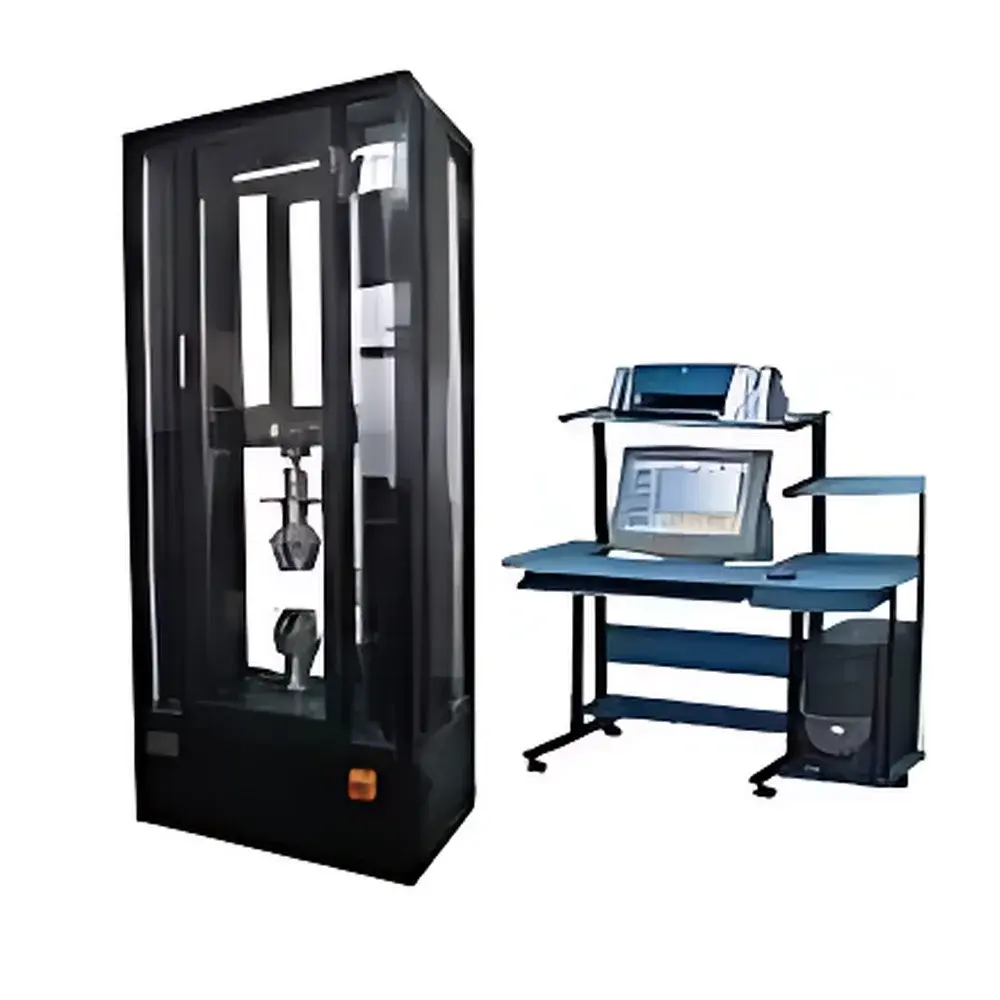
QJ212 Stainless Steel Strip Tensile Testing Machine by Qinsun
| Brand | Qinsun |
|---|---|
| Model | QJ212 |
| Max Load Capacity | 10–300 kN (configurable) |
| Effective Test Width | 540 mm |
| Effective Stroke | 600 / 800 mm |
| Test Speed Range | 0.001–1000 mm/min |
| Speed Accuracy | ±0.5% of indicated value |
| Load Resolution | ±1/250,000 full scale |
| Displacement & Strain Measurement Accuracy | ±0.5% of indicated value |
| Control System | 32-bit ARM microprocessor architecture (56 MIPS) |
| Compliance Standards | GB, ASTM, ISO, DIN, JIS, USP, FDA 21 CFR Part 11-ready software environment |
| Safety Features | Electronic limit protection, overload protection (110% FS), manual/auto return, dual-speed crosshead control |
| Power Supply | 1.5 kW |
| Dimensions (W×D×H) | 1000 × 680 × 2450 mm |
| Weight | 1450 kg |
Overview
The QJ212 Stainless Steel Strip Tensile Testing Machine is a high-precision universal testing system engineered for mechanical property characterization of metallic strips—particularly austenitic and duplex stainless steel grades used in precision manufacturing, automotive trim, medical device components, and flexible electronics substrates. It operates on the principle of servo-controlled electromechanical force application, utilizing closed-loop feedback from load cells, encoder-based displacement transducers, and extensometer-compatible strain measurement channels to deliver traceable, repeatable tensile data in accordance with ISO 6892-1, ASTM E8/E21, and GB/T 228.1. Designed for laboratory and quality control environments, the machine supports both static monotonic loading and quasi-static cyclic protocols—including low-cycle fatigue evaluation—within a single platform.
Key Features
- Modular load frame architecture rated for 10–300 kN maximum capacity, with interchangeable load cells calibrated to ISO 376 Class 0.5 accuracy.
- High-resolution motion control system featuring 0.001–1000 mm/min adjustable crosshead speed, maintaining ±0.5% speed fidelity across the full range via real-time PID tuning.
- 32-bit ARM-based embedded controller delivering 56 MIPS processing throughput, enabling synchronous acquisition of load, displacement, and strain at up to 1 kHz sampling rate.
- Dual-mode crosshead actuation: rapid positioning (up to 500 mm/min) and precision testing speed (0.001–50 mm/min), both programmable with acceleration/deceleration ramping.
- Integrated safety subsystem including electronic end-limit switches, hardware-based overload cutoff (triggered at 110% of selected full-scale load), and emergency stop circuit compliant with IEC 60204-1.
- Multi-language GUI supporting English, German, French, Spanish, Italian, Portuguese, Japanese, Russian, and Simplified Chinese—each with localized unit systems (SI, Imperial, metric ton-force) and standard-specific calculation templates.
Sample Compatibility & Compliance
The QJ212 accommodates flat strip specimens up to 540 mm wide and 800 mm gauge length, with clamping options including pneumatic wedge grips (for smooth or embossed stainless surfaces), hydraulic side-action grips (for high-strength alloys ≥1200 MPa UTS), and custom jaw inserts for thin-gauge foils (<0.1 mm). Specimen alignment is verified per ASTM E1012 to minimize bending moments. Software modules support automatic compliance with ISO 6892-1 Annexes A (tensile testing at ambient temperature), B (testing at elevated temperatures with furnace integration), and C (strain-controlled cyclic tests). All test reports include digital signatures, audit trails, and metadata required for GLP/GMP validation and FDA 21 CFR Part 11 compliance.
Software & Data Management
The proprietary Qinsun TestSuite v5.x software provides a validated, standards-driven environment for test definition, execution, and reporting. It features automated parameter derivation—including Rm (tensile strength), ReH/ReL (upper/lower yield strength), A50 (elongation at break), E (Young’s modulus), n-value (strain hardening exponent), and r-value (plastic strain ratio)—all computed per ISO 10113 and ASTM E646. Raw data is stored in HDF5 format with embedded calibration certificates and environmental metadata (temperature, humidity, operator ID). Export options include PDF/CSV/XML, with configurable report templates aligned to internal QA checklists or third-party certification bodies (e.g., TÜV, SGS, UL).
Applications
- Tensile property verification of cold-rolled AISI 304, 316, and 2205 stainless steel strips for coil-to-coil certification.
- Evaluation of annealing effects on yield point elongation (YPE) and Lüders band propagation in thin-gauge austenitic alloys.
- Interlaboratory round-robin testing for ASTM A666 compliance in cryogenic-grade stainless materials.
- Quality gate testing for supplier-submitted material certifications under IATF 16949 Clause 8.4.2.2.
- Research into strain-rate sensitivity (m-value) of metastable stainless steels using controlled ramp-hold protocols.
FAQ
Does the QJ212 support extensometer integration for true strain measurement?
Yes—the system provides analog and digital (LVDT/TTL) input channels compatible with clip-on, non-contact, and video extensometers meeting ISO 9513 Class 0.5 or better.
Can test methods be locked to prevent unauthorized modification during production QA?
Yes—role-based access control (RBAC) allows administrators to assign read-only, operator, or engineer privileges; method templates can be digitally signed and version-controlled.
Is thermal compensation available for long-duration creep or relaxation tests?
While the base configuration does not include environmental chambers, the controller supports external temperature sensor inputs (PT100/thermocouple) for real-time load correction per ASTM E139 Annex A3.
What documentation is provided for regulatory audits?
A complete validation package is supplied, including IQ/OQ protocols, traceable calibration certificates (NIST-traceable load cell & encoder), software verification reports, and 21 CFR Part 11 implementation evidence.
How is mechanical alignment verified after installation?
A certified field service technician performs verticality and parallelism checks per ISO 20412 using optical alignment tools; a certificate of mechanical verification is issued upon commissioning.



