
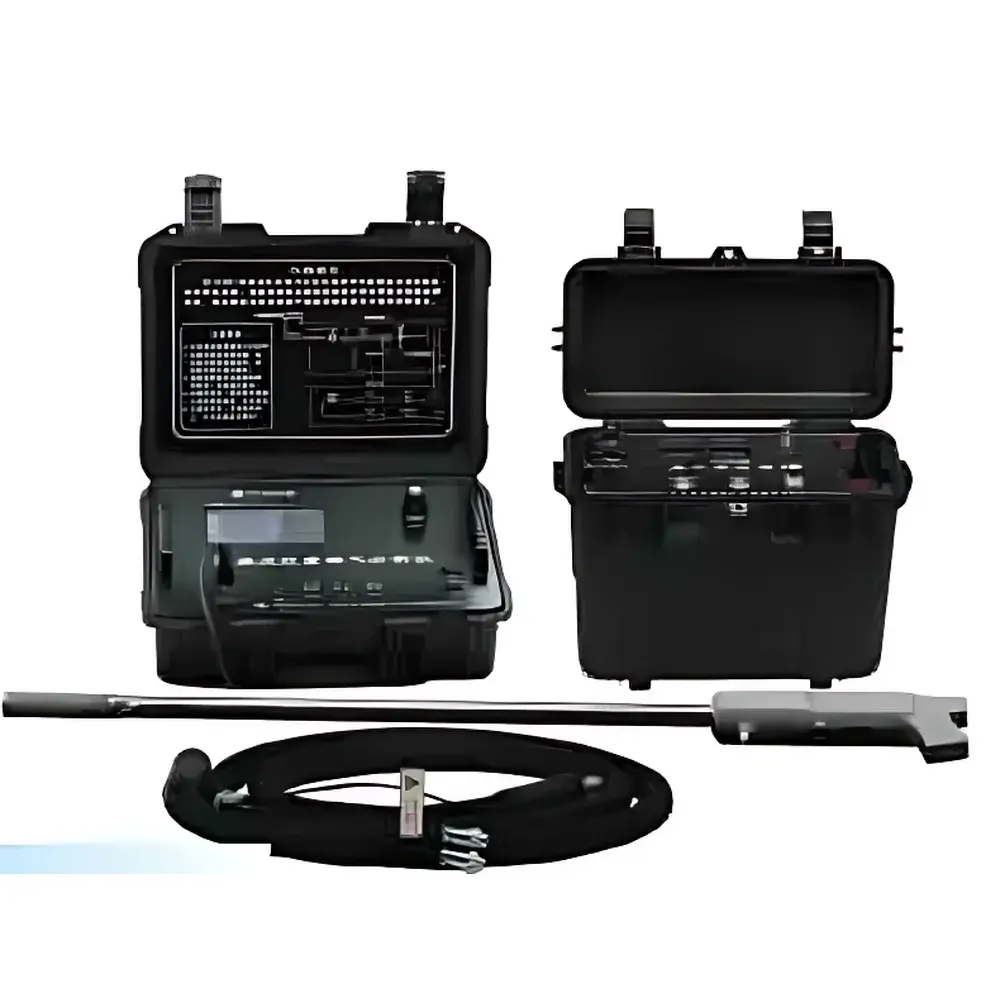
Tianhong TH-890D UV Differential Optical Absorption Spectroscopy (DOAS) Flue Gas Analyzer
| Brand | Tianhong |
|---|---|
| Model | TH-890D |
| Origin | Hubei, China |
| Category | Flue Gas Heavy Metal & Multi-Component Gas Analyzer |
| Measurement Principle | UV Differential Optical Absorption Spectroscopy (UV-DOAS) |
| Measured Gases | SO₂, NOₓ (NO/NO₂), NH₃, O₂, CO, CO₂ (configurable) |
| Operating Temperature Range | −20 °C to 50 °C (electronics) |
| Sample Gas Temp. Tolerance | up to 500 °C |
| Operating Pressure Range | 0–2000 kPa |
| Display | 7-inch TFT LCD with touch interface |
| Data Storage | 3000 measurement records |
| Power Supply | AC 220 V ±10% / 50 Hz or external portable DC power |
| Environmental Humidity | 0–90% RH (non-condensing) |
| Compliance | Meets HJ/T 76–2017, HJ 1045–2019, and GB/T 37186–2018 requirements for flue gas CEMS verification |
Overview
The Tianhong TH-890D UV Differential Optical Absorption Spectroscopy (DOAS) Flue Gas Analyzer is a field-deployable, multi-component emission monitoring instrument engineered for continuous or spot measurement of gaseous pollutants in industrial flue gas streams. It operates on the physical principle of ultraviolet differential optical absorption spectroscopy — a non-dispersive, in-situ optical technique that exploits the unique electronic transition absorption bands of target molecules (e.g., SO₂ at ~280–320 nm, NO at ~200–230 nm, NO₂ at ~350–450 nm, NH₃ at ~200–220 nm) within the deep UV to near-UV spectral range. By acquiring high-resolution absorption spectra across defined wavelength intervals and applying least-squares fitting algorithms against reference cross-sections, the analyzer quantifies trace gas concentrations with high selectivity and minimal cross-interference. Designed for compliance-grade stack testing and process optimization, the TH-890D supports both extractive sampling (with heated probe and conditioning system) and direct optical path configurations, enabling reliable operation under harsh thermal and pressure conditions (up to 500 °C sample gas temperature and 2000 kPa total system pressure).
Key Features
- UV-DOAS core engine with dual-beam optical path design for enhanced signal stability and drift compensation
- Configurable multi-gas detection: Standard support for SO₂, NOₓ (NO + NO₂), NH₃; optional expansion to O₂ (electrochemical or paramagnetic), CO (NDIR), and CO₂ (NDIR)
- Integrated environmental parameter acquisition: High-accuracy Pt100 temperature sensor and calibrated piezoresistive pressure transducer for real-time flue gas condition correction
- Optional pitot tube module for automated stack velocity, static pressure, and dynamic pressure calculation per ISO 9096 and EPA Method 1/2
- Ruggedized mechanical architecture: Shock-absorbing chassis, IP54-rated enclosure, and reinforced optical bench for transport resilience and field durability
- 7-inch capacitive touchscreen interface with intuitive menu navigation, multilingual UI support (English default), and context-sensitive help prompts
- Onboard data management: Timestamped storage of 3000 complete measurement sets (including gas concentrations, T/P/V values, calibration logs, and user annotations)
- Embedded real-time clock (RTC) with battery backup ensures traceable timestamping compliant with EN 15267 and US EPA PS-11 audit requirements
- Software-based calibration: Zero/span adjustment, spectral baseline correction, and cross-sensitivity coefficient tuning via USB or Wi-Fi-connected PC utility
- Dual-power operation: Compatible with standard 220 V AC supply or external 24 V DC portable battery packs for extended off-grid deployment
Sample Compatibility & Compliance
The TH-890D accommodates a wide range of flue gas matrices from coal-fired boilers, waste incinerators, cement kilns, and chemical process heaters. Its heated sampling train (optional) maintains sample line temperature above dew point to prevent condensation-induced analyte loss or corrosion. The analyzer meets key regulatory specifications including China’s HJ/T 76–2017 (Technical Specification for Continuous Emission Monitoring Systems for Flue Gas), HJ 1045–2019 (Technical Guideline for Calibration of UV-DOAS Gas Analyzers), and GB/T 37186–2018 (Performance Requirements for Online Monitoring Instruments of Gaseous Pollutants). While not certified to EU MCERTS or US EPA PS-15 out-of-the-box, its optical architecture and data handling protocols are fully compatible with third-party validation procedures required for CEMS certification under ISO/IEC 17025-accredited laboratories.
Software & Data Management
The TH-890D runs embedded Linux firmware with deterministic real-time task scheduling. Data output conforms to Modbus RTU/TCP and optional OPC UA protocols for integration into SCADA or DCS environments. Internal memory retains full spectral raw data (absorbance vs. wavelength) alongside processed concentration results, enabling post-hoc reanalysis and method validation. Export formats include CSV and XML, supporting import into LIMS platforms compliant with GLP and 21 CFR Part 11 (when paired with validated external software and audit-trail-enabled user authentication). Firmware updates are performed via signed package installation over USB or secure HTTPS, preserving configuration integrity and cryptographic signature verification.
Applications
- Regulatory stack testing per local environmental protection bureau mandates
- Real-time combustion efficiency assessment via simultaneous O₂, CO, and CO₂ measurement
- Ammonia slip monitoring in SNCR/SCR denitrification systems
- SO₂ and NOₓ emission factor derivation for carbon accounting and reporting (e.g., GHG Protocol, ISO 14064)
- Troubleshooting abnormal flue gas composition during startup, shutdown, or load transitions
- Method development and reference analysis in metrology labs supporting CEMS verification
- Mobile source emissions screening for temporary installations or emergency response scenarios
FAQ
Does the TH-890D require daily zero/span calibration?
No — the instrument employs stable UV LED sources and thermally compensated detectors, enabling calibration intervals of 7–14 days under routine operation. However, pre-test verification using certified span gases is recommended per HJ/T 76–2017.
Can it measure particulate-bound heavy metals?
Not directly — the TH-890D is a gas-phase analyzer. For atmospheric heavy metal speciation (e.g., Pb, Cd, As), a complementary ICP-MS or XRF-based online aerosol monitor (e.g., TH-920 series) must be deployed upstream with integrated filter collection and thermal desorption.
Is remote diagnostics supported?
Yes — via optional Ethernet/Wi-Fi module, enabling secure SSH access, live spectrum viewing, and firmware update push by authorized service engineers.
What is the minimum detectable concentration for SO₂?
Based on typical optical path length (1.2 m) and detector SNR, the practical LOD is ≤2 mg/m³ (≈0.7 ppm) at standard temperature and pressure, consistent with Class I performance per HJ 1045–2019.
How is moisture interference mitigated in humid flue gas?
The system includes a Nafion™-based permeation dryer (optional accessory) and applies water vapor cross-section subtraction during spectral fitting, minimizing H₂O-related baseline distortion in the UV region.
Related Products







