
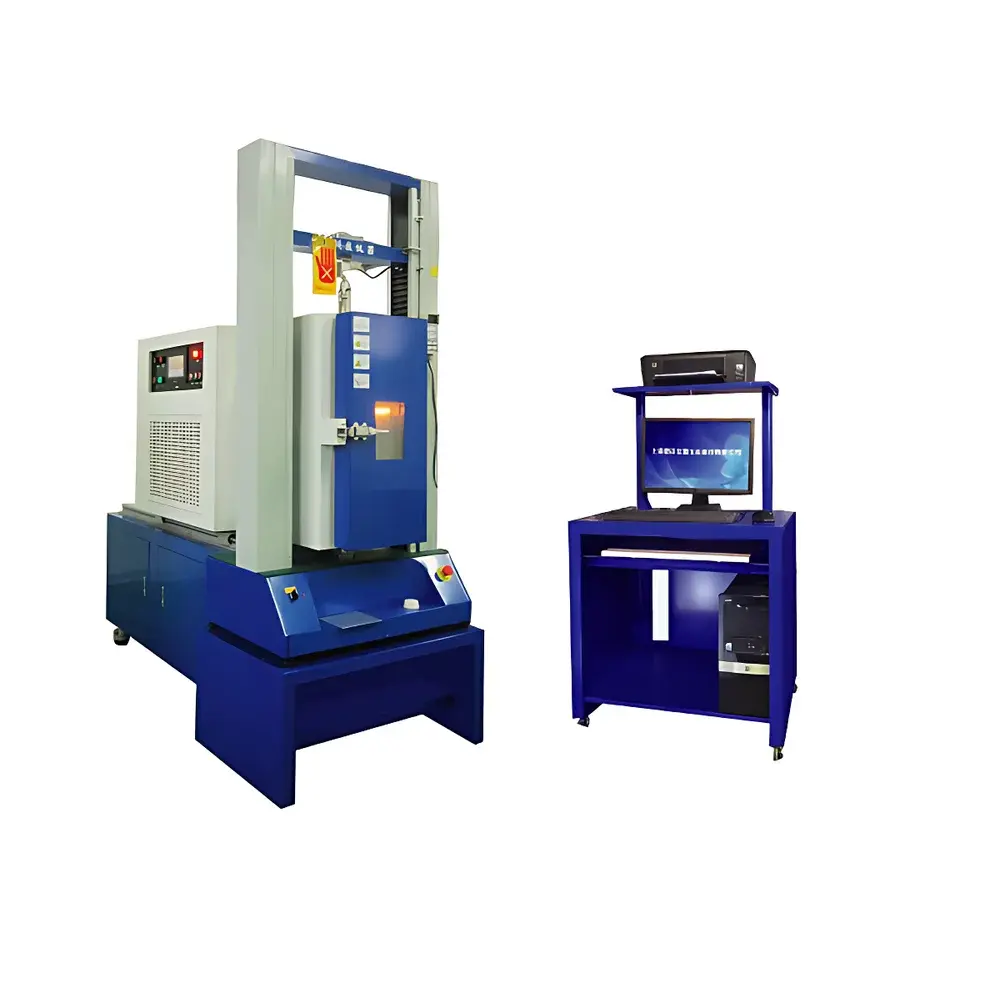
QJ211B Low-Temperature Tensile Testing System with Integrated Environmental Chamber
| Origin | Shanghai, China |
|---|---|
| Manufacturer Type | Authorized Distributor |
| Country of Origin | China |
| Model | QJ211B |
| Instrument Type | Electromechanical Tensile Testing Machine |
| Maximum Test Load | 30 kN |
| Load Range | 0–30 kN (fully adjustable) |
| Load Accuracy | < ±1% FS or < ±0.5% FS (selectable) |
| Crosshead Travel | 420 mm |
| Displacement Resolution | ±0.5% of reading |
| Temperature Range | –7 °C to +350 °C (isothermal hold at 350 °C) |
| Heating/Cooling Rate | ≥5 °C/min |
| Temperature Controller Resolution | 0.1 °C |
| Test Speed Range | 0.01–500 mm/min (optional extension to 1000 mm/min) |
| Speed Accuracy | ±0.5% |
| Strain Measurement Accuracy | ±0.5% |
| Safety Features | Electronic end-limit protection, emergency stop button |
| Machine Weight | 265 kg |
| Effective Width | 420 mm |
| Effective Test Height | ~800 mm (extendable) |
Overview
The QJ211B Low-Temperature Tensile Testing System is an electromechanical universal testing platform engineered for high-fidelity mechanical property characterization of solid materials under controlled thermal environments. It integrates a precision servo-driven tensile frame with a fully enclosed, actively temperature-regulated environmental chamber—enabling static and quasi-static uniaxial testing across a broad thermal spectrum from sub-zero conditions (–7 °C) up to sustained isothermal exposure at 350 °C. The system operates on the fundamental principle of force-displacement transduction using calibrated load cells and high-resolution linear encoders, compliant with ISO 7500-1 (Class 0.5 or Class 1), ASTM E4, and GB/T 228.1 for metallic and polymeric material testing. Its modular architecture allows rapid reconfiguration: the environmental chamber can be mechanically decoupled for ambient-temperature applications, increasing workspace flexibility and supporting auxiliary test fixtures (e.g., peel, shear, bend, puncture).
Key Features
- Integrated dual-mode thermal chamber with independent heating/cooling circuits, achieving ramp rates ≥5 °C/min and stable isothermal control at ±0.5 °C over full range (–7 °C to 350 °C).
- High-stiffness, four-column load frame with 30 kN rated capacity and optional overload protection up to 150% FS.
- Load measurement via precision S-type or cantilever load cell with 0.01% linearity and repeatability, traceable to national metrological standards.
- Displacement and strain acquisition with ±0.5% accuracy per ISO 9513, supported by encoder-based crosshead positioning and optional extensometer integration (contact or non-contact).
- Dual-control interface: Windows-based PC software for full test sequence programming, real-time data logging, and post-processing; supplemented by standalone digital panel for manual operation and quick verification.
- Comprehensive safety architecture including hardware-based emergency stop, programmable software limits, mechanical end-stop switches, and automatic load-cell zero-check before each test.
- Expandable test envelope: standard effective height ~800 mm (adjustable upward); 420 mm clear width accommodates standardized grips, environmental adapters, and custom jigs.
Sample Compatibility & Compliance
The QJ211B supports specimens conforming to ISO 527, ASTM D638, ASTM D882, GB/T 1040, ISO 178, and JIS K7113 geometries—including dog-bone, rectangular, film, fiber, and composite coupons (up to 25 mm thick). Grip systems include pneumatic, wedge, and hydraulic options with surface treatments optimized for metallic, elastomeric, thermoplastic, and brittle ceramic substrates. All firmware and control logic comply with IEC 61508 functional safety guidelines. Data integrity meets GLP/GMP requirements through audit-trail-enabled software (optional 21 CFR Part 11 compliance package available), and calibration records adhere to ISO/IEC 17025 documentation protocols.
Software & Data Management
The embedded test control software provides ISO 17025-aligned data acquisition at up to 100 Hz sampling rate, with synchronized thermal and mechanical parameter logging (load, displacement, temperature, time, strain). Users define multi-step test profiles—including preload, dwell, ramp, hold, and cyclic segments—with conditional triggers (e.g., “hold at 10 kN until temperature stabilizes at –20 °C”). Raw data exports in CSV, Excel, and universal .tdms formats; stress–strain curves auto-generate modulus (Young’s, secant), yield point (0.2% offset), ultimate tensile strength, elongation at break, and toughness integrals. Calibration certificates, user permissions, and version-controlled method files are stored locally with SHA-256 hashing for tamper evidence.
Applications
- Low-temperature ductility assessment of aerospace alloys (e.g., Ti-6Al-4V, Inconel 718) below –20 °C.
- Thermal transition analysis of polymer blends during glass transition (Tg) and cold crystallization events.
- Creep and stress-relaxation behavior of elastomers and thermosets under isothermal holds at elevated temperatures.
- Adhesive bond strength evaluation (peel, lap-shear) across service-relevant thermal gradients.
- Quality control validation of medical device polymers (e.g., PEEK, PEKK) per ISO 10993-12 and USP biocompatibility screening protocols.
- Material qualification for automotive under-hood components exposed to thermal cycling between –40 °C and +150 °C.
FAQ
Does the QJ211B support ASTM D638 Type I specimen testing at –40 °C?
No—the integrated chamber’s lower limit is –7 °C. For sub-zero testing down to –40 °C or lower, a cryogenic chamber upgrade (liquid nitrogen-cooled) is required and available as an OEM option.
Can test data be exported directly to LIMS or ERP systems?
Yes—via configurable ODBC drivers and RESTful API endpoints included in the Advanced Data Integration module.
Is third-party calibration certification provided with delivery?
Yes—a full NIST-traceable calibration certificate covering load, displacement, and temperature channels is supplied prior to shipment.
What is the recommended maintenance interval for the load cell and drive system?
Biannual verification of load cell linearity and encoder resolution is advised; annual mechanical inspection of ball screws, belts, and grip actuation mechanisms is specified in the operator manual.
Are ISO 17025-compliant uncertainty budgets available for this system?
Yes—upon request, a detailed measurement uncertainty analysis (MUA) report aligned with GUM (JCGM 100:2008) is provided, covering combined standard uncertainty for force, displacement, and temperature measurements.



