
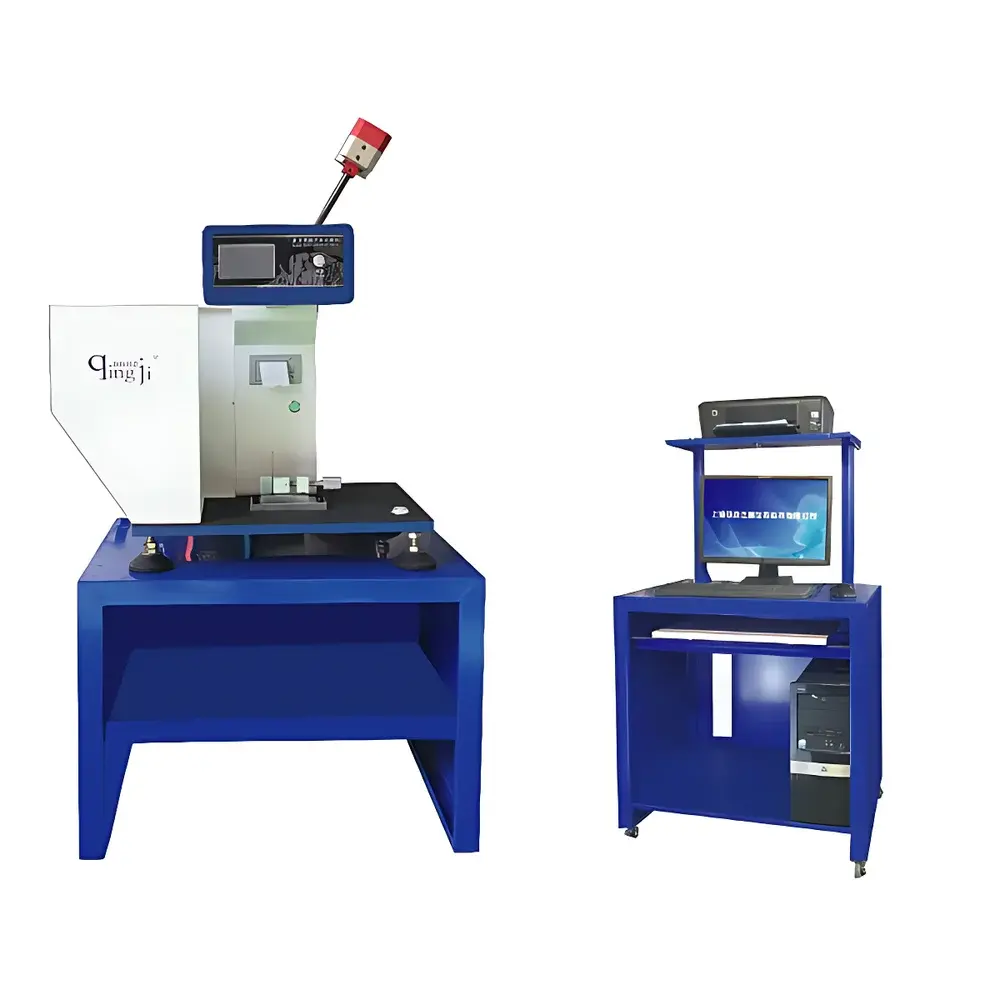
Qingji QJBCX Cantilever Beam Impact Tester for Electrical Insulating Materials
| Brand | Qingji |
|---|---|
| Origin | Shanghai, China |
| Manufacturer Type | Authorized Distributor |
| Origin Category | Domestic (China) |
| Model | QJBCX |
| Price | USD 2,800 (FOB Shanghai) |
| Impact Velocity | 3.5 m/s |
| Impact Energies | 1 J, 2.75 J, 5.5 J, 11 J, 22 J, 50 J |
| Energy Resolution | 0.001 kJ/m² |
| Pendulum Pre-lift Angle | 150° |
| Distance from Pivot to Impact Center | 322 mm |
| Impact Blade Radius | R 0.8 mm |
| Dimensions (W×D×H) | 550 mm × 300 mm × 900 mm |
| Power Supply | 220 V ±10%, 50 Hz |
| Net Weight | ~85 kg |
Overview
The Qingji QJBCX Cantilever Beam Impact Tester is a precision mechanical testing instrument engineered for the quantitative determination of impact toughness in rigid non-metallic electrical insulating materials—including thermoset and thermoplastic polymers, fiber-reinforced composites (e.g., glass-reinforced nylon), ceramic substrates, cast stone, and high-voltage insulating ceramics. It operates on the standardized cantilever beam principle defined in ISO 180 and GB/T 1843, where a notched specimen is clamped at one end and struck by a calibrated pendulum impacting the free end. The energy absorbed during fracture—expressed as impact strength in kJ/m²—is calculated from the difference between the pendulum’s initial potential energy and its residual energy post-impact. This method provides critical data for material qualification in high-reliability applications such as insulator housings, busbar supports, transformer bushings, and semiconductor packaging substrates, where resistance to sudden mechanical stress under electric field conditions must be rigorously verified.
Key Features
- Modular pendulum system with six selectable impact energy levels (1 J to 50 J), enabling precise matching to material stiffness and thickness per ISO 180 Annex A and GB/T 1843 Clause 6.
- High-stiffness cast-iron base and rigid column structure ensure minimal frame deflection (<0.02 mm under full 50 J impact), preserving measurement integrity across repeated tests.
- Optimized impact blade geometry with certified R 0.8 mm radius complies with ISO 180:2019 Clause 5.3.2 and GB/T 1843–2008 Section 4.3, minimizing notch root stress concentration artifacts.
- Digital angular encoder (0.01° resolution) tracks pendulum swing trajectory, supporting traceable energy calculation per ASTM D256 calibration protocols.
- Standardized specimen fixture with adjustable clamping force (2–5 kN) ensures consistent notch alignment and eliminates slippage during high-energy impacts.
- Integrated safety guard interlock system halts pendulum release unless the transparent polycarbonate shield is fully closed and latched—meeting EN ISO 13857 mechanical safety requirements.
Sample Compatibility & Compliance
The QJBCX accommodates standard ISO 180 Type 1A (80 × 10 × 4 mm) and GB/T 1843 rectangular specimens, including those with machined U- or V-notches per ISO 2818. It is validated for use with Class Y, A, E, B, F, H, and C electrical insulation materials per IEC 60216 and GB/T 11021. Test reports generated comply with GLP documentation standards and support audit readiness for ISO/IEC 17025-accredited laboratories. The instrument satisfies mandatory requirements of GB/T 2611 (General Requirements for Testing Machines) and JB/T 8761 (Impact Testing Machines — Technical Conditions), and its mechanical design conforms to CE machinery directive 2006/42/EC when used with appropriate local power conditioning.
Software & Data Management
While the base QJBCX operates via analog pointer scale and manual energy readout, optional digital upgrade kits integrate RS-232 or USB-to-serial interfaces for direct data logging into PC-based test management software. Exported datasets include impact energy (J), calculated impact strength (kJ/m²), specimen dimensions, notch type, and operator ID—structured to align with LIMS ingestion protocols. Audit trails record timestamped calibration events, energy verification checks (per ISO 17025 Clause 6.5), and user access logs. For regulated environments, optional 21 CFR Part 11-compliant software modules provide electronic signatures, role-based permissions, and immutable data archiving—supporting FDA-regulated polymer component validation in medical device and nuclear-grade insulator manufacturing.
Applications
- Quality control of epoxy-molded insulators and silicone rubber housing materials in photovoltaic junction boxes and EV charging infrastructure.
- R&D evaluation of ceramic matrix composites (CMCs) for high-voltage switchgear arc chutes and plasma containment components.
- Comparative assessment of aging effects (thermal, UV, humidity) on polyimide films and PEEK insulating tapes per IEC 60277-2.
- Third-party certification testing for UL 746C (Polymeric Materials – Industrial Applications) and GB 4943.1 (IT Equipment Safety) compliance.
- Failure analysis of brittle fracture in alumina substrates used in high-frequency RF modules and power electronics packages.
- Teaching laboratory implementation for mechanical property modules in materials science curricula aligned with ABET EC2020 student outcome criteria.
FAQ
What standards does the QJBCX explicitly support for electrical insulating materials?
It is fully compliant with GB/T 1843, ISO 180, GB/T 2611, and JB/T 8761. For insulating ceramics, it supports test execution per GB/T 775.3 and IEC 60672-3 for impact strength characterization.
Can the QJBCX be used for both unnotched and notched specimens?
Yes—the fixture accepts both ISO 180 Type 1A notched specimens and unnotched variants per ISO 180 Annex B, though notched configurations are required for comparative toughness ranking of insulating polymers.
Is calibration certification included with shipment?
Each unit ships with a factory calibration certificate traceable to NIM (National Institute of Metrology, China) for pendulum energy and angle measurement, valid for 12 months under normal operating conditions.
What maintenance intervals are recommended for long-term accuracy?
Biannual verification of pendulum bearing friction, blade radius wear (using optical profilometry), and clamping force consistency is advised; Qingji provides NIST-traceable calibration kits and OEM spare parts (blades, anvils, clamps) with documented shelf life.
Does the instrument meet international shipping and customs classification requirements?
Yes—it is classified under HS Code 9024.80 (Testing machines for physical properties of materials) and includes CE-conformity documentation, RoHS-compliant materials declaration, and bilingual (English/Chinese) operation manuals compliant with ISO/IEC Guide 104.



