
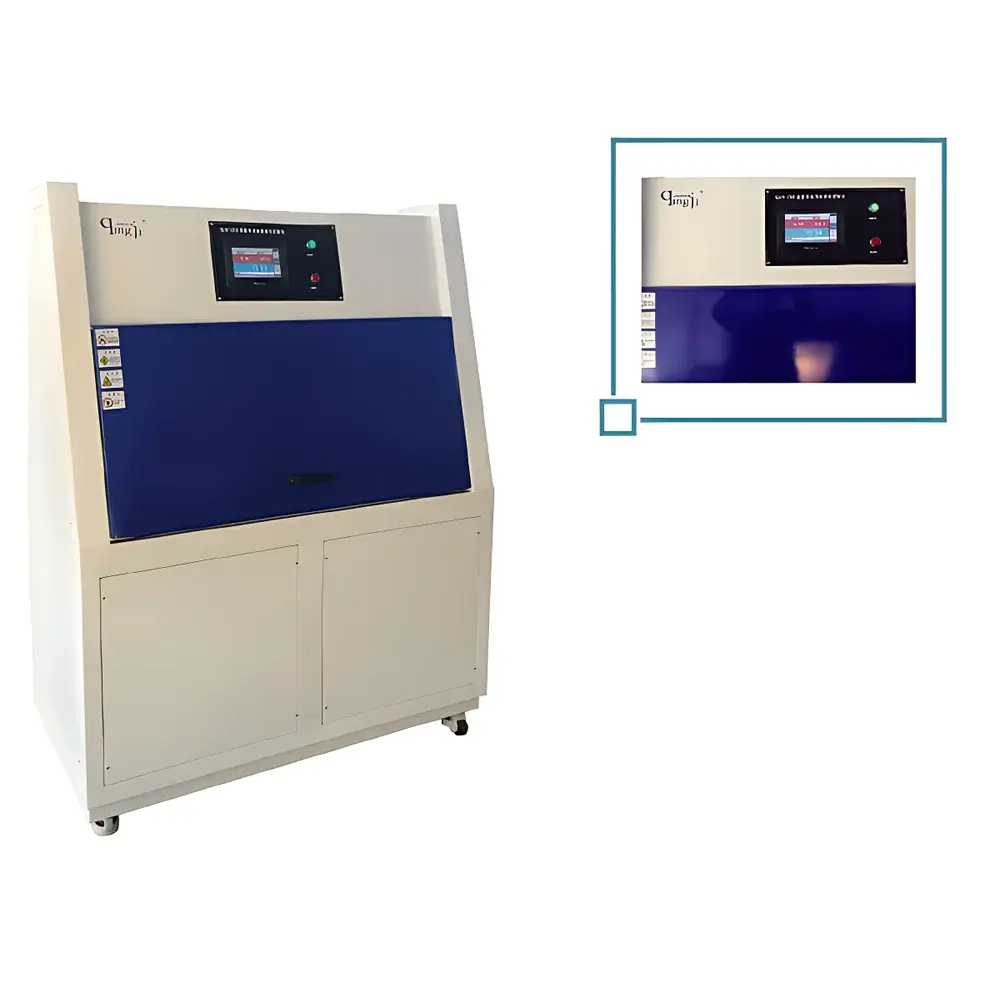
Q-Lab QUV1003 UV Aging Test Chamber
| Key Features | UV-B irradiation (280–315 nm) |
|---|---|
| Irradiance control | 0.72 W/m² @ 313 nm |
| Lamp power | 25 W per tube |
| Test chamber volume | 450 × 1165 × 500 mm (L×W×H) |
| Black panel temperature range | RT+10°C to 70°C |
| Cabinet temperature range (light phase) | RT+10°C to 70°C |
| Humidity during condensation phase | ≥75% RH |
| Cycle options | 4 h UV + 4 h condensation OR 8 h UV + 4 h condensation |
| Specimen-to-lamp distance | 55 mm |
| Lamp center spacing | 65–70 mm |
| Standard specimen size | 75 × 150 mm |
| Water consumption | ~8 L/day (deionized or distilled water required) |
| Compliance | GB/T 14522–1993 |
Overview
The Q-Lab QUV1003 UV Aging Test Chamber is an engineered solution for accelerated weathering evaluation of polymeric, coating, and elastomeric materials under controlled ultraviolet radiation, thermal stress, and moisture exposure. Based on the fundamental principle of photochemical degradation—where UV-B photons (280–315 nm) induce bond scission, oxidation, and crosslinking in organic matrices—the QUV1003 replicates critical outdoor aging drivers: solar UV intensity, thermal cycling, and dew-driven condensation. Unlike broad-spectrum xenon arc chambers, this unit employs fluorescent UV-B lamps calibrated to deliver reproducible irradiance at 0.72 W/m² (measured at 313 nm), enabling standardized comparative testing aligned with national and industrial protocols. Its design prioritizes test repeatability and operational robustness in QC laboratories, R&D facilities, and third-party certification labs conducting long-term durability assessments.
Key Features
- UV-B spectral output (280–315 nm) optimized for accelerated polymer degradation kinetics, consistent with GB/T 14522–1993 requirements
- Precisely regulated black panel temperature control (RT+10°C to 70°C) with ±3°C uniformity, ensuring accurate surface thermal loading during irradiation
- Dual-cycle programmability: configurable sequences of 4 h UV exposure + 4 h condensation or 8 h UV + 4 h condensation to simulate diverse climatic regimes
- Condensation humidity maintained at ≥75% RH via controlled water jacket heating—no external humidifier required
- Optimized optical geometry: 55 mm specimen-to-lamp distance and 65–70 mm lamp center spacing ensure uniform irradiance distribution across standard 75 × 150 mm test specimens
- Stainless-steel interior chamber (450 × 1165 × 500 mm L×W×H) resistant to UV-induced corrosion and thermal fatigue
- Integrated safety interlocks, overtemperature protection, and lamp end-of-life monitoring for unattended operation
Sample Compatibility & Compliance
The QUV1003 accommodates flat-panel specimens up to 75 × 150 mm and supports multi-position sample racks for parallel evaluation of comparative formulations. It is validated for use with plastics, automotive coatings, architectural sealants, rubber compounds, and photovoltaic encapsulants. The system meets the technical requirements of GB/T 14522–1993 (“Accelerated Weathering Test Methods for Plastics, Paints, and Rubber Used in Mechanical Industry Products”) and serves as a foundational tool for pre-compliance screening prior to outdoor exposure per ISO 4892-3 or ASTM G154. While not certified to IEC 60068-2-5 or MIL-STD-810G by default, its operational parameters are fully traceable to NIST-traceable UV radiometers and calibrated thermocouples, supporting GLP-aligned documentation workflows.
Software & Data Management
The QUV1003 operates via an intuitive front-panel controller with real-time display of irradiance, black panel temperature, cabinet temperature, and cycle phase status. All setpoints and runtime logs are stored internally with timestamped records (retention: 30 days). For integration into regulated environments, optional RS-485/Modbus RTU interface enables connection to SCADA or LIMS platforms. When paired with Q-Lab’s optional QUV Data Logger (sold separately), users achieve full 21 CFR Part 11–compliant audit trails—including user authentication, electronic signatures, and immutable event logging—supporting FDA-regulated material qualification in medical device or pharmaceutical packaging development.
Applications
- Evaluation of UV resistance in automotive clearcoats and interior trim materials under cyclic irradiation and condensation
- Comparative ranking of stabilizer packages in polyolefin films used for agricultural mulch or geomembranes
- Pre-screening of photovoltaic module encapsulant yellowing and adhesion loss under damp heat + UV stress
- Correlation studies between QUV exposure hours and natural field exposure in subtropical climates (e.g., Florida or Guangdong)
- Quality assurance of powder-coated aluminum extrusions for architectural façades per AAMA 2604
- Supporting ISO 11341 (paints and varnishes) and ISO 11507 (plastics) test method execution
FAQ
What UV spectrum does the QUV1003 emit, and how is it calibrated?
The chamber uses fluorescent UV-B lamps emitting predominantly between 280–315 nm. Irradiance is calibrated to 0.72 W/m² at 313 nm using a NIST-traceable UV radiometer; recalibration is recommended annually.
Is distilled water mandatory for condensation operation?
Yes—deionized or distilled water must be used to prevent mineral deposition on the condensation water jacket and specimen surfaces, which would otherwise compromise irradiance uniformity and test validity.
Can the QUV1003 meet ASTM G154 Cycle 1 or Cycle 4 specifications?
Yes—its 4 h UV / 4 h condensation mode aligns with ASTM G154 Cycle 1; the 8 h UV / 4 h condensation mode approximates extended daylight exposure scenarios common in tropical durability testing.
What maintenance intervals are recommended for routine operation?
UV lamps require replacement every 1,600–2,000 hours of operation; stainless-steel chamber surfaces should be wiped with ethanol biweekly; water reservoir must be refilled daily and cleaned weekly to inhibit biofilm formation.
Does the unit support remote monitoring or data export?
Standard configuration includes local display only; optional QUV Data Logger adds USB data export, CSV reporting, and 21 CFR Part 11–compliant electronic record generation.



