
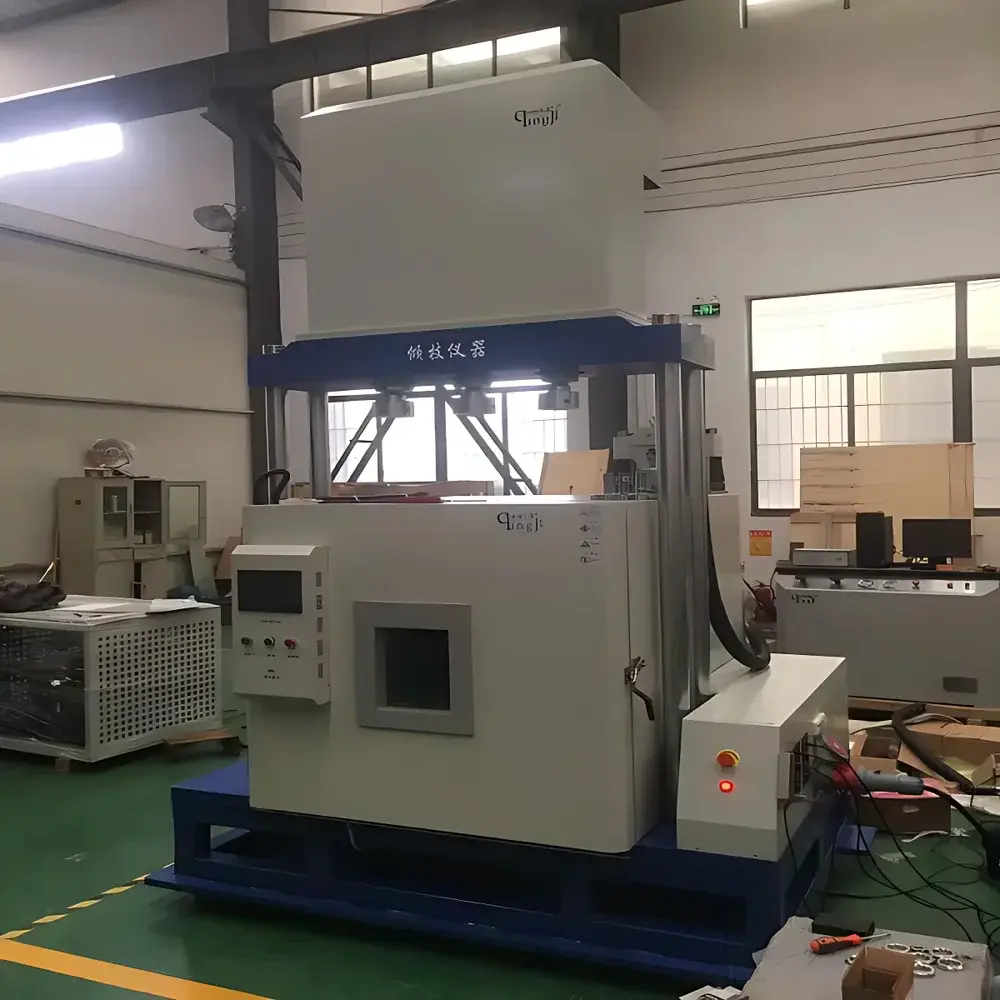
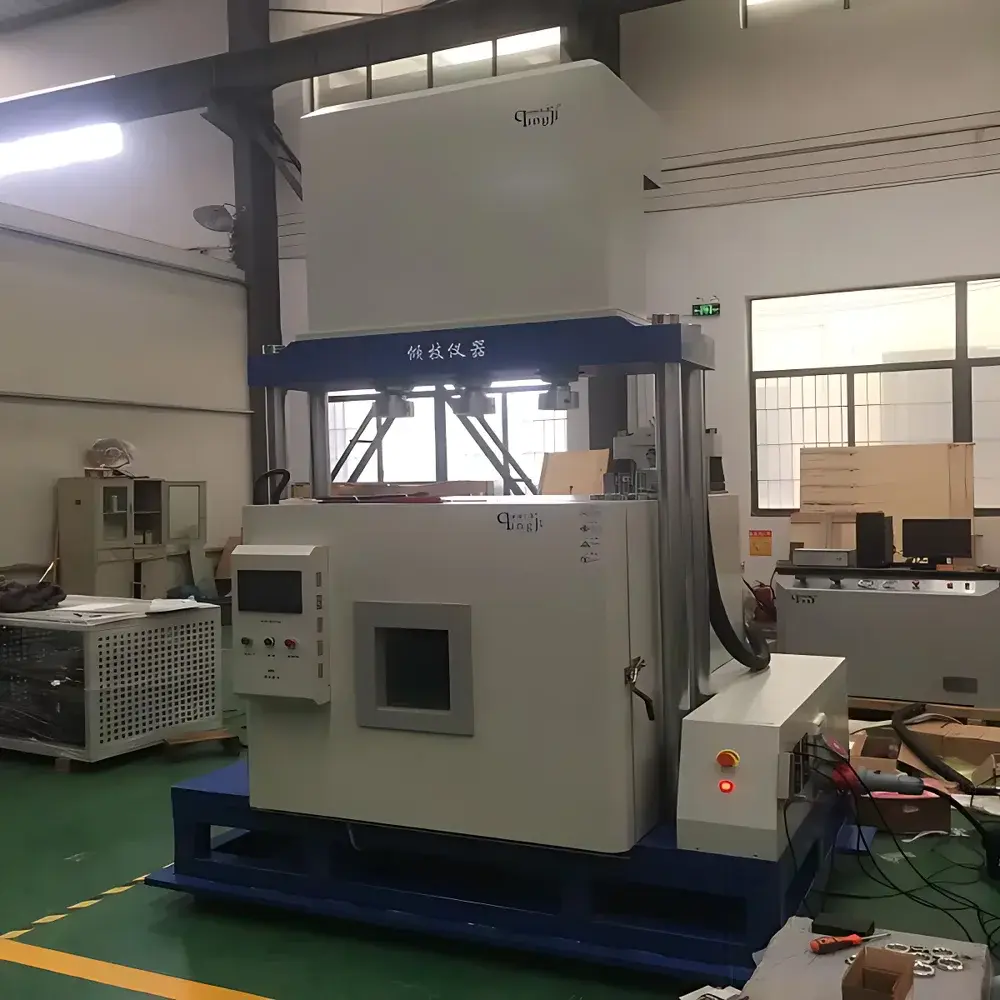
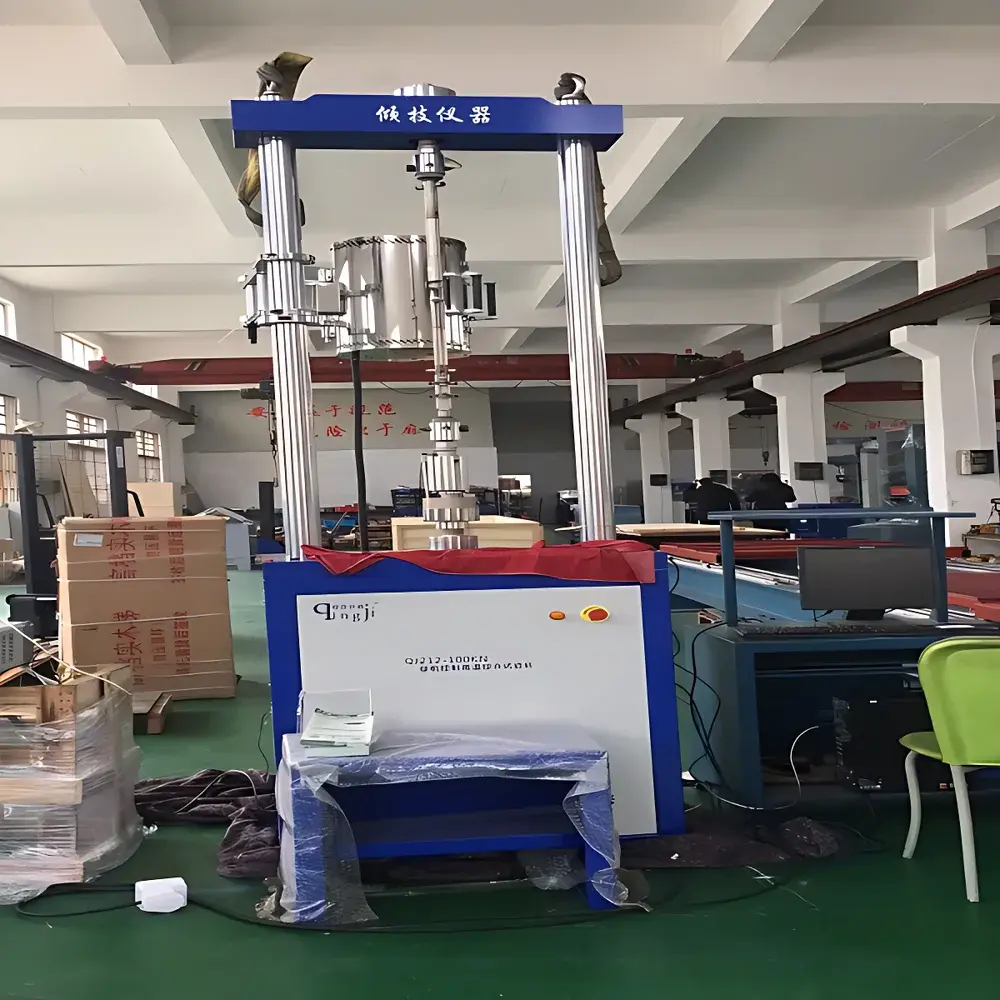
Qinji QJBV-212F Multi-Station High-Temperature Creep and Stress Relaxation Testing Machine
| Brand | Qinji |
|---|---|
| Origin | Shanghai, China |
| Model | QJBV-212F |
| Maximum Test Load | 100 kN |
| Crosshead Travel | 200 mm |
| Furnace Chamber Diameter | φ50 mm |
| Furnace Length | 450 mm |
| Host Weight | 850 kg |
| Temperature Range | Ambient to 1200 °C |
| Temperature Control Accuracy | ±0.5 °C |
| Temperature Resolution | 0.1 °C |
| Constant-Temperature Zone Length | >150 mm |
| Load Control Accuracy | ±1% of set value |
| Load Resolution | 0.1 N |
| Deformation Measurement Error | ±0.5% of reading |
| Deformation Range Options | up to 25 mm |
| Load Measurement Accuracy | ±0.5% of reading (from 1% FS) |
| Crosshead Speed Range | 0.01–180 mm/min |
| Power Consumption | 3 kW |
Overview
The Qinji QJBV-212F Multi-Station High-Temperature Creep and Stress Relaxation Testing Machine is an electromechanical testing system engineered for precise long-term mechanical characterization of advanced materials under sustained thermal and mechanical loading. It operates on the principle of uniaxial tensile or compressive load application while maintaining stable, programmable high-temperature environments—enabling standardized creep rupture, stress relaxation, and time-dependent deformation measurements per ASTM E139, ISO 204, and ASTM D2990. Designed for research laboratories and quality control departments in aerospace, energy storage, and advanced composites manufacturing, the system supports concurrent testing of multiple specimens across independent test stations—significantly improving throughput without compromising measurement integrity or thermal uniformity.
Key Features
- Multi-station architecture: Configurable for 3-, 4-, 6-, or custom multi-position test setups—each station equipped with independent load train, displacement feedback, and thermal isolation.
- High-precision servo-controlled loading: Imported servo motor and controller enable continuous, stepless load application from 0 to 100 kN with ±1% control accuracy and 0.1 N resolution.
- High-stability high-temperature furnace: Cylindrical resistance-heated furnace (φ50 mm chamber × 450 mm length) delivers uniform temperature distribution with a constant-temperature zone exceeding 150 mm; operational range spans ambient to 1200 °C at ±0.5 °C stability and 0.1 °C resolution.
- Robust mechanical frame: Heavy-duty cast-iron base and reinforced column structure (850 kg total mass) minimize thermal drift and mechanical vibration—critical for sub-micron displacement resolution over extended test durations (up to 10,000+ hours).
- High-fidelity deformation sensing: Dual-channel encoder-based extensometry (imported linear encoders) provides real-time strain acquisition across selectable ranges (e.g., 25 mm full scale), with measurement error ≤±0.5% of reading.
- Wide crosshead velocity range: 0.01–180 mm/min, supporting both slow creep ramping and rapid stress-relaxation protocols under thermal soak conditions.
Sample Compatibility & Compliance
The QJBV-212F accommodates standard cylindrical, dog-bone, and custom-shaped specimens—including metallic alloys (Inconel, Ti-6Al-4V), polymer matrix composites, ceramic matrix composites, lithium-ion battery electrode laminates, elastomeric seals, and thermoplastic resins. Specimen diameters up to 12 mm fit within the φ50 mm furnace bore, with axial alignment ensured by precision guide bushings. The system meets mechanical and thermal traceability requirements for GLP-compliant data generation and supports audit-ready documentation per ISO/IEC 17025. All load and temperature channels are calibrated per ISO 7500-1 (Class 0.5) and IEC 60584-2, respectively. Optional third-party certification (e.g., UKAS or DAkkS) is available upon request.
Software & Data Management
Control and acquisition are managed via dedicated Windows-based software compliant with FDA 21 CFR Part 11 requirements—including electronic signatures, role-based access control, full audit trail logging, and immutable raw data archiving. Real-time plotting displays load vs. time, strain vs. time, and creep rate (dε/dt) derivatives. Automated test sequencing enables multi-step protocols: thermal ramp → soak → load application → hold → unloading → cooldown. Export formats include CSV, XML, and ASTM E1436-compliant .tdms files. Data synchronization across all stations ensures temporal correlation of parallel tests—essential for statistical analysis of material batch variability.
Applications
- Creep rupture life prediction of turbine blade superalloys at 900–1100 °C
- Stress relaxation behavior of solid-state battery electrolyte interlayers under 200–400 °C thermal cycling
- Time-dependent modulus degradation in carbon-fiber-reinforced PEEK under combined thermal-mechanical aging
- Long-term seal integrity assessment of fluoroelastomer gaskets in high-pressure hydrogen environments
- ISO 204-compliant comparative creep testing of recycled polyamide blends for automotive under-hood applications
- ASTM D2990-based viscoelastic modeling of silicone encapsulants used in photovoltaic module lamination
FAQ
What standards does the QJBV-212F support for creep and stress relaxation testing?
It is fully compatible with ASTM E139 (metallic materials), ASTM D2990 (polymers), ISO 204 (general metals and alloys), and ISO 899-1/-2 (plastics), with configurable test templates preloaded in software.
Can the system operate unattended for extended durations (e.g., >1,000 hours)?
Yes—the hardware architecture includes redundant thermal monitoring, automatic power-fail recovery, and watchdog-triggered emergency shutdown; software supports scheduled start/stop and email alerts for anomalies.
Is furnace calibration traceable to national standards?
Each furnace is supplied with a NIST-traceable calibration certificate covering the full operating range (ambient to 1200 °C), including temperature uniformity mapping across the 150 mm hot zone.
How is specimen alignment maintained during thermal expansion?
The dual-column design incorporates low-CTE linear guides and self-aligning load train couplings; optional high-temperature extensometers with ceramic knife-edges provide contact-free strain measurement to eliminate alignment-induced artifacts.
Does the system support integration with external environmental chambers or gas purge systems?
Yes—standard RS-485 and analog I/O ports allow synchronized control of inert gas flow (Ar/N₂), vacuum pumps, or humidity modules; custom integration kits are available for OEM-level automation.



