
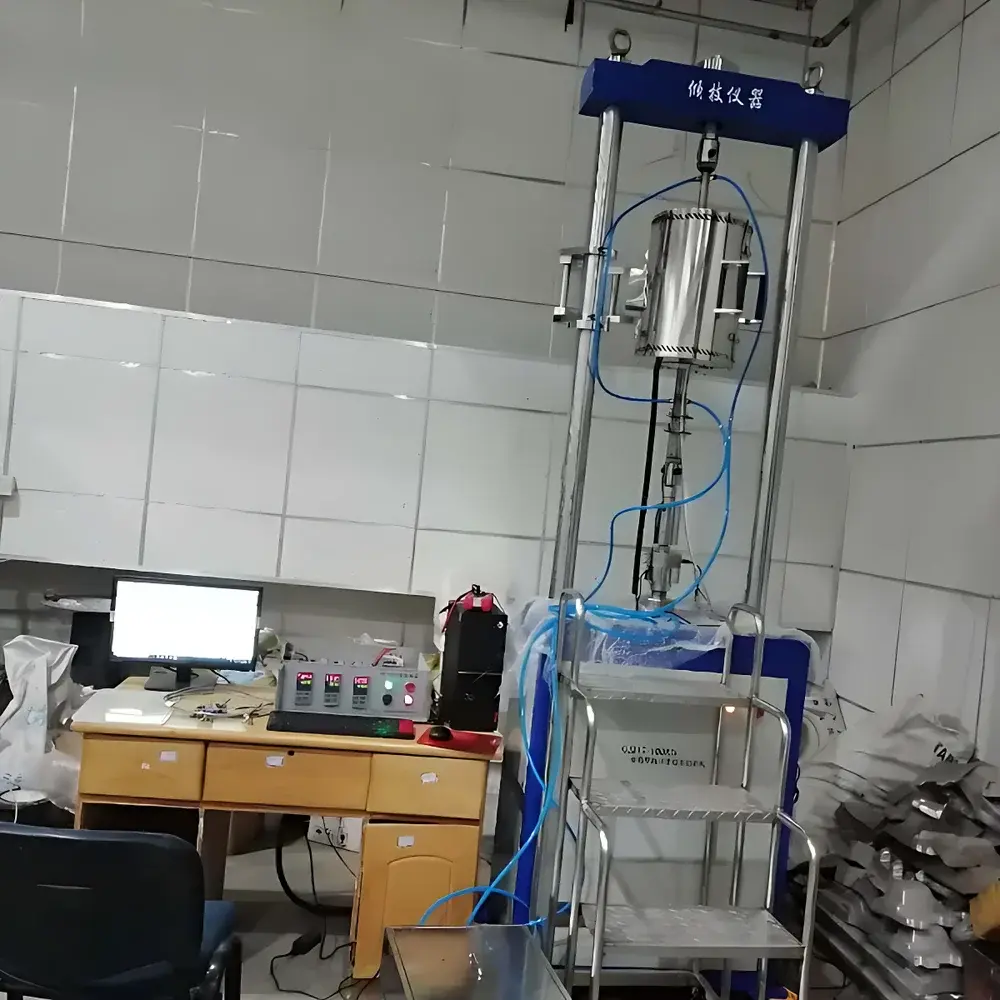
Qinji BV212F High-Temperature Creep and Stress Rupture Testing Machine
| Brand | Qinji |
|---|---|
| Origin | Shanghai, China |
| Model | BV212F |
| Maximum Test Load | 100 kN |
| Crosshead Stroke | 200 mm |
| Furnace Temperature Range | Ambient to 1200 °C |
| Temperature Control Accuracy | ±0.5 °C |
| Temperature Resolution | 0.1 °C |
| Uniform Temperature Zone Length | >150 mm |
| Furnace Chamber Diameter | φ50 mm |
| Furnace Length | 450 mm |
| Load Measurement Accuracy | ±0.5% of reading (from 1% FS) |
| Load Control Stability | ±1% of setpoint |
| Load Resolution | 0.1 N |
| Deformation Measurement | Imported rotary encoder |
| Deformation Range | Up to 25 mm |
| Deformation Accuracy | ±0.5% |
| Crosshead Speed | 0.01–180 mm/min |
| Power Requirement | 3 kW |
| Machine Weight | 850 kg |
| Compliance | JJG276-88, GB/T 2039-1997, HB 5150-1996, HB 5151-1996 |
Overview
The Qinji BV212F High-Temperature Creep and Stress Rupture Testing Machine is an electromechanical testing system engineered for precise, long-duration mechanical characterization of metallic and alloy materials under sustained tensile load at elevated temperatures. It operates on the fundamental principle of uniaxial creep testing—applying a constant or stepwise load to a standardized specimen while maintaining a tightly controlled thermal environment—and measuring time-dependent axial deformation (creep strain) and time-to-failure (stress rupture life). Designed in strict accordance with national metrological verification regulation JJG276-88 and material testing standards including GB/T 2039-1997 (Metallic Materials — Tensile Creep and Stress-Rupture Testing), HB 5150-1996 (High-Temperature Tensile Stress-Rupture Testing of Metals), and HB 5151-1996 (High-Temperature Tensile Creep Testing of Metals), the BV212F delivers metrologically traceable data suitable for qualification of structural alloys in critical high-temperature applications.
Key Features
- Electromechanical actuation architecture with high-resolution servo-controlled loading system, enabling continuous load application from 0 to 100 kN with ±1% control accuracy and 0.1 N resolution.
- Integrated high-stability resistance furnace with φ50 mm internal bore and 450 mm total length, providing a uniform temperature zone exceeding 150 mm at operating temperatures up to 1200 °C.
- Precision temperature regulation with ±0.5 °C accuracy and 0.1 °C digital resolution across the full ambient-to-1200 °C range, verified per ASTM E220 and ISO 15148 calibration protocols.
- Dual-channel real-time measurement: high-accuracy rotary encoder-based extensometry (±0.5% error, 25 mm full-scale range) synchronized with load cell output for concurrent strain and stress acquisition.
- Adjustable crosshead speed spanning 0.01–180 mm/min, supporting both slow creep rate monitoring and rapid preloading/stress application phases.
- Rigid, vibration-damped base frame (850 kg total mass) minimizing environmental interference during multi-hour to multi-thousand-hour tests.
- Modular design accommodating custom specimen geometries, furnace configurations, and environmental enclosures (e.g., inert gas purge systems).
Sample Compatibility & Compliance
The BV212F accommodates standard tensile specimens per ISO 204, ASTM E139, and GB/T 2039—including round-bar, flat-strip, and notched geometries—with gauge lengths compatible with the 150+ mm uniform temperature zone. It supports testing of ferrous alloys (e.g., Cr-Mo steels, stainless grades), non-ferrous metals (e.g., titanium alloys, nickel-based superalloys), and advanced intermetallics. All hardware and software functions are documented to support GLP-compliant operation; test sequences, parameter settings, and raw data streams are timestamped and user-auditable. While not FDA 21 CFR Part 11–certified out-of-the-box, the system’s data logging architecture permits integration with validated LIMS or ELN platforms meeting pharmaceutical and nuclear regulatory requirements.
Software & Data Management
Control and analysis are executed via Qinji’s dedicated CreepTest Suite v3.x, a Windows-based application supporting programmable multi-step load/temperature profiles, automatic zeroing and calibration routines, and real-time plotting of stress–strain–time curves. Raw data is exported in CSV and XML formats compliant with ASTM E1433 and ISO/IEC 17025 reporting structures. The software enforces audit trails for operator actions, parameter modifications, and calibration events—essential for ISO 17025-accredited laboratories. Optional modules include statistical rupture life prediction (Larson–Miller parameter calculation), minimum creep rate derivation (secondary stage identification), and comparative master curve generation using time–temperature superposition principles.
Applications
- Qualification of turbine blade and disc alloys for aerospace gas turbine engines operating above 700 °C.
- Evaluation of pressure vessel steels (e.g., P91, P92) under ASME Section II, Part D, and RCC-M design codes.
- Development and validation of creep-resistant weldments in power generation piping systems.
- Fundamental research into dislocation climb mechanisms, grain boundary sliding, and cavity nucleation kinetics in polycrystalline metals.
- Supporting certification testing for nuclear reactor core components per ASTM E2714 and EN 10291.
- Long-term reliability assessment of automotive exhaust manifold and turbocharger housing materials.
FAQ
What standards does the BV212F comply with?
The system meets JJG276-88 (Chinese metrological verification), GB/T 2039-1997, HB 5150-1996, and HB 5151-1996. Its mechanical and thermal performance aligns with ASTM E139, ISO 204, and EN 10291 for creep and stress rupture testing.
Can the furnace be upgraded for higher temperatures?
Standard configuration supports up to 1200 °C. Custom molybdenum-disilicide (MoSi₂) or graphite-element furnaces rated to 1600 °C are available as factory-engineered options with revised thermal shielding and cooling interfaces.
Is remote monitoring supported?
Yes—the system includes Ethernet connectivity and OPC UA-compatible server interface, enabling secure remote supervision and alarm notification via enterprise SCADA or lab infrastructure networks.
What maintenance intervals are recommended?
Load cell and encoder calibration verification is advised every 12 months or after 500 operational hours; furnace thermocouple recalibration every 6 months; mechanical alignment checks prior to each high-load test series.
Does the system support automated specimen loading/unloading?
Not natively. Specimen mounting and furnace insertion require manual handling per safety and metrological best practices. Robotic integration is feasible via third-party OEM collaboration using the provided I/O and motion control APIs.



