
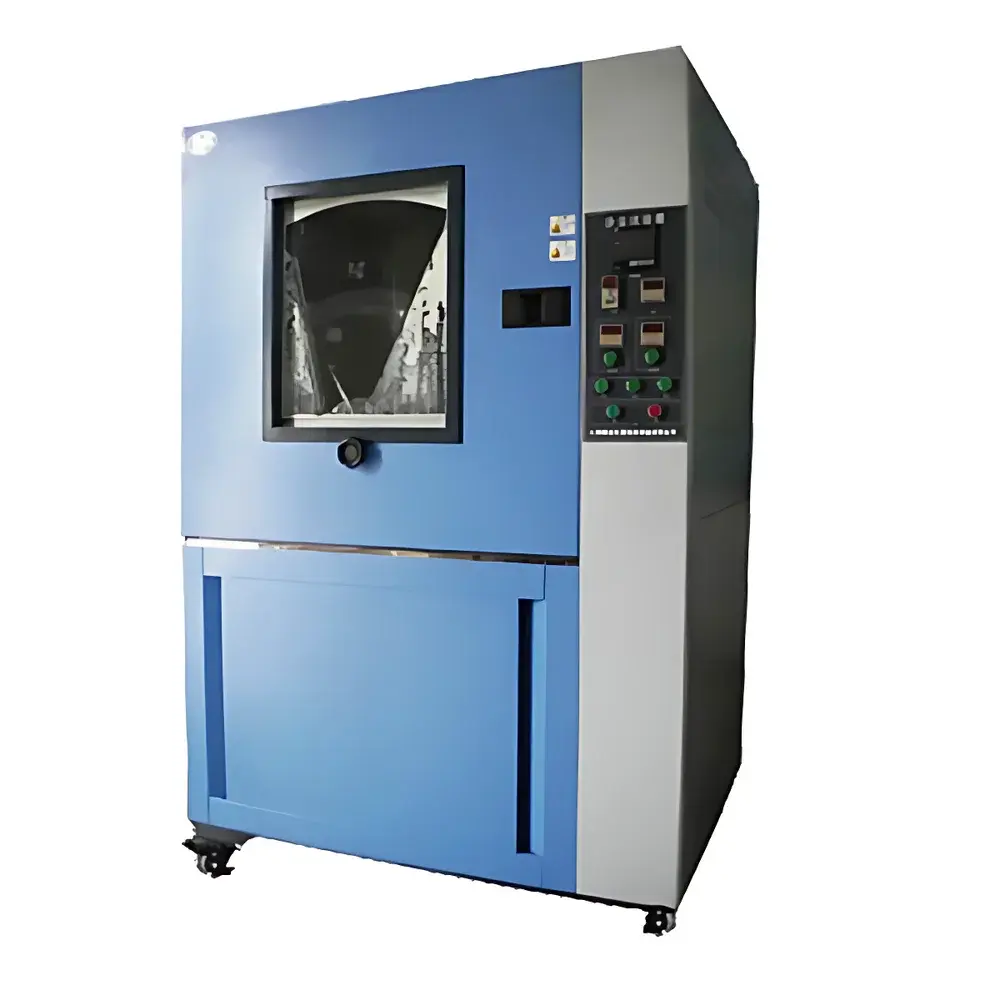
QJSCY-1216 Sand and Dust Test Chamber
| Origin | Shanghai, China |
|---|---|
| Manufacturer Type | Authorized Distributor |
| Origin Category | Domestic (China) |
| Model | QJSCY-1216 |
| Price | USD 9,400 (FOB Shanghai) |
| Dust Concentration | 2–4 kg/m² |
| Sand Concentration | 2–4 kg/m² |
| Dust Blowing Velocity | Adjustable up to 2 m/s |
| Sand Blowing Velocity | Adjustable up to 2 m/s |
| Test Temperature Range | RT +10°C |
| Relative Humidity | 45–75% RH |
| Sieve Mesh Aperture | 50 µm nominal wire diameter, 70 µm nominal spacing |
| Talc Powder Loading | 2–4 kg/m² |
| Internal Chamber Dimensions | 800 × 800 × 800 mm |
| Power Supply | AC 380 V, 50 Hz |
Overview
The QJSCY-1216 Sand and Dust Test Chamber is an engineered environmental test system designed to evaluate the ingress protection (IP) performance of enclosures—particularly those rated IP5X and IP6X per IEC 60529—against airborne particulates under controlled, repeatable conditions. It operates on the principle of forced-air suspension and gravitational settling of standardized dust and sand simulants (e.g., talc powder per ISO 16750-3 Annex C and SAE J575), enabling quantitative assessment of sealing integrity, ventilation filter efficiency, and mechanical resilience of electrical and optical components exposed to arid or desert operational environments. This chamber is widely deployed in automotive lighting validation (headlamps, fog lamps, signal lamps), outdoor LED signage, industrial control cabinets, aerospace avionics housings, and railway signaling equipment—where long-term reliability under particulate-laden ambient conditions is a critical design requirement.
Key Features
- Robust dual-chamber architecture with SUS304 stainless steel interior (mirror-finish) and electrostatically coated carbon steel outer shell for corrosion resistance and structural stability
- High-efficiency centrifugal recirculation blower system with variable-speed control to maintain precise dust/sand suspension velocity (0.5–2.0 m/s) and uniform particle distribution across the test volume
- Programmable digital controller (imported microprocessor-based unit) supporting independent timing for blow cycles (1 s–99 h), vibration impact (1 s–99 h), lamp-on duration (1 s–99 h), and total test runtime (1 h–999 h)
- Integrated mechanical vibrator motor mounted beneath the test chamber floor to simulate road-induced sediment agitation and enhance particle penetration through seals and gaskets
- Optically clear tempered glass observation door with integrated silicone-sealed viewing window, enabling real-time visual monitoring without interrupting test continuity
- Standardized 50 µm wire-diameter, 70 µm pitch stainless steel mesh screen installed at air inlet to ensure consistent particle size distribution and prevent oversized agglomerates from entering the test zone
- Heating element and humidity regulation system maintaining stable ambient conditions (RT+10°C, 45–75% RH) to eliminate condensation and support material-specific conditioning protocols
Sample Compatibility & Compliance
The QJSCY-1216 accommodates samples up to 600 mm in maximum dimension (within the 800 × 800 × 800 mm working volume), including sealed luminaires, junction boxes, sensor housings, and handheld electronic devices. It supports test execution per multiple international standards, including but not limited to: IEC 60529 (IP5X/IP6X dust ingress testing), ISO 20653 (road vehicles — degrees of protection against dust and water), ISO 16750-3 (electrical and electronic equipment — mechanical loads), SAE J575 (lamp mounting and aiming), and GB/T 4208 (Chinese national equivalent of IEC 60529). The chamber’s design incorporates grounding terminals compliant with IEC 61000-4-2 ESD safety requirements and includes overcurrent protection for all motorized subsystems.
Software & Data Management
While the base configuration utilizes a standalone programmable logic controller (PLC) with digital display interface, optional RS485/Modbus RTU communication enables integration into centralized laboratory management systems (LMS) or MES platforms. All timing parameters, cycle counts, and operational status logs are timestamped and stored internally for traceability. For regulated industries—including automotive Tier-1 suppliers and medical device manufacturers—the optional data-logging module provides audit-ready records compliant with GLP and ISO/IEC 17025 documentation requirements. No proprietary software installation is required; raw log files export via USB as CSV for post-test analysis in Excel or statistical process control (SPC) tools.
Applications
- Validation of IP6K dust-tight integrity for automotive headlamp assemblies prior to type approval (UN ECE R112, FMVSS 108)
- Accelerated durability testing of outdoor photovoltaic inverters and charge controllers under simulated desert wind-blown sand exposure
- Qualification of military-grade portable radios and battery packs per MIL-STD-810H Method 510.6 (Sand and Dust)
- Verification of filter media efficiency in HVAC units used in mining or construction equipment cabins
- Research into particle deposition kinetics on optical surfaces and anti-static coating performance under cyclic thermal-humidity stress
FAQ
What dust standard does the QJSCY-1216 use for IP5X/IP6X testing?
It employs talcum powder conforming to ISO 16750-3 Annex C specifications, with median particle size ≤ 75 µm and bulk density ~0.4 g/cm³.
Can the chamber perform simultaneous temperature/humidity and dust exposure?
Yes—ambient temperature is stabilized at RT+10°C and relative humidity maintained between 45–75% RH during dust cycling, per ISO 20653 Clause 6.2.
Is calibration certification included with delivery?
A factory calibration report covering airflow velocity, timer accuracy, and temperature uniformity is provided; third-party accredited calibration (ISO/IEC 17025) is available upon request.
What maintenance intervals are recommended for long-term operation?
Filter elements require replacement every 200 operational hours; blower bearings and vibrator motor grease should be serviced annually or after 1,000 cycles.
Does the system meet FDA 21 CFR Part 11 requirements for electronic records?
The base controller does not support Part 11-compliant audit trails; however, the optional Ethernet-enabled data logger with user authentication and electronic signature capability satisfies this requirement.



