
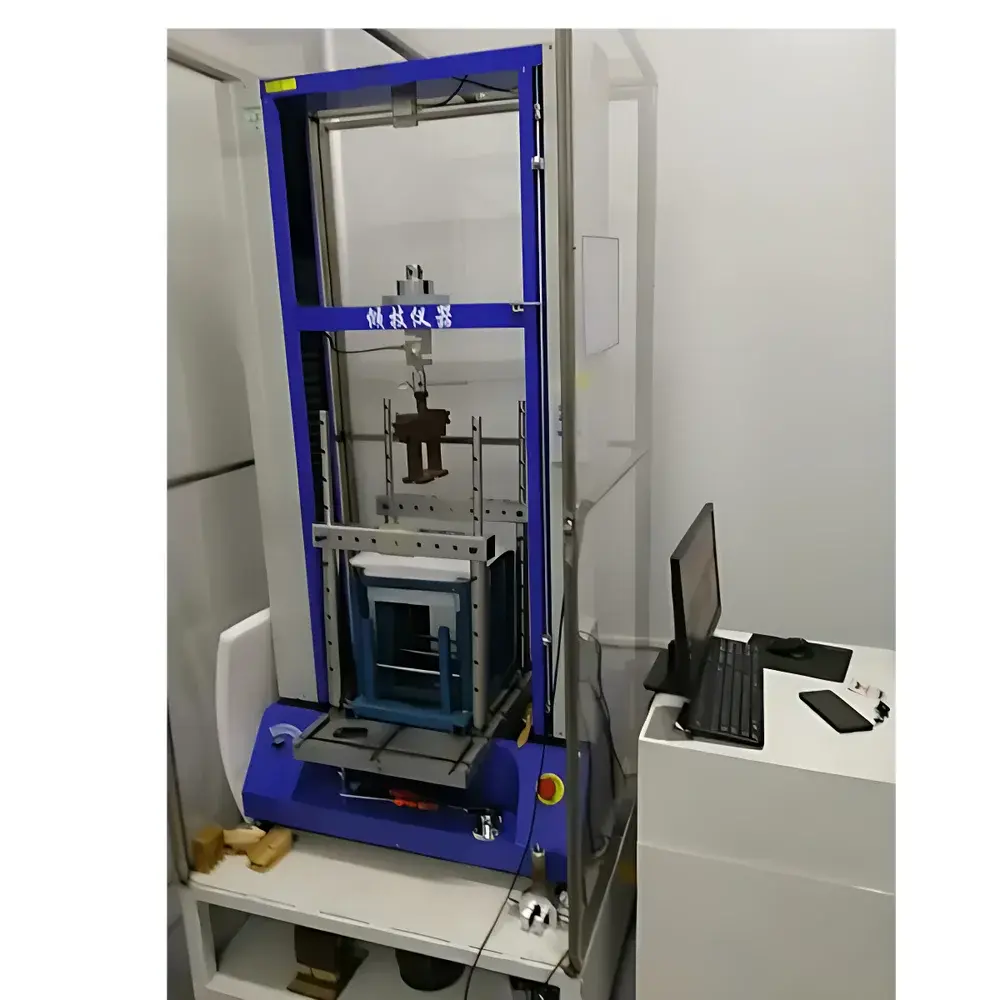
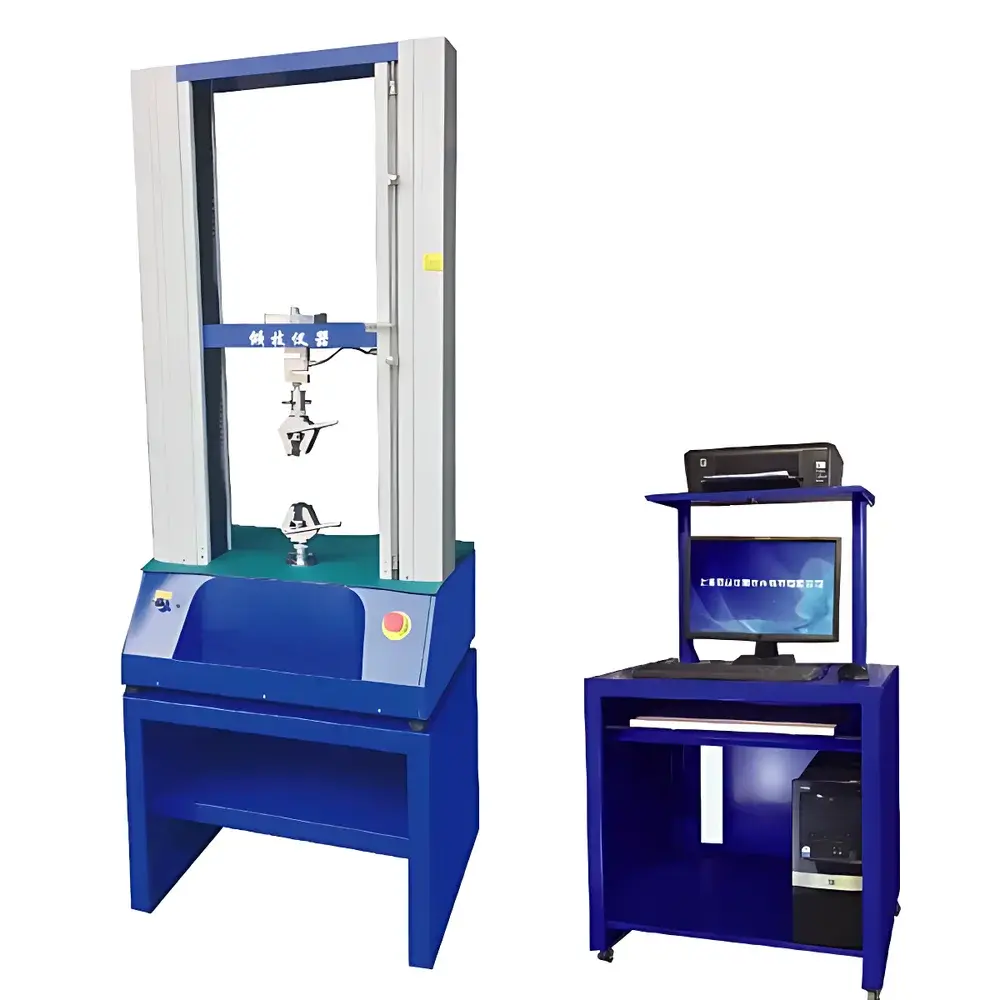
QJ211S Automotive Door Handle Strength Testing Machine
| Brand | Qinsun |
|---|---|
| Origin | Shanghai, China |
| Manufacturer Type | Authorized Distributor |
| Country of Origin | China |
| Model | QJ211S |
| Instrument Type | Electromechanical Universal Testing Machine |
| Load Capacity | 0.001 N to 20 kN |
| Load Accuracy | ±0.5% |
| Test Speed Range | 0.001–500 mm/min |
| Test Width | 400 mm |
| Maximum Travel | 800 mm |
| Approximate Weight | 180 kg |
Overview
The QJ211S Automotive Door Handle Strength Testing Machine is a purpose-built electromechanical universal testing system engineered for precise mechanical evaluation of automotive door handle assemblies in accordance with GB 48001–2026, specifically Clause 5.4 “Door Handle Strength Requirements.” Designed for structural integrity validation under static and quasi-static loading conditions, the system applies controlled axial and lateral forces to simulate real-world operational stresses—including pull-out, twist, and lever-action loads—experienced during vehicle use, service, and emergency egress scenarios. Its modular frame architecture integrates high-rigidity crosshead guidance, precision ball-screw actuation, and closed-loop digital servo control to ensure repeatable force application and displacement tracking across the full 0.001 N–20 kN load range. The machine operates on a fundamental principle of load-cell-based force transduction combined with encoder-resolved displacement feedback, enabling compliance with ISO 7500-1 (Class 0.5) and ASTM E4 verification standards for force measurement systems.
Key Features
- High-accuracy load measurement: ±0.5% full-scale accuracy over the entire 0.001 N–20 kN range, certified per ISO 7500-1 Class 0.5 requirements.
- Wide dynamic speed control: Programmable test speeds from 0.001 mm/min (for creep and relaxation studies) up to 500 mm/min (for rapid functional checks), adjustable in 0.001 mm/min increments.
- Robust mechanical design: Dual-column steel frame with 400 mm test width and 800 mm vertical travel accommodates full-size OEM door modules, including reinforced latch-integrated handles and power-operated mechanisms.
- Digital servo control system: Real-time PID-regulated load and displacement control with data acquisition at ≥1 kHz sampling rate, ensuring stable ramp-hold-step profiles required by GB 48001–2026 test sequences.
- Modular fixture interface: Standard M6 and M8 threaded mounting plates support custom-designed grips, torque adapters, and multi-axis load fixtures for combined tension-torsion testing.
Sample Compatibility & Compliance
The QJ211S is validated for testing passenger car, light commercial vehicle (LCV), and electric vehicle (EV) door handle systems—including interior pull handles, exterior lever-type actuators, capacitive touch surfaces, and integrated release mechanisms. It supports both bare-metal and overmolded polymer-composite handles, accommodating geometries up to 350 mm in length and 120 mm in depth. All test protocols align with GB 48001–2026 Clause 5.4, which specifies minimum failure thresholds (e.g., ≥200 N for interior handles, ≥350 N for exterior handles under perpendicular pull), allowable permanent deformation limits (<1.5 mm), and mandatory hold-time durations (≥10 s at peak load). The system is also compatible with supplementary international references including ISO 11452-5 (mechanical durability), SAE J2400 (door system performance), and EU Regulation (EU) No 661/2009 Annex IV (safety-related component testing).
Software & Data Management
Equipped with Qinsun’s proprietary TestMaster Pro v3.2 software, the QJ211S delivers compliant data handling for regulated environments. The software provides preconfigured test templates for GB 48001–2026 Clause 5.4, automatic pass/fail flagging based on user-defined acceptance criteria, and real-time graphical overlay of force-displacement curves. Raw data export is supported in CSV, XML, and PDF formats—with embedded metadata including operator ID, calibration certificate number, environmental temperature/humidity logs, and timestamped audit trails. For laboratories operating under GLP or IATF 16949 frameworks, optional 21 CFR Part 11 compliance modules are available, enabling electronic signatures, role-based access control, and immutable data archiving with SHA-256 hashing.
Applications
- Validation of static pull-out strength for interior and exterior door handles per GB 48001–2026.
- Functional life cycle testing of rotating and sliding handle mechanisms under cyclic loading (up to 100,000 cycles).
- Evaluation of adhesion integrity between overmolded TPE/TPU grips and underlying metal substrates.
- Quantification of torsional stiffness and angular deflection under rotational loading (using optional torque adapter).
- Pre-production verification of handle assembly robustness following thermal aging (–40 °C to +85 °C) and humidity exposure (95% RH, 500 h).
- Root-cause analysis of field failures via comparative load-displacement signature analysis across production lots.
FAQ
Does the QJ211S comply with ISO/IEC 17025 calibration traceability requirements?
Yes—the standard load cell and displacement encoder are calibrated using NIM-traceable reference standards, and calibration certificates include uncertainty budgets per ISO/IEC 17025:2017 Annex A.
Can the system perform simultaneous force and displacement control during a single test?
Yes—it supports dual-loop closed control modes, including load-controlled ramp-to-target, displacement-controlled hold, and mixed-mode profiles required for GB 48001–2026’s multi-stage test sequences.
Is third-party verification documentation available for regulatory submissions?
Yes—Qinsun provides test method validation reports, instrument qualification (IQ/OQ/PQ) templates, and GMP-aligned installation documentation upon request.
What maintenance intervals are recommended for long-term accuracy retention?
Annual recalibration is advised; routine verification using certified deadweight sets is recommended before each daily shift.
Are custom fixture designs supported for non-standard handle geometries?
Yes—Qinsun’s engineering team offers CAD-based fixture co-design services, including FEA-supported stress analysis of custom grip interfaces.



