
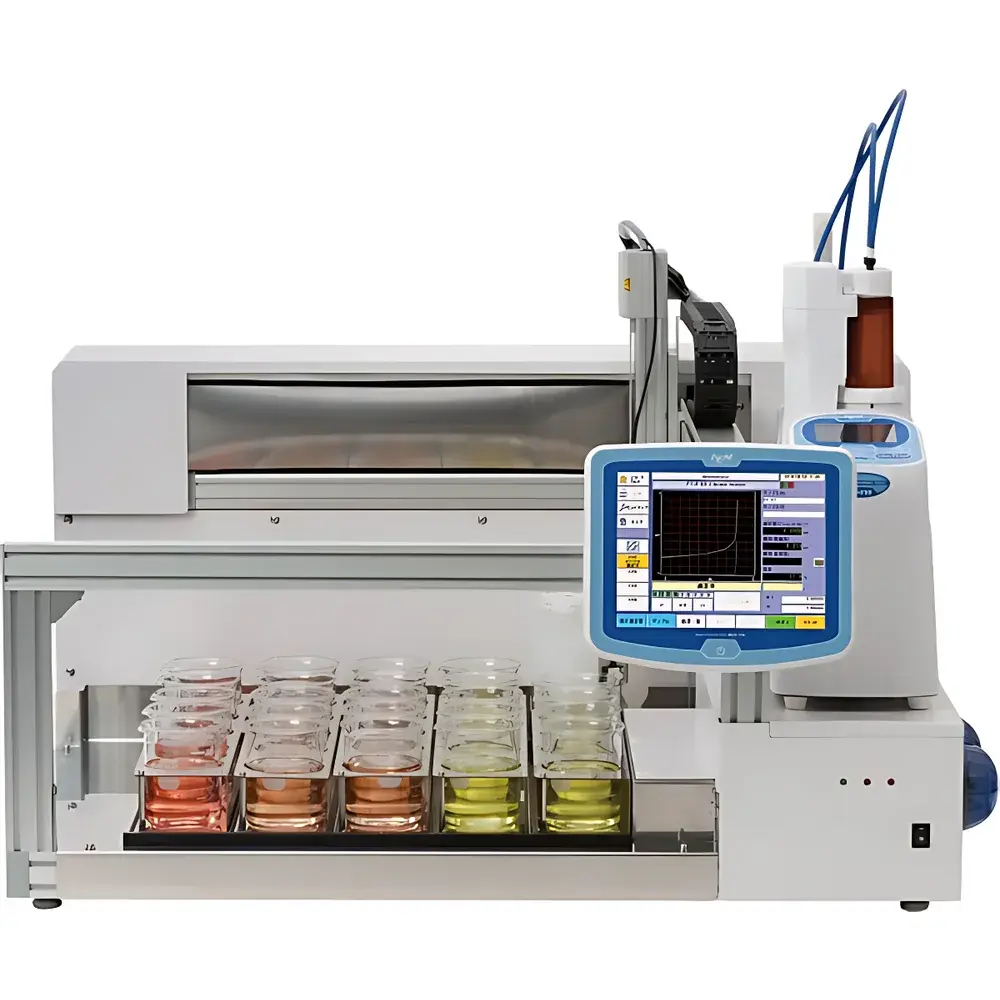
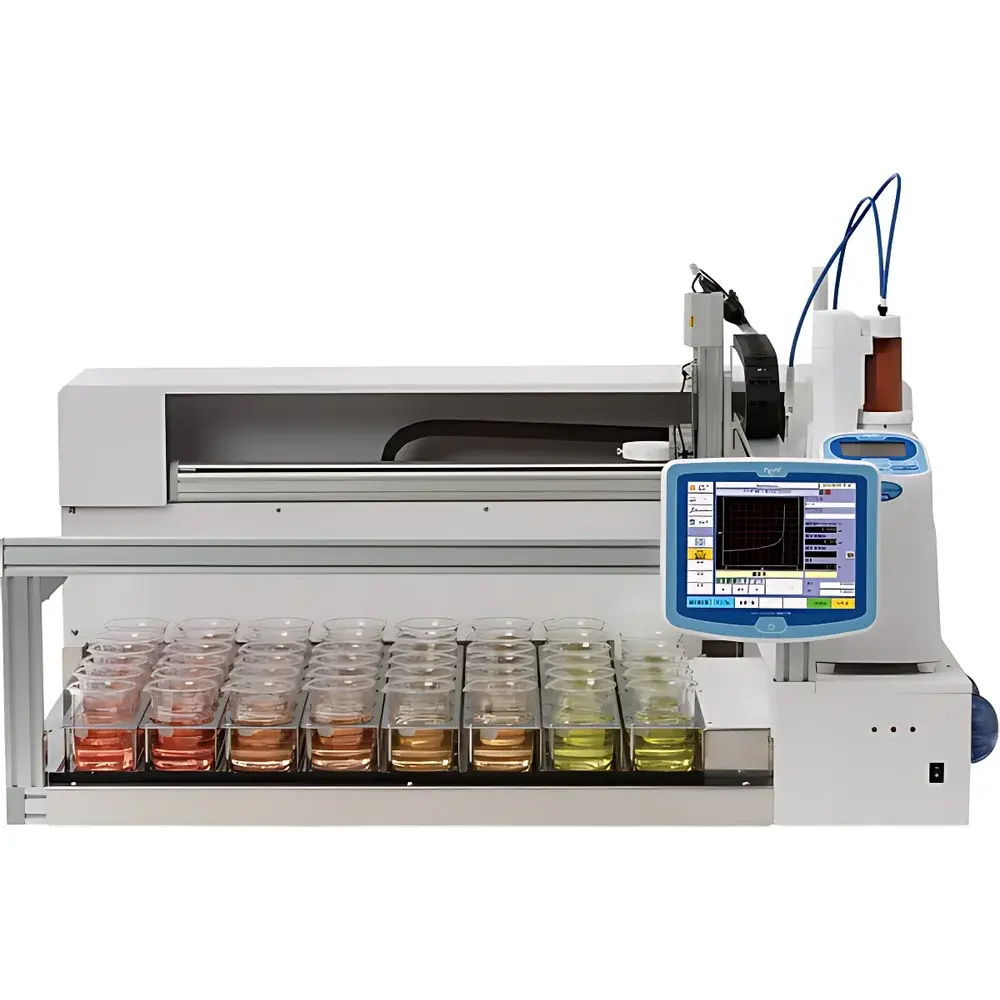
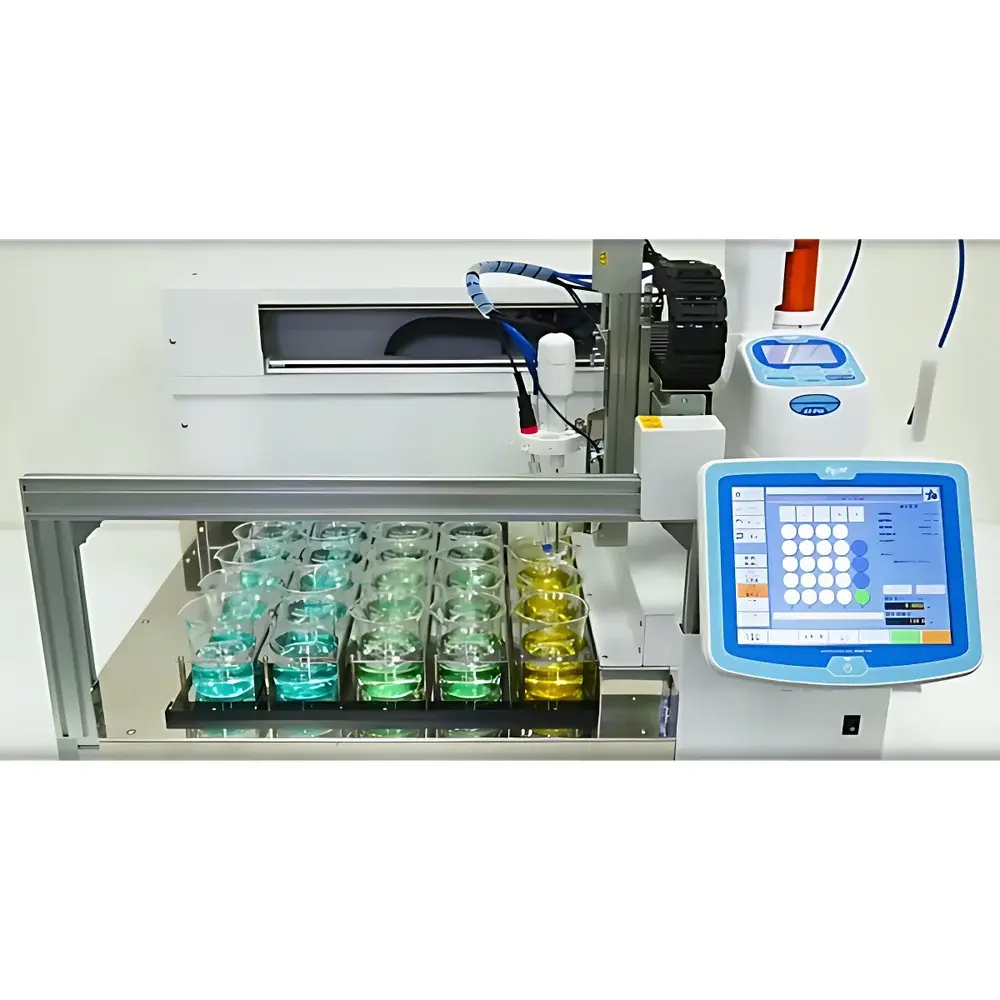
KEM CHA-740 / CHA-760 Automatic Potentiometric Titrator with Integrated Sample Changer
| Brand | KEM (Kyoto Electronics Manufacturing) |
|---|---|
| Origin | Japan |
| Manufacturer | Kyoto Electronics Manufacturing Co., Ltd. |
| Type | Imported Instrument |
| Model | CHA-740 / CHA-760 |
| Instrument Category | General-purpose Potentiometric Titrator |
| Application Scope | Universal |
| Potential Range | −2000.0 mV to +2000.0 mV |
| pH Range | −20.000 to +20.000 pH |
| Burette Accuracy | ±0.01 mL (20 mL burette) |
| Burette Resolution | 0.001 mL (20 mL burette) |
| Titration Precision | ±0.02 mL (20 mL burette) |
| Sample Capacity | 24 (CHA-740) / 47 (CHA-760) positions |
| Washing Modes | Rinse & Immersion, up to 3 wash solutions |
| Wash Liquids | Deionized water, ethanol, acetic acid, etc. |
| Operating Environment | 5–35 °C, ≤85 % RH |
| Power Supply | DC 24 V / 5 A (changer unit), AC 100–240 V / ~120 W |
| Dimensions (W×D×H) | 805×660×540 mm (CHA-740), 1005×760×540 mm (CHA-760) |
| Standard Sample Vessels | 200 mL plastic beakers, 200/250/300 mL glass beakers, tall-form beakers, Erlenmeyer flasks |
Overview
The KEM CHA-740 and CHA-760 Automatic Potentiometric Titrators with Integrated Sample Changers are precision-engineered laboratory systems designed for high-throughput, unattended potentiometric titration analysis. These instruments operate on the fundamental principle of potentiometric endpoint detection—measuring the potential difference between a reference electrode and an indicator electrode as titrant is incrementally added to the analyte solution. The resulting inflection point in the E–V curve (potential vs. volume) enables precise stoichiometric determination of acid–base, redox, precipitation, and complexometric reactions. Unlike manual or semi-automated titrators, the CHA series integrates seamlessly with KEM’s AT-710M, AT-710S, and AT-710B titration units via standardized mechanical and communication interfaces (RS-232C and digital I/O), forming a unified analytical platform compliant with GLP and GMP operational frameworks. The system supports fully automated sequence execution—including sample positioning, electrode immersion, titrant delivery, endpoint recognition, post-titration rinsing, and data logging—without operator intervention across extended shifts.
Key Features
- Modular architecture compatible with AT-710M (quad-channel), AT-710S (dual-channel), and AT-710B (single-channel) titrators, enabling scalable throughput—from 24 samples per run (CHA-740) to 47 (CHA-760), or up to 188 samples when paired with the AT-710M in parallel mode.
- Robust aluminum frame construction with high-resolution stepper-motor-driven robotic arm, ensuring repeatable positioning accuracy (< ±0.2 mm) and long-term mechanical stability under continuous operation.
- Dedicated pump-based washing station supporting dual-mode cleaning (rinse + immersion) with programmable dwell times and up to three independently controlled wash solutions—ideal for cross-contamination mitigation in multi-analyte workflows.
- Real-time sample queue management: new samples may be loaded during active runs without interrupting ongoing titrations, minimizing downtime and maximizing instrument utilization.
- Integrated air purge kit (optional) eliminates trapped air bubbles from burettes and tubing, critical for maintaining volumetric accuracy in low-volume or viscous titrant applications.
- Compact footprint optimized for benchtop integration; titrator units mount directly onto the sample changer base, reducing cable clutter and improving spatial efficiency in regulated lab environments.
Sample Compatibility & Compliance
The CHA-740/760 accommodates a wide range of standard and custom sample vessels—including 50–300 mL glass and plastic beakers, tall-form cylinders, and 200 mL Erlenmeyer flasks—ensuring flexibility across aqueous, organic, and mixed-solvent matrices. All fluidic pathways use chemically resistant PTFE, ETFE, and borosilicate glass components rated for compatibility with common titrants (e.g., HCl, NaOH, AgNO₃, EDTA, Ce(SO₄)₂) and aggressive solvents (e.g., ethanol, acetone, glacial acetic acid). The system meets ISO 8655-3 (burette calibration), ASTM E2087 (standard practice for potentiometric titration), and supports audit-trail generation required under FDA 21 CFR Part 11 when operated with KEM’s AT-Win software (v3.0+). Full traceability is maintained through timestamped method files, raw electrode potential logs, and electronic signatures for user authentication.
Software & Data Management
Controlled exclusively via KEM’s AT-Win software (Windows OS), the CHA series supports method-driven automation with hierarchical parameter inheritance: global settings (e.g., stir speed, delay times), method-specific titration curves (first/second derivative, Gran plot), and per-sample overrides (e.g., initial volume, dilution factor). All raw data—including mV/pH vs. time/volume, calculated equivalence points, and statistical summaries (mean, RSD, confidence intervals)—are stored in encrypted .kem binary format and exportable to CSV, PDF, or LIMS-compatible XML. Software validation packages—including IQ/OQ documentation, electronic signature configuration, and change control logs—are available for regulated pharmaceutical and contract testing laboratories requiring formal validation per ICH Q2(R2) and USP .
Applications
- Quality control of raw materials and finished products in pharmaceutical manufacturing (e.g., assay of active ingredients, residual acid/base quantification).
- Food and beverage analysis: titratable acidity in wines and dairy, chloride content in processed meats, peroxide value in edible oils.
- Environmental testing: alkalinity and hardness in wastewater, cyanide and fluoride in drinking water per EPA Method 325 and ISO 9297.
- Chemical synthesis monitoring: stoichiometric verification of intermediates, catalyst residue quantification, and purity assessment of inorganic salts.
- Academic research: kinetic studies of slow-reacting systems using programmable pause-and-resume protocols, or multi-step titrations involving sequential reagent addition.
FAQ
Can the CHA-740/760 operate independently without a KEM titrator?
No—the CHA units are dedicated sample changers and require connection to an AT-710 series titrator for electrode control, burette actuation, and endpoint calculation.
Is method transfer possible between different AT-710 models when using the same CHA unit?
Yes—AT-Win methods are hardware-agnostic; validated procedures developed on AT-710B can be deployed unchanged on AT-710M with CHA-760, preserving measurement consistency across platforms.
What maintenance intervals are recommended for the robotic arm and washing pumps?
KEM recommends biannual inspection of stepper motor belts and quarterly replacement of peristaltic pump tubing; full preventive maintenance is documented in the service manual (SOP-KEM-CHA-PM-2023).
Does the system support non-aqueous titrations?
Yes—electrode compatibility with non-aqueous solvents (e.g., glacial acetic acid, dimethylformamide) is verified; users must select appropriate reference electrodes (e.g., double-junction Ag/AgCl) and calibrate in relevant media.
How is data integrity ensured during power interruption?
The system features non-volatile memory that retains method parameters and partial run logs; upon recovery, AT-Win resumes from the last completed sample position without data loss.
Related Products




