
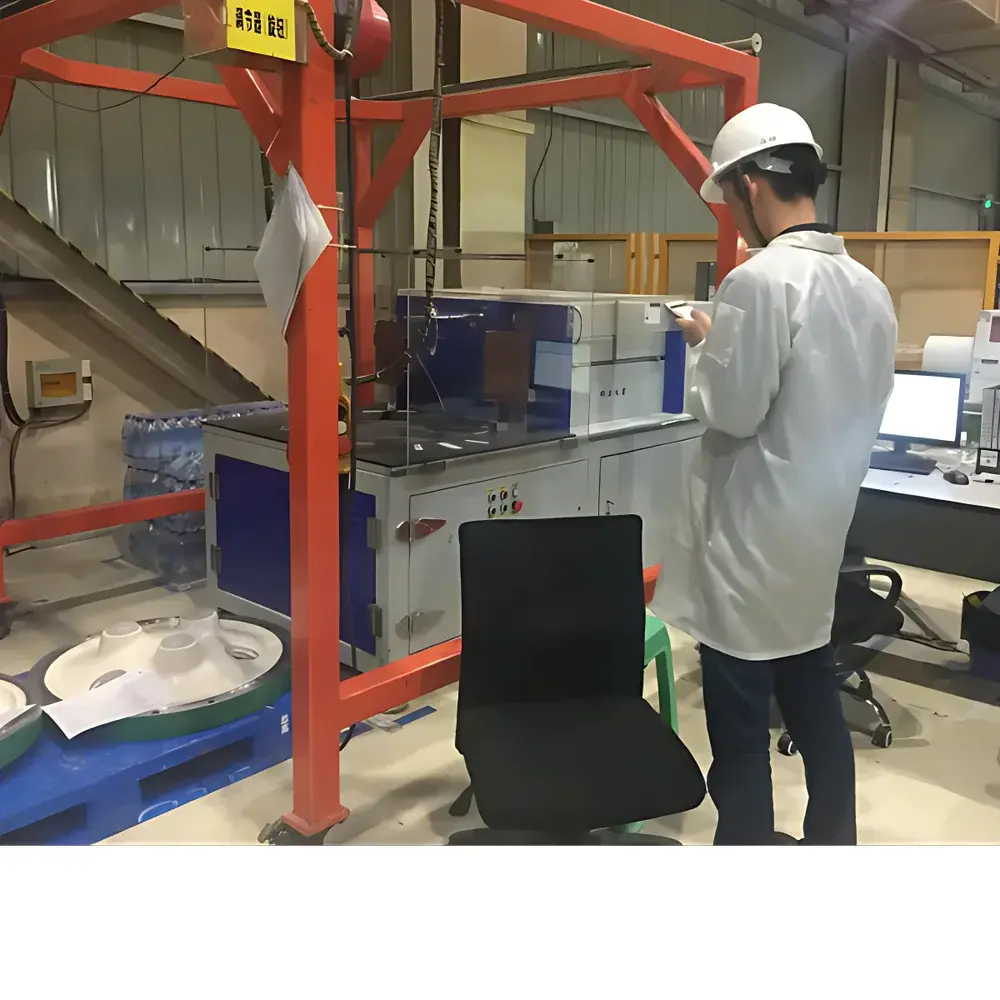
Qingji QJ211WS-50KN Microcomputer-Controlled Insulator Flexural Testing Machine
| Brand | Qingji |
|---|---|
| Origin | Shanghai, China |
| Model | QJ211WS-50KN |
| Maximum Load Capacity | 50 kN |
| Accuracy Class | 0.5 |
| Effective Force Measurement Range | 0.2–100% FS |
| Force Resolution | 500,000 counts (full-scale, unsegmented) |
| Bending Moment Capacity | ≥10,000 N·m |
| Horizontal Load Capacity | ≥40,000 N |
| Lifting Capacity | ≥100 kg |
| Horizontal Travel (4-directional) | ≥1.5 m |
| Vertical Travel | ≥1.6 m |
| Loading Stroke | ≥400 mm |
| Software Platform | Windows-based real-time data acquisition and curve visualization |
Overview
The Qingji QJ211WS-50KN Microcomputer-Controlled Insulator Flexural Testing Machine is a purpose-built mechanical testing system engineered for standardized flexural strength evaluation of high-voltage ceramic and composite insulators—particularly cylindrical or hollow-core insulator posts, bushings, and GIS basin-type insulators. It operates on the principle of three-point or four-point bending per IEC 60383-1, IEC 62271-1, and GB/T 775.2, applying controlled quasi-static vertical load to the specimen while precisely measuring applied force, deflection, and support reaction moments. The machine integrates a rigid dual-column frame with high-stiffness crosshead guidance, servo-controlled hydraulic or electromechanical actuation (configurable), and a calibrated load cell traceable to national metrology standards. Its structural design accommodates large-diameter insulator specimens up to 2.5 m in height, with adjustable support spans and modular fixture interfaces compliant with ANSI C29.4 and DL/T 864.
Key Features
- High-accuracy force measurement system certified to ISO 7500-1 Class 0.5, delivering reproducible results across the full 50 kN range with 0.2% FS minimum measurable load.
- Dual-axis movable loading head with ±1.5 m horizontal travel (X/Y) and ≥1.6 m vertical stroke, enabling precise alignment of load application point relative to insulator geometry and stress concentration zones.
- Integrated moment-resisting base structure rated for ≥10,000 N·m bending moment and ≥40,000 N lateral restraint—critical for preventing frame distortion during high-moment tests on long-span insulators.
- Real-time Windows-based control software supporting dynamic curve overlay, multi-sample comparison, user-defined test protocols (e.g., ramp-hold, cyclic flexure), and automatic pass/fail evaluation against preset deflection or fracture thresholds.
- Full electronic data logging with timestamped force-displacement-moment datasets, exportable to CSV, Excel, or XML formats for downstream statistical process control (SPC) or quality documentation.
- Modular fixture set including adjustable roller supports, spherical seating inserts, and clamping adapters for standard insulator diameters (Φ120–Φ400 mm), compatible with both dry and wet-condition testing per IEC 60587.
Sample Compatibility & Compliance
The QJ211WS-50KN accommodates insulator types defined in IEC 60137, IEC 60672, and GB/T 1001.1, including pin-type, suspension-type, post-type, and GIS basin insulators made from porcelain, glass, or silicone rubber composites. Specimen lengths up to 3.2 m are supported via optional extended support bases. All test procedures align with mandatory requirements for type testing and routine verification under IEC 60383 (Insulators for overhead lines), IEC 62271-1 (HV switchgear), and Chinese grid standards DL/T 620 and DL/T 864. The system meets mechanical safety requirements per ISO 12100 and incorporates emergency stop circuitry compliant with EN 60204-1.
Software & Data Management
The embedded Windows 10 Professional platform runs proprietary Qingji TestMaster v4.2 software, featuring audit-trail-enabled user accounts, electronic signatures, and configurable report templates aligned with GLP/GMP documentation needs. Raw data files include metadata such as operator ID, environmental conditions (optional sensor input), calibration certificate IDs, and instrument configuration logs. Software supports 21 CFR Part 11-compliant electronic records when deployed with network authentication servers and digital certificate infrastructure. Exported datasets retain full resolution (500,000-count force axis) and are compatible with third-party analysis tools including MATLAB, OriginLab, and Minitab for Weibull modulus calculation and strength distribution modeling.
Applications
- Flexural strength certification of new insulator designs prior to grid commissioning.
- Routine mechanical acceptance testing per batch in insulator manufacturing QA labs.
- Aging assessment via comparative flexural testing of field-retired insulators exposed to UV, pollution, or thermal cycling.
- Validation of adhesive bond integrity in composite insulator end-fittings under bending moment.
- Research into failure modes—including crack initiation at cement interfaces or core material delamination—using synchronized displacement and acoustic emission monitoring (via optional add-on interface).
- Supporting technical due diligence for insulator procurement by transmission system operators and independent power producers.
FAQ
What international standards does this machine directly support?
IEC 60383-1 (mechanical tests on overhead line insulators), IEC 62271-1 (bending tests on HV switchgear insulators), GB/T 775.2 (Chinese standard for insulator mechanical testing), and ANSI C29.4 (American National Standard for insulator testing).
Is the system suitable for testing composite insulators with non-cylindrical sheds?
Yes—the adjustable support span and multi-directional loading head enable accurate moment application even for asymmetrical shed profiles; fixture customization is available upon request.
Can test data be integrated into a centralized LIMS or MES environment?
Yes—via OPC UA or TCP/IP API integration, allowing automated transfer of test results, pass/fail status, and calibration metadata to enterprise quality systems.
What maintenance intervals are recommended for long-term accuracy retention?
Annual force calibration traceable to CNAS-accredited laboratories is recommended; quarterly verification using certified reference load cells is advised for continuous operation environments.
Does the system provide overload protection during brittle fracture events?
Yes—hardware-limited emergency stop response (<20 ms), coupled with software-based force-rate limiting and real-time deflection saturation detection, prevents frame damage during sudden insulator failure.



