
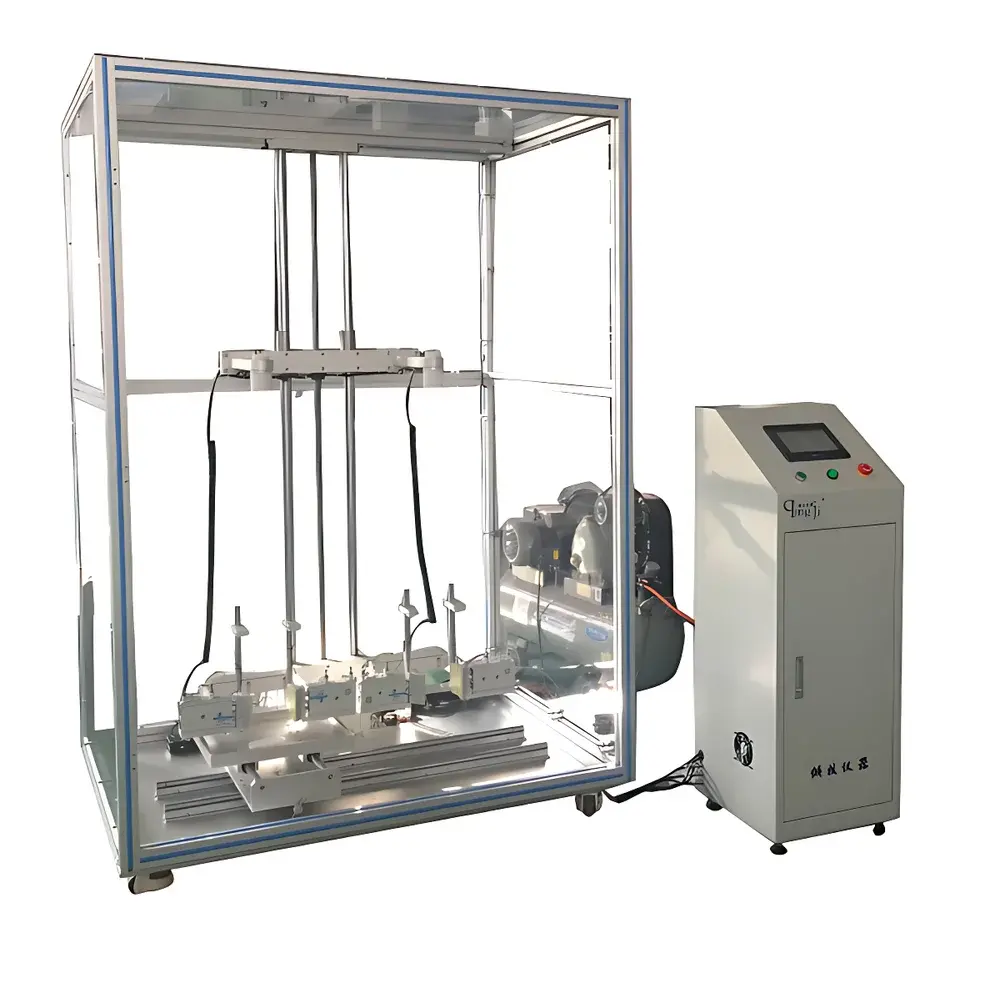
QJLC-2 Dual-Station Electronic Automatic Ball Impact Tester
| Origin | Shanghai, China |
|---|---|
| Manufacturer Type | Authorized Distributor |
| Origin Category | Domestic (China) |
| Model | QJLC-2 |
| Price | USD 1,400 (FOB Shanghai) |
| Maximum Bending Angle | ±90° |
| Bend Cycle Count Range | 0–9999 |
| Bend Frequency | 60 cycles/min |
| Specimen Diameter Range | 0.1–25 mm |
| Specimen Length | 150–200 mm |
| Motor Power | 150 W |
| Dimensions (W×D×H) | 420 × 300 × 1320 mm |
| Weight | 250 kg |
Overview
The QJLC-2 Dual-Station Electronic Automatic Ball Impact Tester is a precision-engineered instrument designed for standardized repetitive bending fatigue testing of metallic wires, strips, and slender cylindrical specimens. It operates on the principle of controlled mechanical oscillation—using dual independent bending arms to subject specimens to symmetrical, programmable angular displacement (±90°) under gravity-assisted ball impact loading. Unlike static torsion testers, this system replicates dynamic flexural stress conditions encountered during real-world service life, particularly in aerospace wiring harnesses, medical guidewires, and flexible printed circuit interconnects. The device complies with core national and industry standards including GJB 1217–1991 (Military Standard for Wire Flexibility Testing) and GB/T 238–2002 (Metallic Materials – Wire – Reverse Bend Test), ensuring traceable, repeatable test execution suitable for QC laboratories, R&D centers, and third-party certification bodies conducting mechanical durability assessments.
Key Features
- Dual-station architecture enables parallel testing of two specimens—reducing throughput time by up to 45% compared to single-arm systems while maintaining synchronized bend timing and amplitude control.
- Electronically regulated servo-motor drive ensures consistent 60-cycle-per-minute bending frequency with <±0.5% speed deviation across full load range, critical for ISO/IEC 17025-compliant test repeatability.
- Adjustable bending arm geometry accommodates specimen diameters from 0.1 mm (e.g., fine thermocouple wire) to 25 mm (structural alloy rods), with precision-machined V-groove clamps minimizing slippage and axial misalignment.
- Integrated digital counter with non-volatile memory records cumulative bend cycles (0–9999) and supports preset stop thresholds—essential for pass/fail criteria defined in ASTM E8/E8M or MIL-STD-883 Method 2030.
- Robust steel frame construction (250 kg mass) suppresses resonant vibration during high-frequency operation, preserving measurement integrity and operator safety per IEC 61000-6-2 EMC requirements.
Sample Compatibility & Compliance
The QJLC-2 accepts straight, annealed, or pre-straightened metallic specimens—including copper alloys (C11000, C19400), stainless steels (304, 316), nickel-titanium (Nitinol), and aluminum 6061-T6—within the specified 150–200 mm length and 0.1–25 mm diameter envelope. Specimens must be free of surface defects exceeding ISO 4967 Class A severity. Test reports generated using this instrument meet documentation requirements for GLP (Good Laboratory Practice) audits when paired with timestamped cycle logs and operator ID inputs. While not certified to UL or CE as a standalone unit, its mechanical design conforms to EN 61000-6-4 emission limits and incorporates dual emergency stop circuits compliant with ISO 13850.
Software & Data Management
The QJLC-2 operates via embedded microcontroller firmware with front-panel membrane keypad interface—no external PC dependency required for basic operation. Optional RS-232/USB data export module (sold separately) enables integration with LIMS or custom Python-based analysis scripts for statistical process control (SPC) of bend-to-failure distributions. All cycle counts, start/stop timestamps, and operator IDs are stored in EEPROM with write-protection—supporting audit trails aligned with FDA 21 CFR Part 11 electronic record requirements when deployed in regulated pharmaceutical or biomedical device manufacturing environments.
Applications
- Evaluation of fatigue resistance in aircraft bonding wires subjected to thermal cycling-induced flexure.
- Validation of solder joint integrity in flexible PCBs undergoing repeated hinge motion.
- Comparative screening of heat-treated vs. cold-drawn stainless steel wire for catheter shaft applications.
- Quality gate testing for automotive sensor harnesses prior to crimping and overmolding.
- Research into strain-rate effects on dislocation mobility in shape-memory alloys under cyclic bending.
FAQ
Does the QJLC-2 support automated data logging without optional hardware?
No—cycle count and timestamp data are retained locally on the device’s internal memory but require the RS-232/USB module for export to external systems.
Can the bending angle be set to values other than ±90°?
Yes—the angular limit is user-configurable in 1° increments between ±15° and ±90°, allowing simulation of partial-flexure service conditions.
Is calibration certification included with purchase?
A factory-issued calibration report (traceable to CNAS-accredited reference standards) is provided; annual recalibration services are available under maintenance contract.
What maintenance intervals are recommended for long-term reliability?
Lubrication of pivot bearings every 500 operating hours and inspection of clamp jaw wear every 2,000 cycles—documented in the included maintenance logbook.
How does the dual-station design affect test validity when specimens differ in material hardness?
Each station operates independently with isolated torque transmission paths; hardness mismatch does not induce cross-talk or load sharing—validated per ISO 5893 Annex B.



