
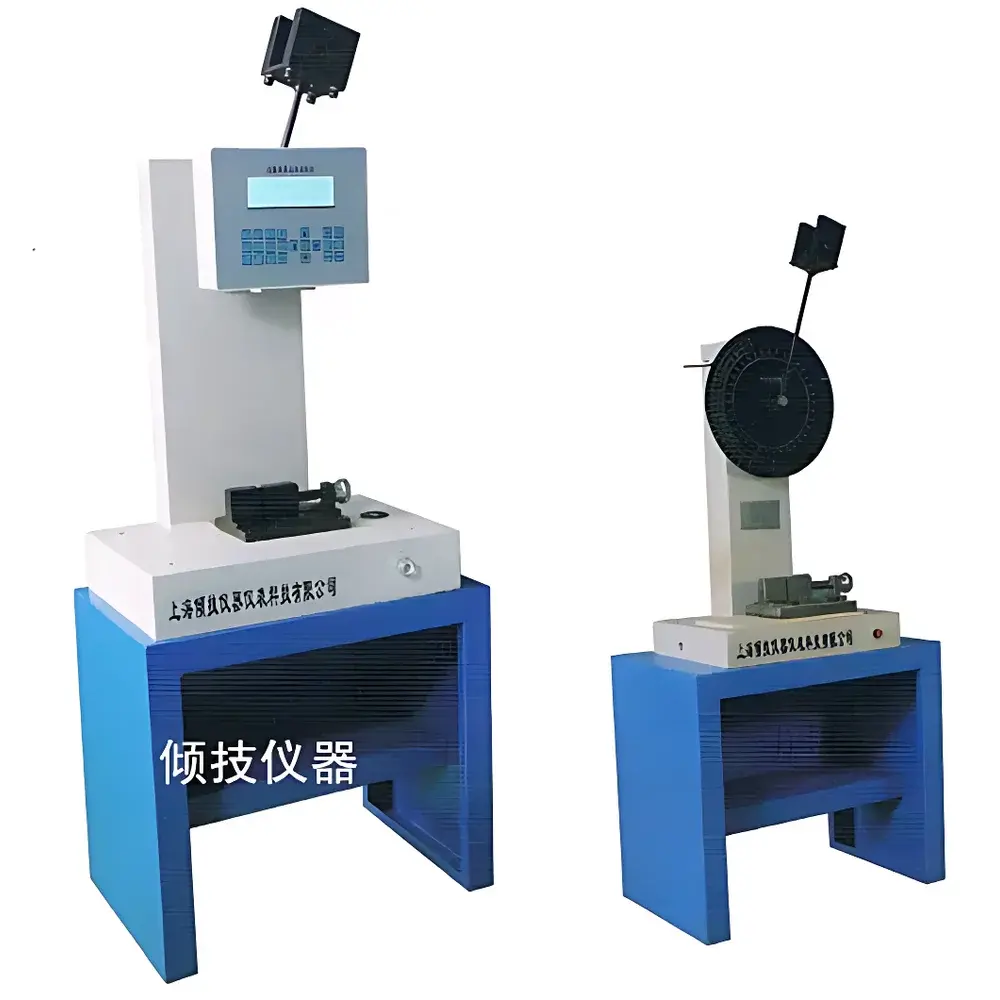
Qinji QJBCX- Ceramic Cantilever Beam Impact Tester
| Brand | Qinji |
|---|---|
| Origin | Shanghai, China |
| Model | QJBCX- |
| Impact Energies | 1 J, 2.75 J, 5.5 J, 11 J, 22 J |
| Pendulum Torque (Impact Constant) | 1 J, 2.75 J, 5.5 J, 11 J, 22 J |
| Load Cell Range | 1 J, 2.75 J, 5.5 J, 11 J, 22 J |
| Impact Velocity | 3.5 m/s |
| Pendulum Pre-lift Angle | 150° |
| Distance from Pivot to Strike Center | 322 mm |
| Notch Radius | R 0.8 mm |
| Dimensions (L×W×H) | 550 mm × 300 mm × 900 mm |
| Power Supply | 220 V ±10%, 50 Hz |
| Net Weight | ~85 kg |
| Compliance | GB/T 1843, ISO 180, GB/T 2611, JB/T 8761 |
Overview
The Qinji QJBCX- Ceramic Cantilever Beam Impact Tester is a precision mechanical testing instrument engineered for the quantitative determination of impact toughness in rigid and semi-rigid non-metallic materials—particularly ceramics, advanced composites, glass-reinforced plastics, electrical insulating materials, and high-performance polymers. It operates on the classical cantilever beam principle: a notched specimen is rigidly clamped at one end while subjected to a pendulum-driven impact at the free end. The energy absorbed during fracture—calculated from the loss in pendulum potential energy—is normalized to specimen cross-sectional area behind the notch to yield impact strength in kJ/m². This method provides reproducible, standardized metrics essential for quality control, material qualification, and comparative mechanical evaluation in R&D and production environments.
Key Features
- Modular pendulum system with five calibrated impact energy levels (1 J, 2.75 J, 5.5 J, 11 J, and 22 J), each corresponding to a dedicated pendulum configuration and verified impact constant
- Precision-machined anvil and clamp assembly ensuring consistent specimen alignment and minimal energy loss at the support interface
- High-stiffness cast-iron frame with vibration-damping base, minimizing extraneous oscillation and enhancing measurement repeatability
- Digital angular encoder and microprocessor-controlled release mechanism enabling accurate pre-lift angle setting (150°) and synchronous trigger timing
- Integrated load cell-based force sensing path—fully traceable to NIST-equivalent calibration protocols—for direct validation of energy absorption profiles
- Ergonomic specimen handling station with adjustable clamping pressure and quick-release notch alignment guide compliant with ISO 180 Type A and GB/T 1843 geometry requirements
Sample Compatibility & Compliance
The QJBCX- is optimized for standardized 80 mm × 10 mm × 4 mm rectangular bars with a 2 mm deep, R 0.8 mm radius U-notch located at mid-span. It accommodates brittle and quasi-brittle ceramic specimens—including alumina, zirconia, silicon carbide, and reaction-bonded silicon nitride—as well as fiber-reinforced polymer laminates and thermoset composites. All mechanical and metrological performance parameters conform to ISO 180:2019 (Plastics — Determination of impact resistance using the cantilever beam method), GB/T 1843–2008 (Chinese national standard equivalent), GB/T 2611–2013 (General requirements for testing machines), and JB/T 8761–1998 (Technical specifications for pendulum impact testers). The system supports GLP-compliant documentation workflows when paired with optional audit-trail-enabled software modules.
Software & Data Management
While the base QJBCX- model operates in standalone analog/digital hybrid mode, it features RS-232 and USB 2.0 interfaces for integration with third-party data acquisition platforms. Optional Qinji ImpactSuite™ software enables automated test sequencing, real-time energy loss curve visualization, statistical reporting (mean, SD, CV%), and export to CSV, PDF, or XML formats compatible with LIMS and ERP systems. All digital records maintain timestamped operator ID, environmental metadata (ambient temperature/humidity), and calibration certificate references—supporting compliance with ISO/IEC 17025:2017 and FDA 21 CFR Part 11 requirements where electronic signatures and audit trails are mandated.
Applications
This tester serves critical roles across multiple technical domains: evaluating thermal shock resistance and flaw tolerance in structural ceramics for aerospace and energy applications; validating batch-to-batch consistency of sintered ceramic substrates used in semiconductor packaging; assessing notch sensitivity in dental zirconia crowns per ISO 6872; qualifying impact performance of ceramic armor tiles under MIL-STD-662F surrogate conditions; supporting ASTM C1161 flexural strength correlation studies; and performing routine QC checks on ceramic insulators in high-voltage transmission infrastructure. Its robust architecture ensures stable operation in ISO Class 8 cleanrooms, university mechanics labs, and accredited materials testing laboratories.
FAQ
What specimen dimensions and notch geometry are required for ISO 180 compliance?
Standard specimens must be 80 mm × 10 mm × 4 mm with a U-notch 2 mm deep and R 0.8 mm root radius, positioned 10 mm from the clamped end.
Can the QJBCX- be used for metallic materials?
No—it is specifically designed and calibrated for non-metallic, brittle-to-semibrittle materials per ISO 180 and GB/T 1843; metallic impact testing requires Charpy or Izod configurations per ISO 148 or ASTM E23.
Is traceable calibration documentation provided with shipment?
Yes—each unit ships with a factory calibration certificate referencing national metrology institute standards, including verification of pendulum moment of inertia, impact velocity (3.5 m/s ±0.2%), and energy scale linearity across all five ranges.
What maintenance intervals are recommended for long-term accuracy?
Biannual verification of pivot friction torque, anvil flatness (≤0.005 mm deviation), and notch gauge wear is advised; annual recalibration by an ISO/IEC 17025-accredited provider is recommended for regulated environments.
Does the system support automated data archiving for regulatory audits?
When equipped with ImpactSuite™ software, full electronic records—including raw sensor traces, operator logs, and calibration history—are stored with SHA-256 hashing and configurable retention policies aligned with 21 CFR Part 11 and EU Annex 11 requirements.
Related Products



