
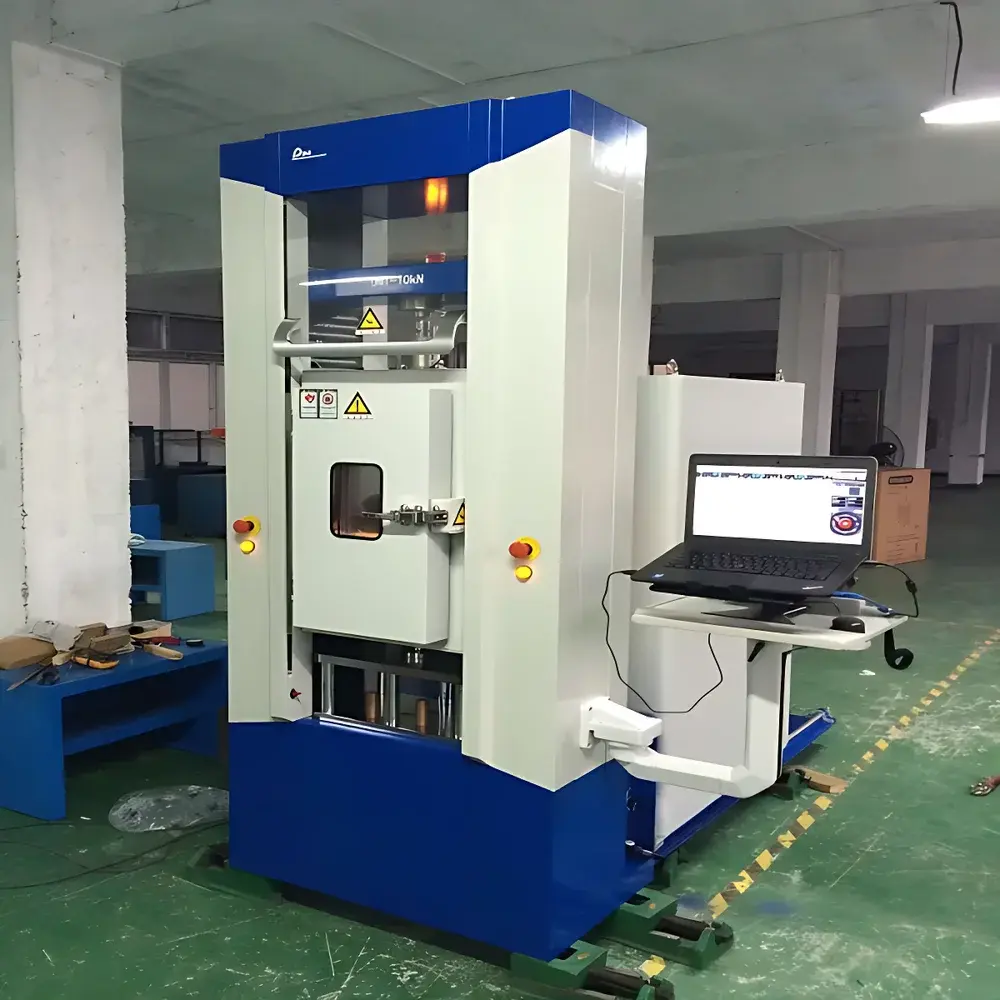
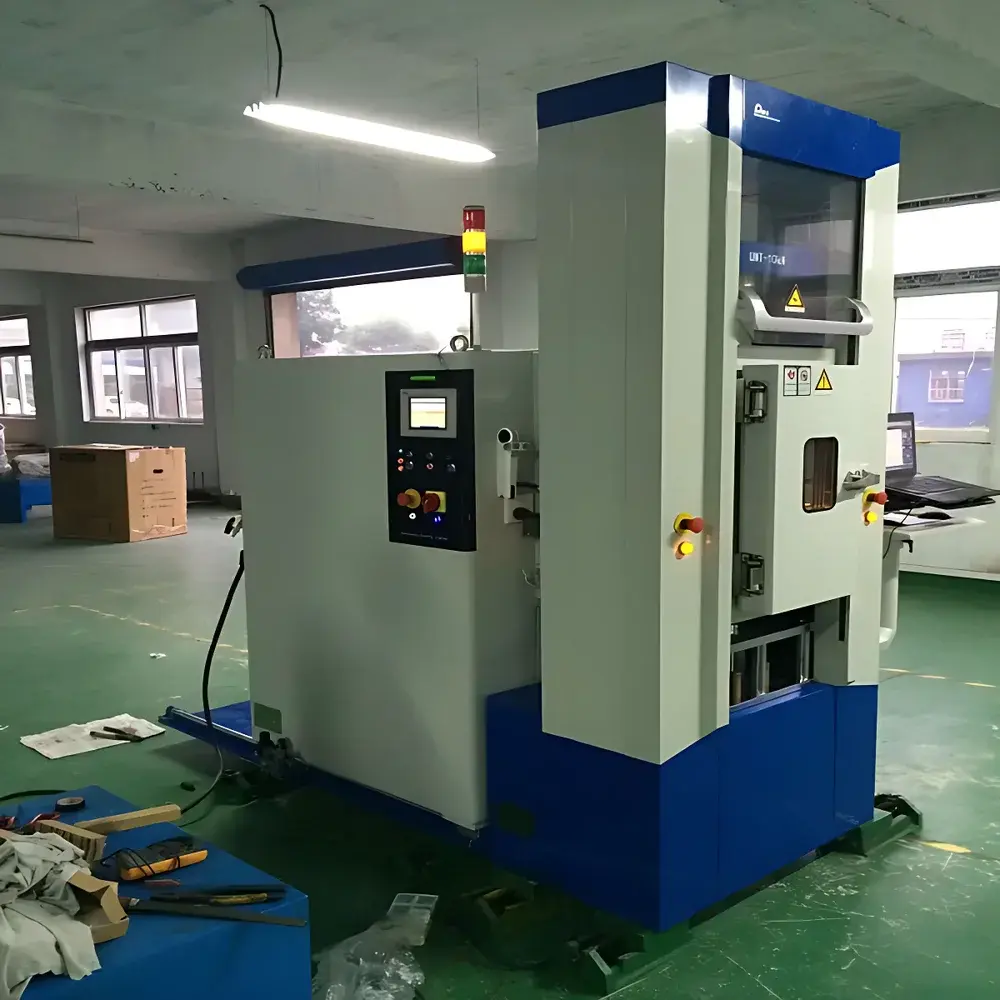
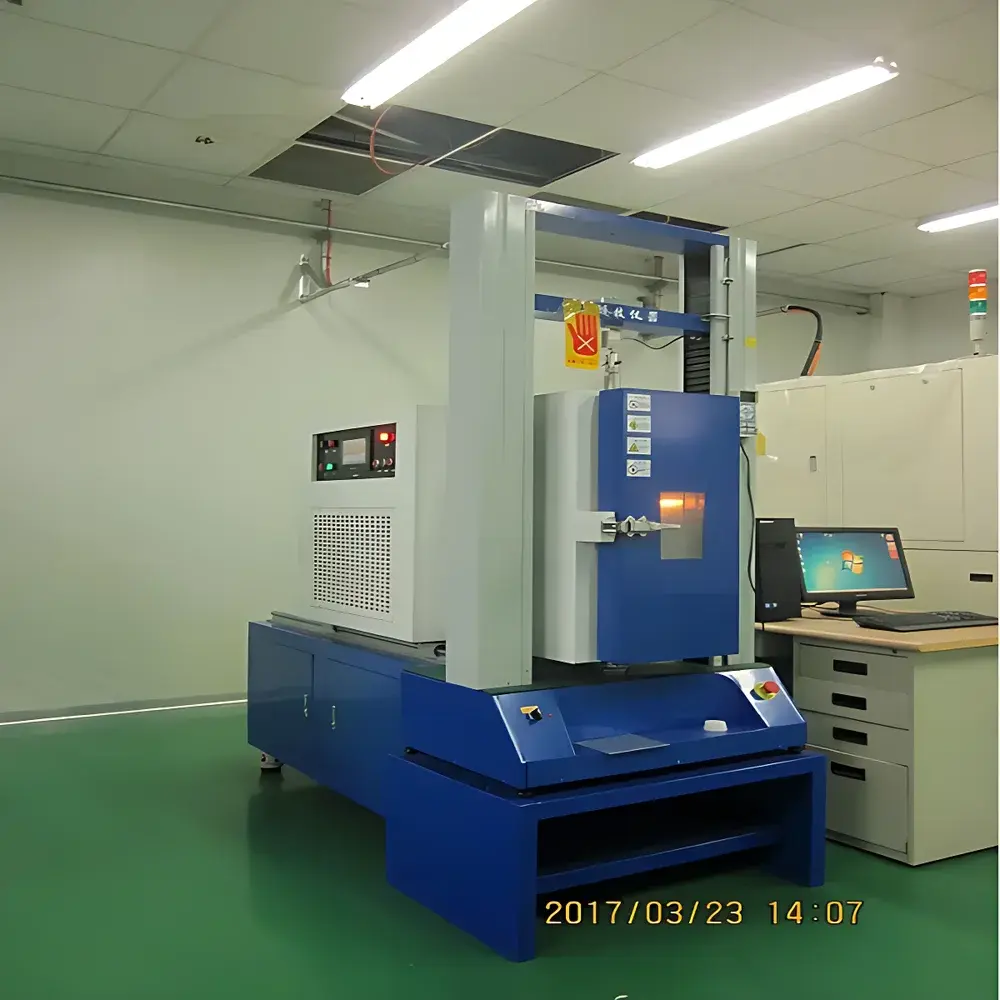
QJ211B High-Low Temperature Universal Testing Machine
| Origin | Shanghai, China |
|---|---|
| Manufacturer Type | Authorized Distributor |
| Origin Category | Domestic (PRC) |
| Model | QJ211B |
| Instrument Type | Electromechanical Universal Testing Machine |
| Load Capacity | 0–30 kN |
| Temperature Range | −70 °C to +350 °C (isothermal at 350 °C) |
| Heating/Cooling Rate | ≥5 °C/min |
| Temperature Controller Resolution | 0.1 °C |
| Effective Test Width | 420 mm |
| Maximum Test Stroke | ~800 mm (extendable) |
| Crosshead Speed Range | 0.001–500 mm/min (or up to 1000 mm stroke) |
| Speed Accuracy | ±0.5% |
| Displacement Measurement Accuracy | ±0.5% |
| Strain/Deformation Measurement Accuracy | ±0.5% |
| Load Cell Accuracy | 0.01% of full scale |
| Force Measurement Uncertainty | <±1% or <±0.5% (per ASTM E4 and ISO 7500-1) |
| Control Interface | Dual-mode — PC-based software + integrated digital controller |
| Safety Systems | Electronic travel limit switches, emergency stop circuit |
| Net Weight | 135 kg |
Overview
The QJ211B High-Low Temperature Universal Testing Machine is an electromechanical materials testing system engineered for precise mechanical characterization of solids and semi-solids across extreme thermal conditions. It integrates a high-stability servo-controlled actuator with a thermally isolated environmental chamber capable of continuous operation from −70 °C to +350 °C under isothermal or ramped profiles. The system operates on the principle of controlled uniaxial force application—measuring load, displacement, and strain in real time—to determine tensile strength, yield point, modulus, elongation at break, peel resistance, tear propagation, compressive stiffness, flexural properties, and low-cycle fatigue behavior. Designed to meet the structural integrity validation requirements of polymer composites, aerospace alloys, elastomers, adhesives, biomedical polymers, and electronic packaging materials, the QJ211B complies with core calibration and performance verification protocols defined in ASTM E4 (Load Cells), ASTM E8/E21 (Tensile Testing of Metals), ASTM D638/D3039 (Plastics and Composites), ISO 7500-1 (Static Calibration), ISO 527 (Tensile Properties), and GB/T 228.1 (Chinese National Standard for Metallic Materials). Its modular chamber design allows rapid detachment for ambient-temperature testing, optimizing lab space utilization and workflow flexibility.
Key Features
- Thermally stable dual-zone environmental chamber with independent heating/cooling circuits and PID-controlled temperature regulation (0.1 °C resolution)
- High-precision 30 kN load cell calibrated to 0.01% of full scale, traceable to national metrological standards
- Electromechanical drive system delivering crosshead speeds from 0.001 to 500 mm/min with ±0.5% speed accuracy over full range
- Dual-control architecture: fully programmable PC-based test software plus embedded digital controller for redundancy and offline operation
- Robust frame with 420 mm effective test width and 800 mm standard stroke (field-extendable to 1000 mm)
- Comprehensive safety suite including hardware-based emergency stop, electronic travel limits, and overload cutoff
- Modular chamber mounting interface enabling quick removal for ambient-only mechanical testing without recalibration
Sample Compatibility & Compliance
The QJ211B accommodates standardized specimens per ASTM, ISO, GB, JIS, and DIN geometries—including dog-bone tensile bars, peel strips, compression cylinders, three-point bend beams, and shear coupons—across widths up to 40 mm and thicknesses up to 25 mm. Environmental chamber internal dimensions support specimen lengths up to 300 mm while maintaining uniform thermal gradients (±2 °C across active zone at steady state). System validation documentation supports GLP-compliant testing environments and satisfies audit requirements for ISO/IEC 17025 accredited laboratories. All force and displacement measurements are traceable to SI units via NIST-traceable calibration certificates; temperature uniformity and stability data comply with ASTM E2203 for thermal chambers used in mechanical testing.
Software & Data Management
The system ships with dedicated Windows-based testing software compliant with FDA 21 CFR Part 11 requirements, featuring role-based user access control, electronic signatures, full audit trail logging, and immutable raw data storage in .tdms or ASCII formats. Test methods are fully customizable using drag-and-drop sequence editors supporting multi-step thermal-mechanical profiles (e.g., pre-condition at −40 °C → ramp to 120 °C at 5 °C/min → hold → apply tensile load at 10 mm/min). Real-time plots display stress–strain, load–displacement, and temperature–time overlays with automatic feature detection (yield onset, peak load, fracture point). Export modules generate PDF reports conforming to ISO 14289-1 (PDF/A) for archival integrity and include metadata such as calibration dates, operator ID, environmental chamber log files, and uncertainty budgets per GUM (Guide to the Expression of Uncertainty in Measurement).
Applications
- Temperature-dependent tensile modulus mapping of thermoplastic matrix composites for automotive lightweighting
- Creep rupture analysis of high-performance elastomers under sustained load at elevated temperatures
- Adhesive bond strength evaluation across thermal cycling (−55 °C ↔ +125 °C) per MIL-STD-883
- Mechanical hysteresis quantification in shape-memory alloys during thermo-mechanical cycling
- Compression set testing of silicone gaskets under combined thermal and mechanical stress per ASTM D395
- Low-cycle fatigue life prediction of solder joints in PCB assemblies subjected to thermal shock profiles
FAQ
Does the QJ211B support automated thermal ramping synchronized with mechanical loading?
Yes—the software enables tightly coupled thermal-mechanical protocols where temperature ramps, holds, and transitions are precisely timed relative to load application, displacement control, or strain rate modulation.
Is third-party calibration certification included with delivery?
Each unit ships with a factory-issued calibration certificate covering load, displacement, and temperature subsystems, traceable to CNAS-accredited reference standards; optional UKAS or DAkkS-certified calibration is available upon request.
Can the system be integrated into a laboratory LIMS or MES environment?
Yes—via OPC UA or TCP/IP API interfaces, the controller supports bidirectional data exchange with enterprise systems for sample ID tracking, result auto-upload, and equipment utilization analytics.
What maintenance intervals are recommended for long-term measurement stability?
Biannual verification of load cell linearity and temperature chamber uniformity is advised; annual full recalibration is recommended for ISO/IEC 17025 compliance; preventive maintenance kits and firmware updates are provided under extended service agreements.
Are custom grips and fixtures available for non-standard specimen geometries?
Yes—custom-designed pneumatic, hydraulic, or mechanical grips—including cryogenic-compatible jaws and high-temperature ceramic-faced clamps—are available through engineering consultation and qualification testing.



