
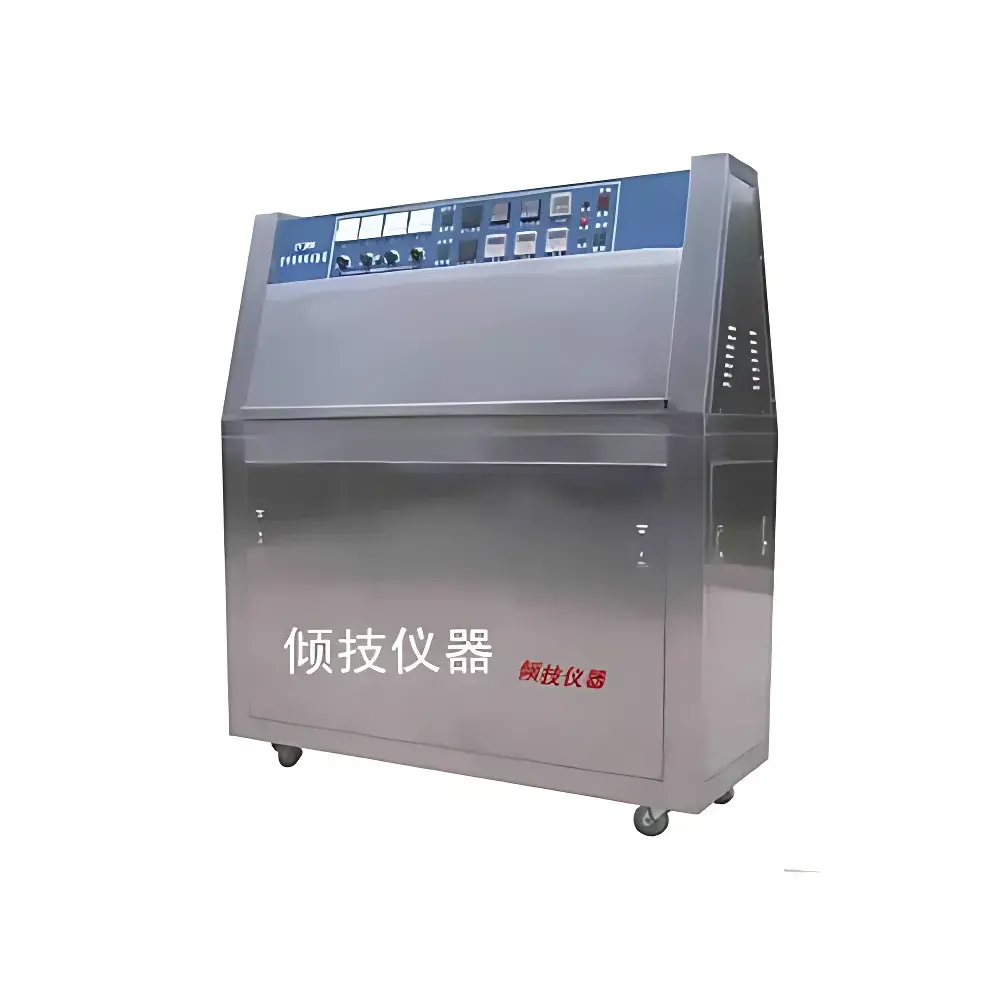
Qingji QUV1003 UV Aging Test Chamber
| Brand | Qingji |
|---|---|
| Origin | Shanghai, China |
| Model | QUV1003 |
| Illumination Temperature Range | RT+10°C to 70°C |
| Black Panel Temperature Range | RT+10°C to 70°C |
| UV Wavelength Range | 280–315 nm (UV-B) |
| Chamber Internal Dimensions (L×W×H) | 450 × 1165 × 500 mm |
| Temperature Uniformity | ±3°C |
| Humidity During Condensation | ≥75% RH |
| Cycle Options | 4 h UV irradiation + 4 h condensation or 8 h UV + 4 h condensation |
| Lamp Center-to-Center Spacing | 65–70 mm |
| Specimen-to-Lamp Distance | 55 mm |
| Standard Specimen Size | 75 × 150 mm |
| Water Consumption | ~8 L/day (deionized or distilled water required) |
Overview
The Qingji QUV1003 UV Aging Test Chamber is an engineered environmental test system designed to accelerate the evaluation of material degradation under controlled ultraviolet radiation, thermal cycling, and moisture exposure. It operates on the principle of xenon-arc–free UV-B irradiation (280–315 nm), replicating the most photochemically aggressive portion of terrestrial sunlight. Unlike broad-spectrum xenon weatherometers, this chamber utilizes fluorescent UV-B lamps to selectively stress polymer-based coatings, paints, plastics, and elastomers—enabling rapid assessment of chalking, gloss loss, color fading, microcracking, delamination, and oxidative embrittlement. The system supports standardized accelerated aging protocols aligned with GB/T 14522–1993, ASTM G154, ISO 4892-3, and JIS D 0205, making it suitable for R&D laboratories, quality control departments, and regulatory compliance testing in automotive, architectural coating, and industrial finishing sectors.
Key Features
- UV-B-specific fluorescent lamp array (280–315 nm) with calibrated spectral output and stable irradiance over lamp lifetime
- Dual-phase cyclic operation: precisely timed UV irradiation followed by condensation-driven moisture exposure at controlled black panel temperature
- Independent control of illumination temperature (RT+10°C to 70°C) and black panel temperature (RT+10°C to 70°C) with ±3°C uniformity across specimen plane
- Condensation humidity maintained at ≥75% RH via heated water reservoir and controlled chamber wall cooling
- Standard specimen capacity for up to ten 75 × 150 mm panels, mounted vertically at fixed 55 mm distance from lamp plane
- Robust stainless-steel interior construction with quartz-filtered UV-transparent viewing window and integrated safety interlock
- Front-access design with quick-release door latch and removable specimen trays for efficient loading/unloading
Sample Compatibility & Compliance
The QUV1003 accommodates flat, rigid specimens up to 3 mm thickness—including solvent-borne and waterborne paint films on metal, plastic, or wood substrates; powder-coated panels; automotive clearcoats; and architectural acrylic emulsions. It is validated for use in accordance with GB/T 14522–1993 (China National Standard for accelerated weathering of plastics, coatings, and rubber), ASTM G154 Class I and II cycles, and ISO 4892-3 Method A (fluorescent UV-condensation exposure). While not inherently 21 CFR Part 11 compliant, its operational logs and cycle parameters can be manually documented to support GLP-aligned reporting workflows in regulated environments.
Software & Data Management
The QUV1003 employs a microprocessor-based digital controller with real-time display of UV irradiance (via optional calibrated sensor), chamber temperature, black panel temperature, and elapsed cycle time. All setpoints and runtime data are stored in non-volatile memory with timestamped event logging. Though the base configuration does not include PC connectivity or automated report generation, the controller supports external data acquisition via analog 0–10 V outputs for temperature and UV intensity signals—enabling integration into centralized lab monitoring systems (e.g., LabVIEW, SCADA) when paired with compatible DAQ hardware. Users may export cycle history manually for inclusion in internal QA documentation or regulatory submission dossiers.
Applications
- Comparative durability screening of automotive OEM and refinish coatings under UV-B/condensation stress
- Formulation development for UV-stabilized architectural paints and exterior wood finishes
- Pre-qualification testing of plastic housings and gaskets used in outdoor electronics enclosures
- Verification of pigment stability and binder resistance to photolytic chain scission in industrial coil coatings
- Supporting technical documentation for ISO 9001-certified manufacturing processes requiring documented environmental aging validation
- Academic research on photooxidation kinetics in polymeric thin films and nanocomposite coatings
FAQ
What UV spectrum does the QUV1003 emit, and how is it relevant to real-world degradation?
It emits UV-B radiation (280–315 nm), the most energetic and damaging segment of solar UV that drives photochemical degradation in organic binders and pigments.
Can the chamber operate continuously without user intervention?
Yes—it supports unattended multi-day cycling with automatic phase transitions between UV exposure and condensation phases.
Is distilled water mandatory for condensation operation?
Yes. Deionized or distilled water is required to prevent mineral deposition on condensing surfaces and lamp sleeves, ensuring long-term optical clarity and thermal stability.
Does the system include calibration traceability or NIST-traceable lamp certification?
Lamp spectral output is factory-characterized per IEC 60068-2-5, but end-user recalibration or third-party irradiance verification is recommended annually for critical applications.
How is specimen temperature monitored during testing?
A black panel thermometer (BPT) is embedded in the specimen plane to measure surface-referenced temperature, which correlates more closely with actual film temperature than air temperature.



