
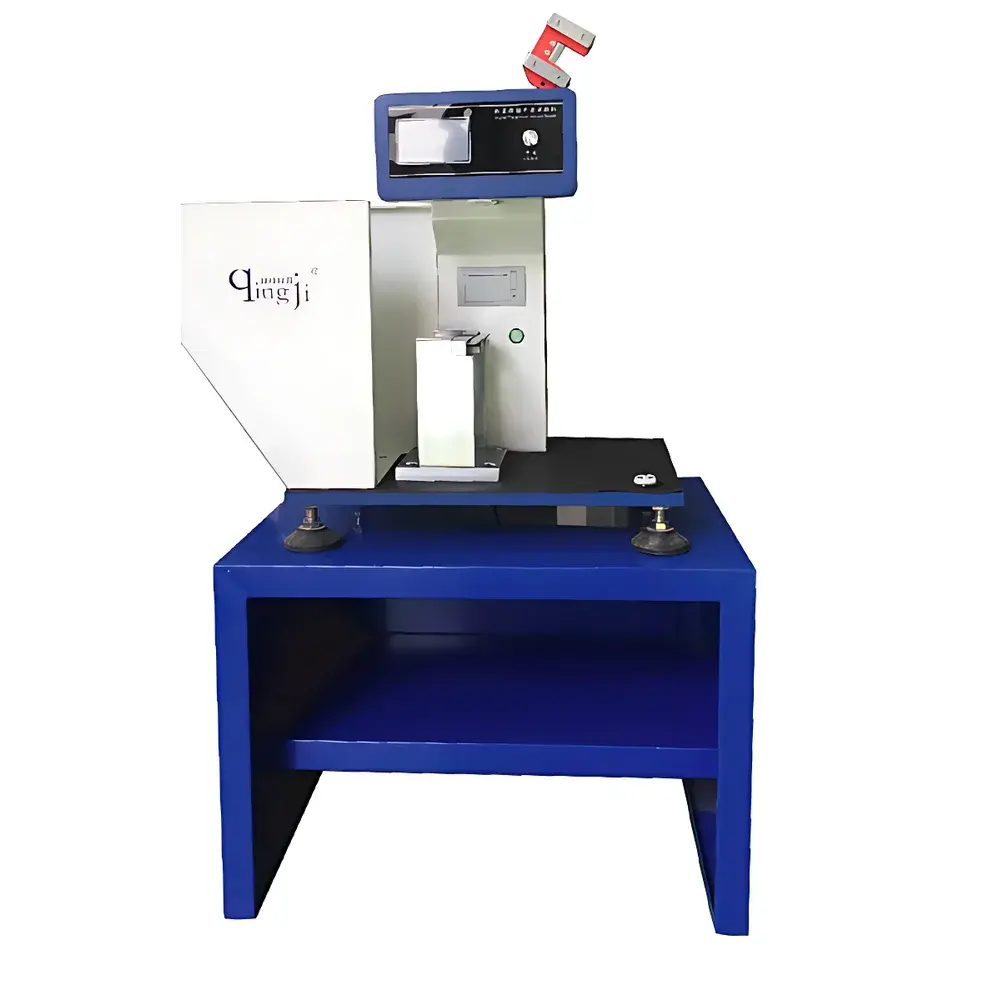
QJBCJ Plastic Charpy/Izod Impact Testing Machine
| Origin | Shanghai, China |
|---|---|
| Manufacturer Type | Authorized Distributor |
| Origin Category | Domestic (PRC) |
| Model | QJBCJ |
| Quotation | USD 4,200 (FOB Shanghai) |
| Instrument Type | Pendulum-Type Impact Tester |
| Impact Energies | 5.5 J, 11 J, 22 J |
| Impact Velocity | 3.5 m/s |
| Pendulum Torque (Impact Constant) | 5.5 J, 11 J, 22 J |
| Load Cell Range | ±0.5 N·m |
| Maximum Hammer Lifting Height | 22 mm |
| Support Span Options | 40 mm, 60 mm, 70 mm, 95 mm |
| Hammer Pre-lift Angle | 160° |
| Distance from Pendulum Axis to Specimen Center | 230 mm |
| Notch Radius (Anvil) | 1 mm |
| Impact Blade Angle | 30° |
| Impact Blade Radius | 2 mm |
| Dimensions (L×W×H) | 280 mm × 250 mm × 500 mm |
| Net Weight | 50 kg |
Overview
The QJBCJ Plastic Charpy/Izod Impact Testing Machine is a precision-engineered pendulum impact tester designed for quantitative determination of the impact toughness and fracture behavior of rigid non-metallic materials under standardized conditions. Based on the principle of conservation of mechanical energy, the instrument measures the energy absorbed by a notched or unnotched specimen during brittle or ductile fracture under a single-point impact load. The system operates in both Charpy and Izod configurations—switchable via specimen clamping orientation—enabling compliance with major international test standards including ISO 179-1 (Charpy), ISO 180 (Izod), ASTM D6110, GB/T 1043.1, GB/T 1843, DIN 53453, and DIN 8078. Its robust cast-iron base, hardened steel anvil and striker assembly, and calibrated pendulum system ensure high repeatability (< ±1.5% CV per ASTM E23) and long-term dimensional stability across laboratory and quality control environments.
Key Features
- Pendulum impact system with three selectable nominal energy levels: 5.5 J, 11 J, and 22 J—each independently calibrated and traceable to national metrological standards;
- Impact velocity fixed at 3.5 m/s at point of contact, maintained via gravity-driven release mechanism with mechanical damping to minimize post-impact oscillation;
- Interchangeable anvils and strikers supporting multiple support spans (40 mm, 60 mm, 70 mm, 95 mm) and notch geometries per ISO/ASTM requirements;
- High-resolution angular encoder and digital torque sensor (±0.5 N·m range) enable real-time energy calculation with automatic zero compensation and thermal drift correction;
- Ergonomic manual lifting mechanism with precise 22 mm maximum lift height and 160° pre-lift angle ensures consistent potential energy input and eliminates operator-induced variability;
- Stainless-steel specimen holder with 1 mm anvil radius and 30° ±0.5° impact blade geometry conforming to ISO 179 Annex B and ASTM D6110 Figure 2 specifications;
- Compact footprint (280 × 250 × 500 mm) and 50 kg net weight facilitate integration into ISO/IEC 17025-accredited testing labs without structural reinforcement.
Sample Compatibility & Compliance
The QJBCJ accommodates standard rectangular bars (e.g., 80 × 10 × 4 mm per ISO 179) and ISO 180-type Izod specimens (63.5 × 12.7 × 3.2 mm), including filled thermoplastics (e.g., GF-PP, carbon-fiber PA6), thermosets (epoxy, phenolic), composites (GFRP, CFRP), ceramics, and rigid elastomers. It supports both unnotched and machined-notch configurations (A, B, C types per ISO 179-2). All mechanical components meet ISO 9001:2015 manufacturing controls and are supplied with calibration certificates compliant with ISO/IEC 17025 requirements. The instrument satisfies essential safety and performance criteria outlined in EN 12477 (machinery safety for impact testers) and is routinely deployed in GLP-regulated environments for material qualification under automotive (SAE J2116), aerospace (AMS 3675), and medical device (ISO 10993-12) supply chains.
Software & Data Management
While the base QJBCJ model operates in analog-digital hybrid mode with direct LCD readout, optional USB-connected PC software (QJBCJ-Link v3.2) provides full audit-trail functionality aligned with FDA 21 CFR Part 11 requirements. The software records timestamped test events—including pendulum angle, energy absorption, peak force, and failure mode classification—with user-level access control, electronic signatures, and encrypted data export in CSV, PDF, and XML formats. All raw sensor outputs are stored with metadata (operator ID, environmental temperature/humidity, calibration date) to support traceability during regulatory audits or interlaboratory proficiency testing (e.g., ILAC-P14).
Applications
- Quality assurance of injection-molded plastic components in automotive interior trim and under-hood applications;
- Comparative evaluation of polymer formulations during R&D—e.g., effect of plasticizer content, UV stabilizers, or nanofiller dispersion on impact resistance;
- Conformance testing of composite laminates used in wind turbine blades per IEC 61400-23;
- Failure analysis of brittle fracture in electrical insulating materials (e.g., epoxy castings, silicone rubber housings) per IEC 60270;
- Teaching laboratories for undergraduate polymer engineering courses covering fracture mechanics fundamentals and standardization principles.
FAQ
Does the QJBCJ comply with ASTM D6110 for Izod impact testing?
Yes—the machine supports both Izod (vertical clamping) and Charpy (horizontal clamping) configurations, and its striker geometry, anvil radii, and support span tolerances meet all dimensional and dynamic requirements specified in ASTM D6110-22.
Is calibration certification included with shipment?
Each unit ships with a factory calibration report traceable to CNAS-accredited reference standards, covering pendulum moment of inertia, impact velocity verification, and energy linearity across all three energy ranges.
Can the system be upgraded to automated release and data capture?
Yes—optional pneumatic release module and QJBCJ-Link software enable fully automated testing sequences, statistical process control (SPC) charting, and integration with LIMS platforms via OPC UA or REST API.
What maintenance intervals are recommended for long-term accuracy?
Biannual verification of pendulum axis alignment, anvil/striker hardness (HRC 58–62), and sensor zero-drift is advised; consumables such as striker blades and anvil inserts are available as certified spare parts with lot-specific calibration documentation.
Is technical support available outside mainland China?
Global field service and remote diagnostics are provided through authorized distributors in EU, North America, and ASEAN regions, with English-language documentation and ISO 13485-compliant service records.



