
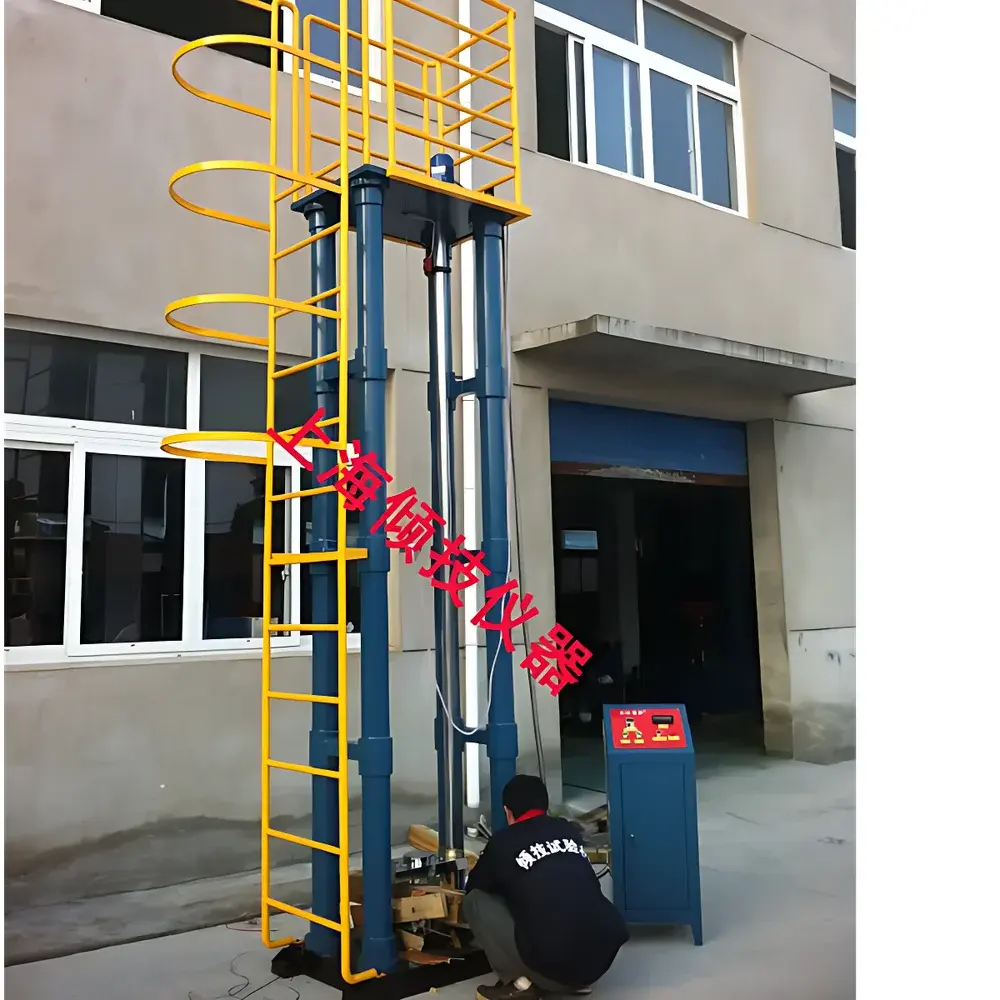
Qingji QLLC-2 High-Energy Impact Force Tester
| Brand | Qingji |
|---|---|
| Origin | Shanghai, China |
| Model | QLLC-2 |
| Impact Energy | 500 kN |
| Impact Velocity | 10 m/s |
| Maximum Drop Height | 10,000 mm |
| Accuracy Class | Class 1 |
| Measuring Range | 20–500 kN |
| Full-Scale Accuracy | ±1% |
| Drop Height Resolution | 0.1 mm |
| Standard Weights | 2, 3, 4, 5, 10, 20, 50, and 100 kg (AISI 1045 steel) |
| Weight Tolerance | ±1% |
| Control & Data Acquisition System | Integrated QJLC17.7.Ttest software platform |
Overview
The Qingji QLLC-2 High-Energy Impact Force Tester is a precision-engineered drop-weight impact testing system designed for quantitative mechanical characterization of brittle and ductile materials under high-strain-rate loading conditions. Operating on the principle of controlled gravitational free-fall impact, the instrument delivers reproducible kinetic energy to test specimens via calibrated weights dropped from precisely adjustable heights—enabling direct measurement of peak impact force, dynamic deformation, time-resolved force-time response, and energy absorption behavior. Unlike conventional Charpy or Izod pendulum testers, the QLLC-2 employs a rigid, low-inertia load frame with high-frequency piezoelectric force transducers and synchronized high-speed data acquisition (≥1 MHz sampling rate), allowing full capture of transient mechanical events occurring within microseconds. It is engineered for laboratory and industrial quality control environments where ASTM E2298 (Standard Test Method for Instrumented Impact Testing of Metallic Materials), ISO 148-2, and GB/T 2611-compliant validation is required.
Key Features
- High-resolution drop height adjustment (0–10,000 mm, ±0.1 mm repeatability) via servo-controlled lifting mechanism with optical position feedback
- Modular weight set (2–100 kg, AISI 1045 steel) enabling flexible energy calibration across 20–500 kN force range
- Class 1 accuracy certified force measurement system with integrated thermal drift compensation and real-time sensor diagnostics
- Dual-channel synchronized acquisition: simultaneous recording of force (kN), displacement (mm), and time (µs) with timestamp alignment
- Rigid C-frame construction with reinforced base plate and anti-rebound damping to minimize structural resonance and ensure measurement fidelity
- Integrated safety interlocks including infrared beam curtains, emergency stop circuitry, and automatic weight locking during positioning
Sample Compatibility & Compliance
The QLLC-2 accommodates standardized specimens per ASTM E23, ISO 148-1, and GB/T 229—including notched and unnotched bars (10 × 10 × 55 mm), cylindrical rods, rock cores (up to Ø100 mm × 200 mm), and custom-shaped hard materials such as sintered carbides, diamond compacts, graphite electrodes, and high-strength alloys. Its modular anvil and support fixture design permits rapid reconfiguration for tensile-bar impact, bending-impact, or compression-impact configurations. All hardware and firmware comply with CE machinery directive (2006/42/EC), electromagnetic compatibility (2014/30/EU), and IEC 61000-6-2/6-4 standards. The system supports GLP/GMP audit trails and meets data integrity requirements aligned with FDA 21 CFR Part 11 when deployed with user-access controls and electronic signature modules.
Software & Data Management
The QJLC17.7.Ttest software platform provides a unified interface for test setup, real-time monitoring, post-test analysis, and regulatory reporting. It supports multi-curve overlay, derivative calculation (e.g., dF/dt for impact stiffness estimation), energy integration (area under force-displacement curve), and automated pass/fail evaluation against user-defined thresholds. Raw binary data (.qdt) is stored with embedded metadata (operator ID, calibration certificate ID, environmental conditions). Export formats include CSV, XML, and PDF reports compliant with ISO/IEC 17025 documentation requirements. Software validation documentation (IQ/OQ/PQ protocols) is available upon request for regulated laboratories.
Applications
- Dynamic fracture toughness assessment of geological core samples and mining tool inserts
- Impact resistance qualification of cemented carbide cutting tools and wear-resistant coatings
- Energy absorption profiling of aerospace-grade composites and structural plastics under crash-relevant strain rates
- Validation of heat-treated steel microstructure performance in high-velocity impact scenarios
- Calibration reference for field-deployable impact sensors used in blast and ballistic testing
- Research into rate-dependent plasticity and adiabatic shear band formation in high-strength alloys
FAQ
What standards does the QLLC-2 support for impact testing?
It supports ASTM E2298, ISO 148-2, GB/T 2611, and GB/T 229 for instrumented drop-weight impact testing, with traceable calibration certificates issued by CNAS-accredited labs.
Can the system be integrated into a LIMS or MES environment?
Yes—via TCP/IP API and OPC UA protocol support, enabling bidirectional data exchange with laboratory information management systems and manufacturing execution systems.
Is remote calibration and diagnostic support available?
Qingji provides secure remote desktop access for firmware updates, sensor recalibration assistance, and troubleshooting—subject to customer network policy approval.
What maintenance intervals are recommended for long-term accuracy?
Annual verification of drop height encoder linearity, force transducer sensitivity, and mechanical alignment is recommended; biannual inspection of guide rail wear and damping fluid levels is advised for high-throughput facilities.
Related Products



