
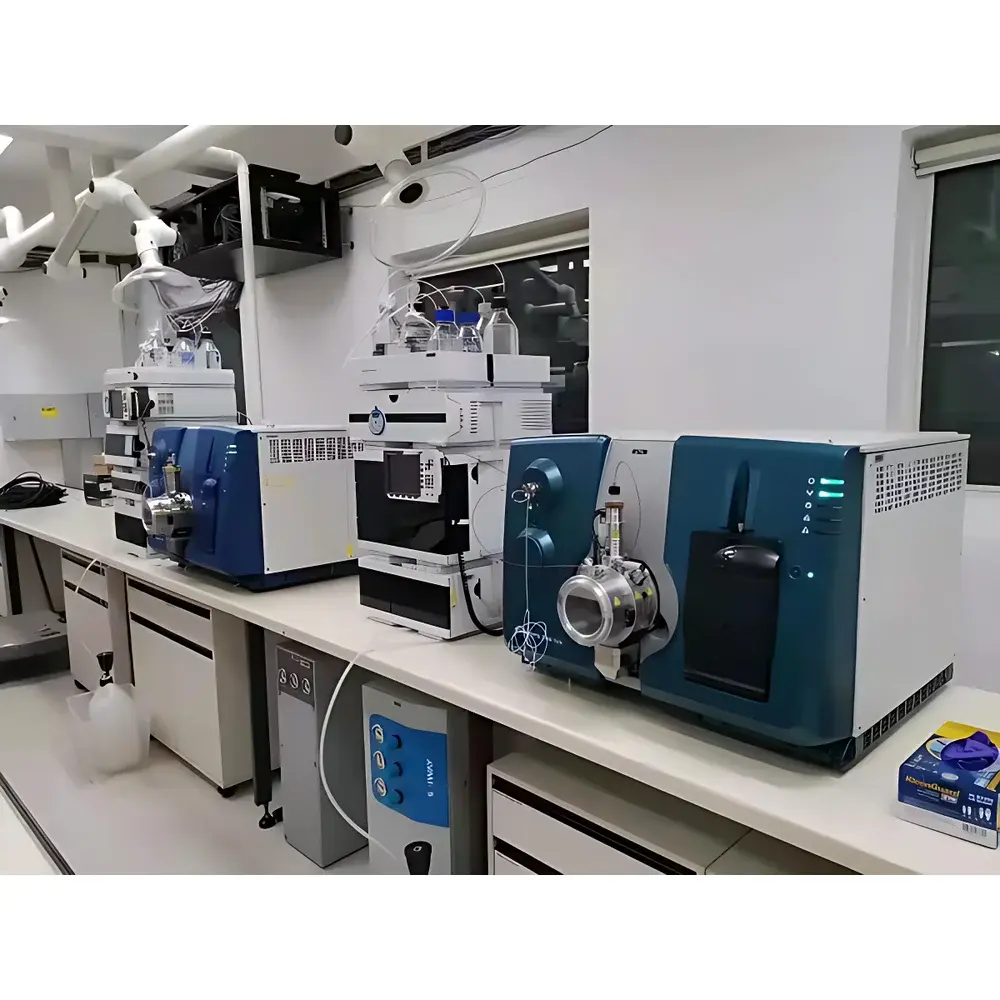
SCIEX Triple Quad 5500 LC-MS/MS System (Refurbished)
| Brand | SCIEX |
|---|---|
| Origin | USA |
| Model | SCIEX 5500 |
| Instrument Type | Triple Quadrupole Mass Spectrometer |
| Configuration | Liquid Chromatography Tandem Mass Spectrometry (LC-MS/MS) |
| Mass Range | m/z 5–2000 (typical for QqQ operation) |
| Polarity Switching Speed | ≤ 50 ms |
| MRM Dwell Time | down to 1 ms |
| Ion Source Options | Turbo V™, DuoSpray™, PhotoSpray™ |
| Ion Guide | QJet™ 2 Collision Cell |
| Software Platform | Analyst® 1.7.1 or later |
| Regulatory Compliance | Designed for 21 CFR Part 11–compliant workflows (audit trail, electronic signatures, user access control) |
Overview
The SCIEX Triple Quad 5500 LC-MS/MS System is a high-performance, refurbished triple quadrupole mass spectrometer engineered for robust, high-sensitivity targeted quantitative analysis in regulated and research-intensive environments. Operating on the principle of tandem mass spectrometry—where precursor ions are selected in Q1, fragmented in a collision cell (Q2), and product ions are analyzed in Q3—the system delivers exceptional specificity, dynamic range, and reproducibility for multiple reaction monitoring (MRM) assays. Its architecture integrates advanced ion optics, rapid polarity switching electronics, and thermally stable ion source designs to maintain analytical integrity across complex biological matrices, including plasma, tissue homogenates, environmental extracts, and food digests. As a legacy platform widely deployed in pharmaceutical development labs since its commercial release, the refurbished 5500 retains full functional equivalence to new-unit performance when validated per ICH Q2(R2) and ASTM E2687-22 guidelines.
Key Features
- Next-generation eQ™ electronics enabling ≤50 ms polarity switching and sub-millisecond MRM dwell times—critical for high-speed UHPLC separations with peak widths <5 s.
- QJet™ 2 ion guide technology offering enhanced ion transmission efficiency, improved collisional focusing, and reduced neutral gas load—contributing directly to signal stability and long-term sensitivity retention.
- Modular ion source compatibility: standard Turbo V™ electrospray interface; optional DuoSpray™ for parallel positive/negative mode screening; PhotoSpray™ for atmospheric pressure photoionization (APPI) of non-polar analytes.
- Integrated split waste valve and optimized vacuum architecture reduce maintenance frequency and extend turbo pump lifetime under continuous operation.
- Analyst® software v1.7.1+ provides comprehensive method setup, real-time data acquisition, automated calibration, and built-in reporting templates aligned with GLP/GMP documentation requirements.
Sample Compatibility & Compliance
The Triple Quad 5500 supports direct injection, microflow, and nano-LC configurations, accommodating sample volumes from 1 µL to 100 µL with minimal carryover (<0.005%). It meets essential regulatory benchmarks for bioanalytical method validation, including FDA Bioanalytical Method Validation Guidance (2018), EMA Guideline on Bioanalytical Method Validation (2022), and ISO/IEC 17025:2017 for testing laboratories. Full 21 CFR Part 11 compliance is achievable through optional software licensing, enabling secure user authentication, electronic signatures, audit trail logging, and data integrity controls required for submissions to regulatory agencies.
Software & Data Management
Analyst® software serves as the central operational interface, supporting both acquisition and processing workflows. It includes automated peak integration algorithms, internal standard ratio calculations, batch reprocessing capabilities, and export formats compatible with LIMS and ELN systems (e.g., CSV, XML, .wiff). Raw data files (.wiff) are stored in vendor-native format with embedded metadata—including instrument parameters, calibration history, and operator ID—ensuring traceability throughout the data lifecycle. Optional MultiQuant™ software extends quantitation functionality for large-scale biomarker and metabolite panels, while Skyline integration enables open-source method sharing and cross-platform verification.
Applications
This system is routinely applied in pharmacokinetic (PK) and toxicokinetic (TK) studies for small-molecule drug candidates; targeted proteomics via peptide-level MRM quantification; clinical assay development for therapeutic drug monitoring (TDM); residue analysis of pesticides, mycotoxins, and veterinary drugs in food commodities; and environmental monitoring of persistent organic pollutants (POPs) and endocrine-disrupting compounds. Its demonstrated low limits of quantitation (LOQs) in the low-attomole range—validated using isotopically labeled standards—make it suitable for biomarker discovery follow-up and clinical reference method implementation.
FAQ
Is this refurbished instrument fully validated prior to shipment?
Yes—each unit undergoes full factory refurbishment, including replacement of consumable components (ion sources, detectors, pumps), recalibration against NIST-traceable standards, and performance verification per SCIEX Application Note P/N 405029-01.
Does the system include original manufacturer warranty?
Refurbished units ship with a 12-month parts-and-labor warranty covering all major subsystems, including mass analyzer, detector, vacuum system, and electronics.
Can the Triple Quad 5500 be integrated with third-party LC systems?
Yes—it features standard analog/digital I/O ports and supports remote control via Ethernet using SCIEX API protocols, enabling seamless integration with Agilent, Waters, Shimadzu, and Thermo LC platforms.
What level of training is provided with purchase?
Comprehensive on-site installation qualification (IQ), operational qualification (OQ), and hands-on user training (2 days) are included, covering routine maintenance, method development, troubleshooting, and regulatory documentation practices.
Are software updates and technical support available post-purchase?
SCIEX-certified software patches and security updates remain accessible through the customer portal; priority technical support is offered via phone and remote desktop during business hours (EST), with SLA-based response times defined in the service agreement.





