
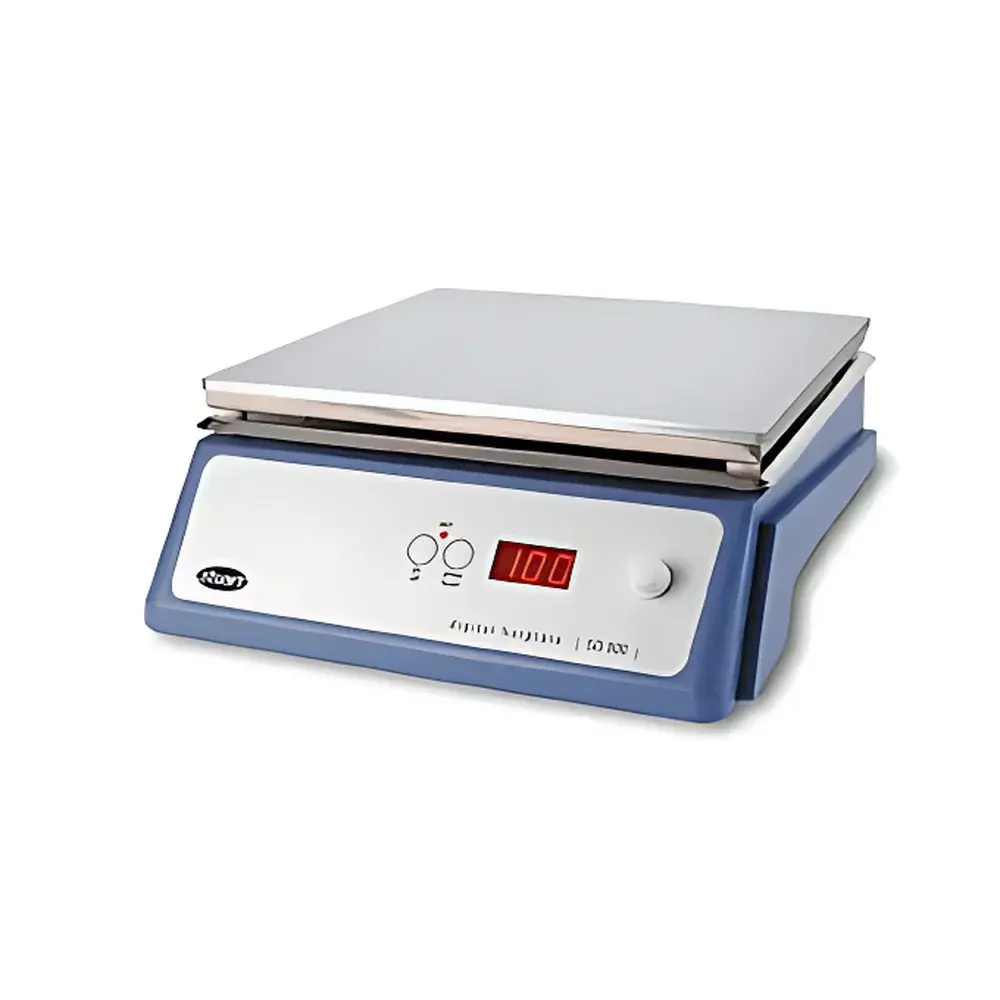
Stuart SD300 & SD500 Digital Programmable Heating Plates
| Brand | Stuart |
|---|---|
| Origin | United Kingdom |
| Model | SD300, SD500 |
| Control Type | Digital |
| Heating Plate Material | Aluminium-Silicon Alloy |
| Plate Dimensions | 300 × 300 mm, 300 × 500 mm |
| Heating Power | 600 W, 1500 W |
| Overall Dimensions (W × D × H) | 320 × 365 × 105 mm, 520 × 360 × 130 mm |
| Temperature Display Resolution | 1 °C |
| Maximum Operating Temperature | 300 °C |
| Net Weight | 6 kg, 12 kg |
| Power Supply | 230 V / 50–60 Hz |
Overview
The Stuart SD300 and SD500 Digital Programmable Heating Plates are precision-engineered laboratory heating platforms designed for consistent, uniform thermal delivery across large surface areas. These instruments operate on resistive heating principles, utilizing embedded planar heating elements beneath a monolithic aluminium-silicon alloy plate to achieve rapid thermal response and exceptional spatial temperature homogeneity. Unlike conventional coil-based or ceramic-top plates, the SD-series employs a distributed thin-film heating architecture that eliminates localized hot spots and ensures minimal radial temperature deviation—typically ≤ ±3 °C from center to edge under steady-state conditions. This performance profile makes them especially suitable for applications requiring reliable, reproducible thermal environments over extended durations, such as cell culture plate warming, slide drying, solvent evaporation, and sample pre-conditioning prior to digestion or extraction protocols.
Key Features
- Digital microprocessor-based temperature control with real-time LED display (1 °C resolution) for precise setpoint definition and monitoring.
- Aluminium-silicon alloy heating surface offering high thermal conductivity (>180 W/m·K), mechanical robustness, and resistance to abrasion and thermal shock.
- Two platform configurations: SD300 (300 × 300 mm active area, 600 W power) and SD500 (300 × 500 mm active area, 1500 W power), enabling scalability based on throughput and sample footprint requirements.
- Integrated over-temperature protection circuitry with visual alert (flashing LED indicator) and automatic cut-off to prevent thermal runaway or equipment damage.
- Low-profile, stable chassis design with non-slip rubber feet and reinforced structural geometry to minimize vibration transmission during sensitive operations.
- Compliance with IEC 61010-1:2010 safety standards for electrical equipment used in laboratory environments.
Sample Compatibility & Compliance
The SD300 and SD500 accommodate standard multiwell plates (6–96-well), microscope slides, Petri dishes, glassware (e.g., beakers, flasks up to 1 L), and digestion vessels—including borosilicate and PTFE-lined containers—within their respective working envelopes. The flat, chemically inert surface resists corrosion from common reagents (e.g., dilute acids, alcohols, acetone) and supports routine cleaning with ethanol or mild detergent solutions. Both models meet CE marking requirements and conform to EN 61326-1:2013 for electromagnetic compatibility (EMC) in laboratory settings. While not certified for use in explosion-proof or Class I/II hazardous locations, they are routinely deployed in ISO 17025-accredited testing laboratories where thermal traceability and operational repeatability are mandated per internal SOPs.
Software & Data Management
These units operate as standalone analog-digital hybrid controllers with no external software dependency. All operational parameters—including set temperature, real-time surface reading, and fault status—are managed via front-panel push-button interface and displayed on a dual-digit LED screen. Though lacking USB or Ethernet connectivity, the microprocessor firmware incorporates non-volatile memory to retain last-used settings after power cycling. For regulated environments governed by GLP or GMP frameworks, users may integrate the SD-series into broader instrument qualification protocols (IQ/OQ/PQ) using calibrated external thermocouple probes (e.g., PT100 or Type K) and manual logbook entries. No data export functionality is provided; however, the stability and repeatability of thermal output support audit-ready documentation when paired with validated calibration procedures aligned with ISO/IEC 17025 clause 6.4.
Applications
- Pre-warming of cell culture plates and reagent reservoirs prior to assay setup.
- Controlled drying of histological sections and cytological smears without curling or cracking.
- Thermal conditioning of samples before microwave-assisted acid digestion (e.g., EPA Method 3051A).
- Evaporation of solvents from extracted analytes in environmental and food testing workflows.
- Stabilization of reaction mixtures during enzymatic assays requiring constant low-to-moderate heat input (e.g., 37–65 °C range).
- Supporting ASTM D5291 (determination of ash content) and ISO 11885 (heavy metals in water) sample preparation steps.
FAQ
What is the maximum recommended load weight for the SD500 heating plate?
The SD500 is engineered to support static loads up to 5 kg evenly distributed across its surface; exceeding this may affect thermal uniformity and long-term mechanical integrity.
Can these units be used with temperature probes for closed-loop feedback control?
No—the SD-series does not feature an input port for external probe integration. Temperature regulation is open-loop, based solely on internal sensor feedback from the alloy plate substrate.
Is the heating surface compatible with acidic digestions involving HNO₃ or HF?
While the aluminium-silicon alloy exhibits moderate resistance to diluted mineral acids, direct contact with concentrated hydrofluoric acid (HF) is strictly prohibited due to risk of rapid etching and surface degradation.
Do the SD300 and SD500 comply with FDA 21 CFR Part 11 requirements?
No—these are Class A laboratory utility devices without electronic record generation, audit trail, or user authentication capabilities required under Part 11.
What calibration interval is recommended for routine use?
Stuart recommends annual verification against a NIST-traceable reference thermometer at three points (ambient, 100 °C, and 300 °C) per ISO/IEC 17025 guidance for thermal instrumentation.
Related Products



