
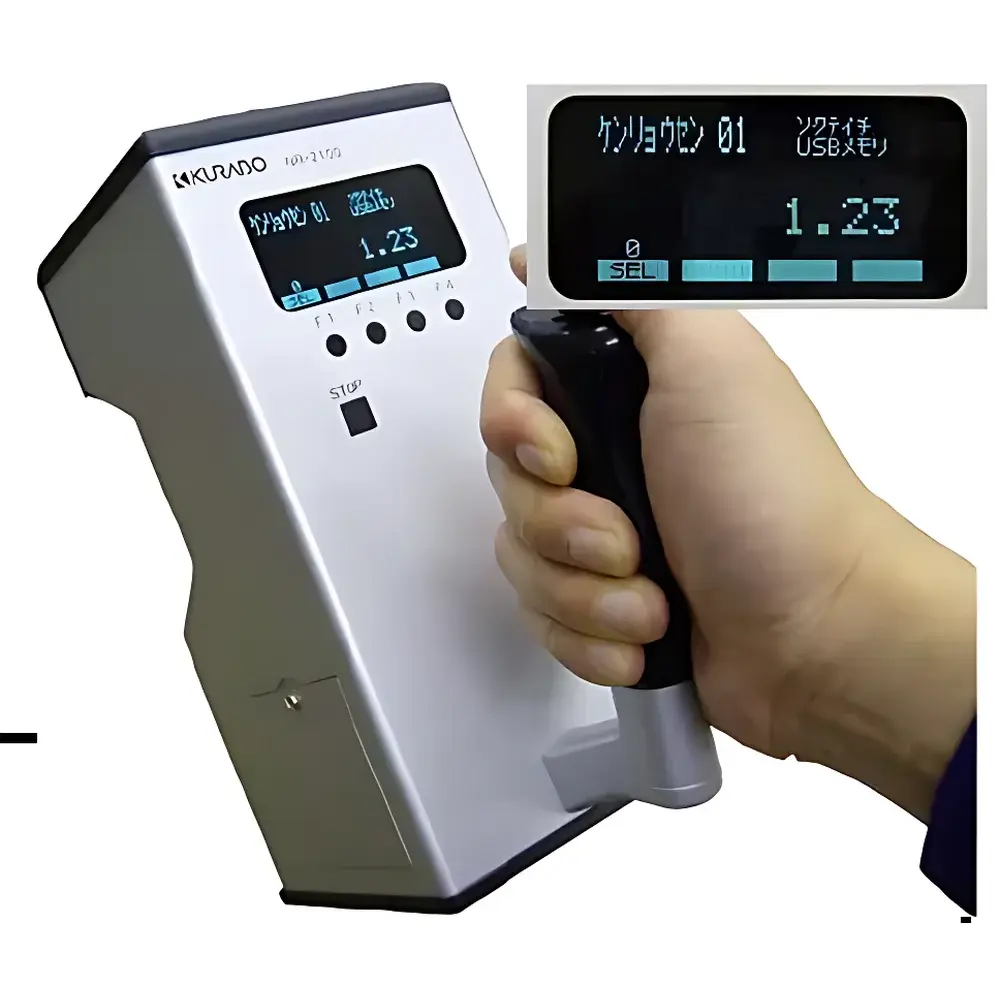
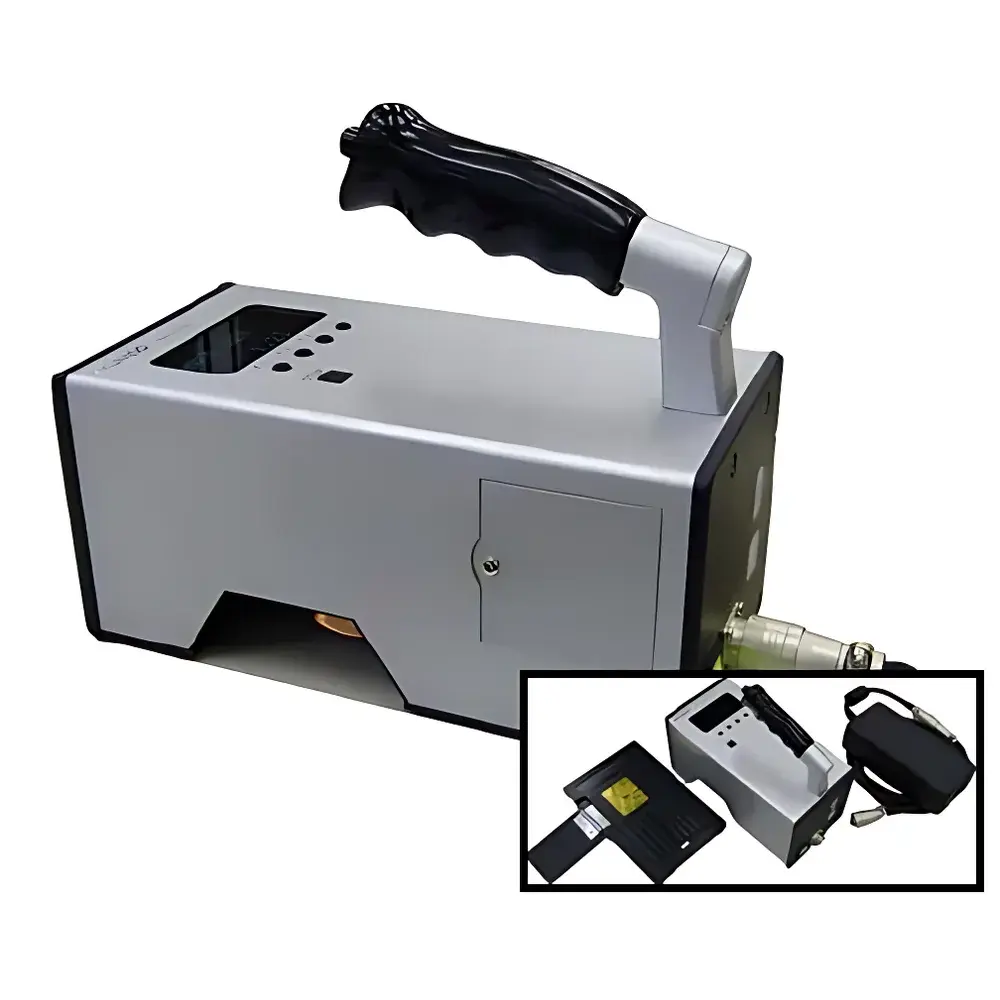
Kurabo NR-2100IB Infrared Oil and Passivation Film Thickness Analyzer
| Brand | Kurabo |
|---|---|
| Origin | Japan |
| Model | NR-2100IB |
| Measurement Principle | Infrared Reflectance Absorption (Rotating Filter Method) |
| Thickness Range | 0.1–10 µm |
| Repeatability | < 0.01 µm |
| Measurement Area | 518 × 36 mm (elliptical) |
| Dimensions (W×D×H) | 100 × 210 × 145 mm |
| Weight | ~1.5 kg |
| Light Source Configuration | P-polarized Incident Beam |
| Integrated Thermal Printer | Yes |
Overview
The Kurabo NR-2100IB Infrared Oil and Passivation Film Thickness Analyzer is a portable, benchtop-grade metrology instrument engineered for non-destructive, quantitative measurement of ultra-thin organic coatings on conductive metallic substrates. It operates on the physical principle of infrared reflectance absorption spectroscopy—specifically leveraging characteristic vibrational absorption bands of hydrocarbon functional groups (e.g., C–H stretch at ~2920 cm⁻¹ and ~2850 cm⁻¹) in lubricating oils, rust inhibitors, passivation layers, and polymer-based barrier films. Unlike optical interferometry or eddy-current methods, the NR-2100IB employs a rotating interference filter to isolate narrowband IR wavelengths, enabling high spectral selectivity without requiring broadband detectors or Fourier-transform optics. The system utilizes p-polarized incident radiation to suppress spurious contributions from surface Fresnel reflection and substrate-induced multiple internal reflections—thereby enhancing signal fidelity for low-absorbance, sub-micron films on highly reflective metals such as cold-rolled steel, aluminum sheet, and tinplate. Its elliptical 518 × 36 mm measurement footprint allows rapid scanning across wide strip sections while maintaining uniform illumination geometry and calibrated path-length consistency.
Key Features
- Proprietary p-polarized infrared illumination architecture minimizes specular reflection artifacts and improves baseline stability on mirror-finish metal surfaces.
- Rotating optical filter mechanism delivers wavelength-specific excitation without mechanical shuttering or thermal drift—ensuring long-term calibration integrity.
- Integrated thermal printer enables immediate hardcopy output of measurement values, timestamps, and operator IDs—supporting traceability in production QA/QC workflows.
- Compact form factor (100 × 210 × 145 mm; ~1.5 kg) and three-point mechanical alignment system facilitate handheld or fixture-mounted operation directly on production lines or coil handling stations.
- Factory-calibrated absorbance-to-thickness correlation curves are preloaded for common industrial formulations—including mineral oil-based rust preventives, fatty acid ester lubricants, acrylic passivation layers, and epoxy-phenolic can coatings.
Sample Compatibility & Compliance
The NR-2100IB is validated for use with flat, rigid metallic substrates exhibiting high infrared reflectivity (>85% at 2900–3000 cm⁻¹), including cold-rolled carbon steel, electrolytic tin-coated steel (ETP), aluminum beverage can stock (AA3004/AA5182), and prepainted metal coils. It complies with ASTM E131 (Standard Terminology Relating to Molecular Spectroscopy) and ISO 2178 (Non-magnetic coatings on magnetic substrates—measurement of coating thickness). While not designed for roughness-compensated analysis, its large-area averaging inherently mitigates localized topographic noise typical of mill-scale or roll-marked surfaces. For regulated environments, the device supports manual entry of batch numbers and operator codes—enabling alignment with GLP documentation practices. Though it does not incorporate electronic audit trails or 21 CFR Part 11-compliant user authentication, its printed records meet basic FDA and IATF 16949 documentation requirements for coating process verification.
Software & Data Management
The NR-2100IB operates as a standalone instrument with no external PC dependency. All calibration coefficients, spectral reference libraries, and measurement algorithms reside in embedded firmware. Data acquisition is fully automated: upon sample placement and trigger activation, the system executes a full spectral scan cycle (typically < 3 seconds), computes film thickness using a linearized Beer–Lambert relationship derived from NIST-traceable reference standards, and outputs the result with uncertainty estimation. Measurement history is retained in volatile memory for up to 100 entries and may be exported via printed reports only—no USB, Bluetooth, or network interface is provided. This design prioritizes operational simplicity, electromagnetic immunity in industrial settings, and avoidance of software validation overhead in GMP-regulated facilities.
Applications
- Quantitative verification of rolling oil residual mass on cold-rolled steel strip prior to annealing or galvanizing—ensuring optimal lubricity without post-process residue carryover.
- In-line monitoring of fingerprint-resistant organic topcoats on pre-painted building panels, where thickness uniformity directly impacts corrosion resistance and gloss retention.
- End-of-line quality control of interior lacquer coatings on two-piece aluminum beverage cans—validating compliance with FDA 21 CFR §175.300 for food-contact surface migration limits.
- Process validation of chromate-free passivation layers on zinc-coated fasteners, where sub-micron organic film integrity determines salt-spray performance per ASTM B117.
- Coating weight auditing of backside insulating layers on color-coated roofing sheets—supporting energy efficiency certification (e.g., ENERGY STAR® Roof Products Program).
FAQ
Can the NR-2100IB measure films on non-metallic substrates such as plastic or glass?
No. The instrument relies on high IR reflectivity from conductive substrates to generate a measurable reference signal; dielectric substrates yield insufficient signal-to-noise ratio for reliable quantification.
Is calibration required before each measurement session?
A daily zero-point verification using a clean, uncoated reference substrate of identical material is recommended. Full recalibration is performed annually by authorized Kurabo service centers using certified reference foils.
Does the device support statistical process control (SPC) data export?
No. SPC-compatible digital output is not available; users must manually transcribe printed results into external SPC software or spreadsheets.
What is the minimum detectable film thickness for mineral oil on steel?
Under controlled environmental conditions (23 ± 2°C, <50% RH), the practical lower limit is 0.12 µm, corresponding to ~0.15 g/m² oil loading based on typical density assumptions.
Can the NR-2100IB distinguish between different oil chemistries?
It cannot identify chemical composition, but differences in C–H bond density and chain branching produce measurably distinct absorbance ratios—enabling empirical differentiation between paraffinic, naphthenic, and synthetic ester-based lubricants when calibrated accordingly.



