
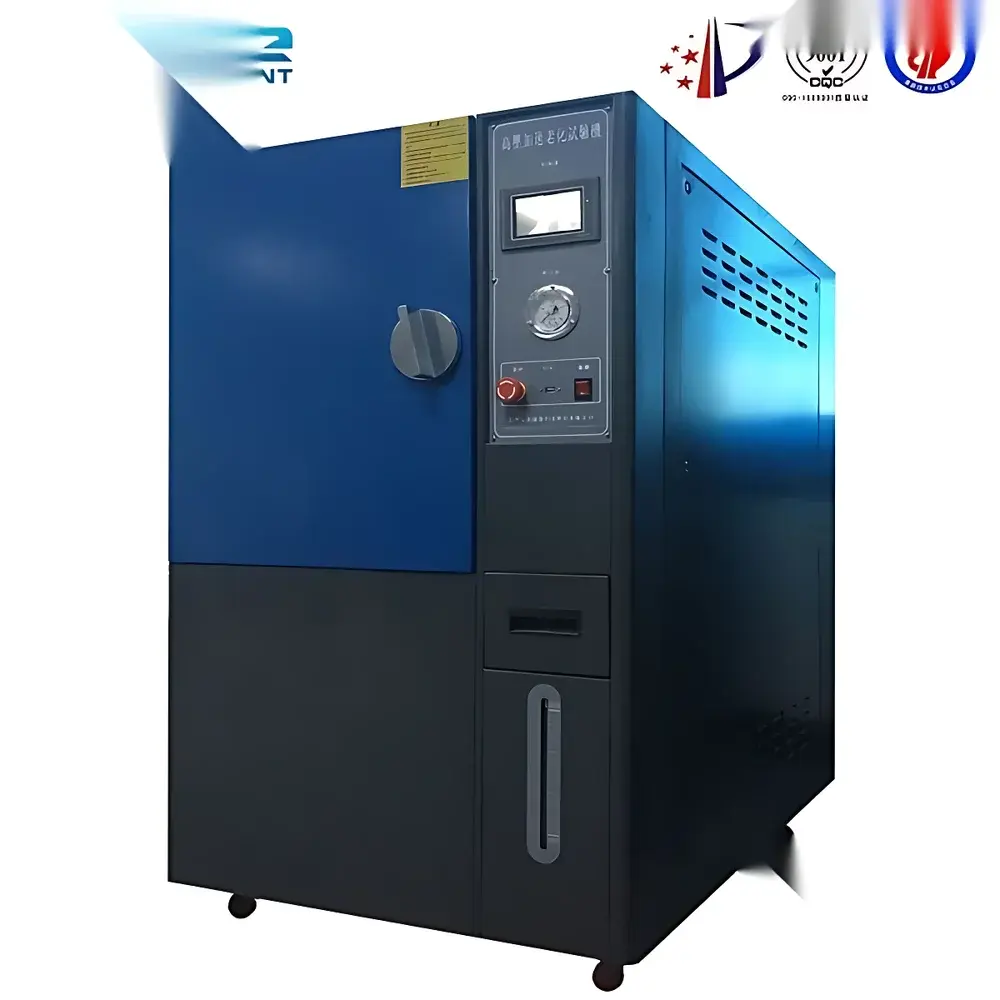
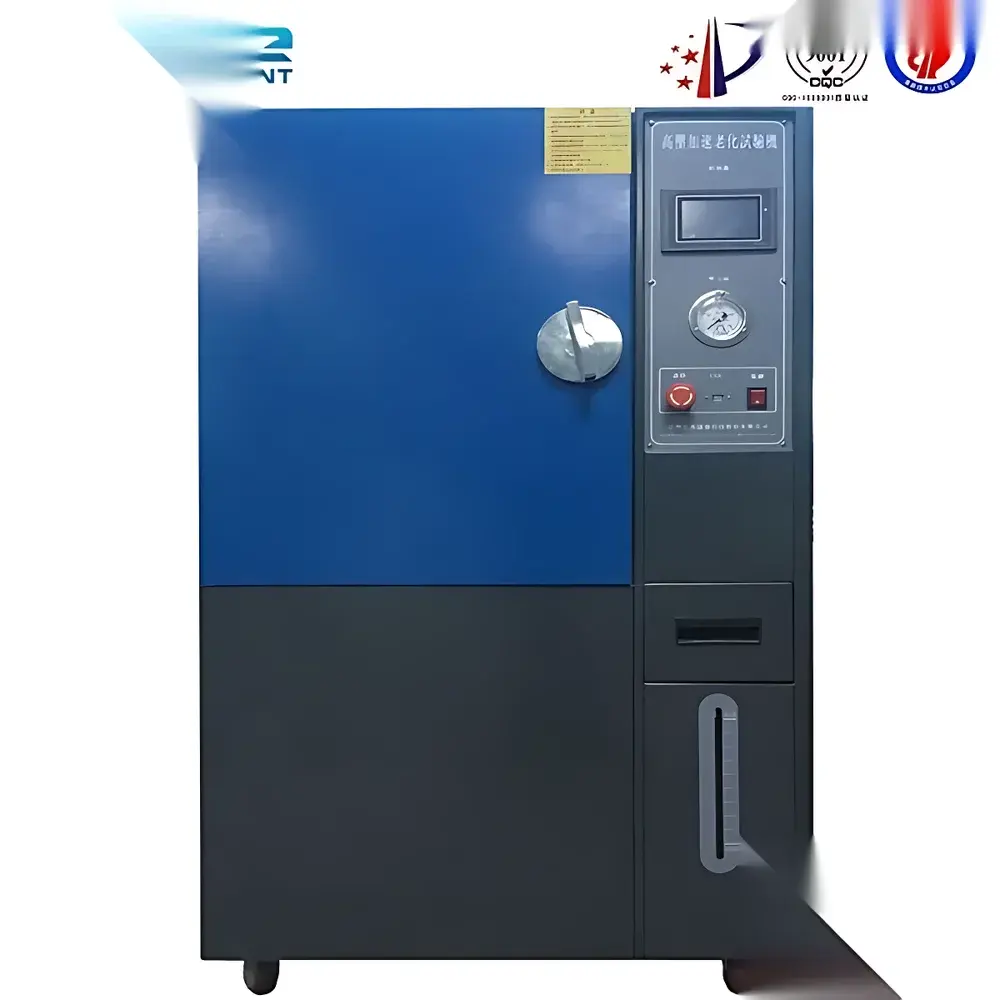
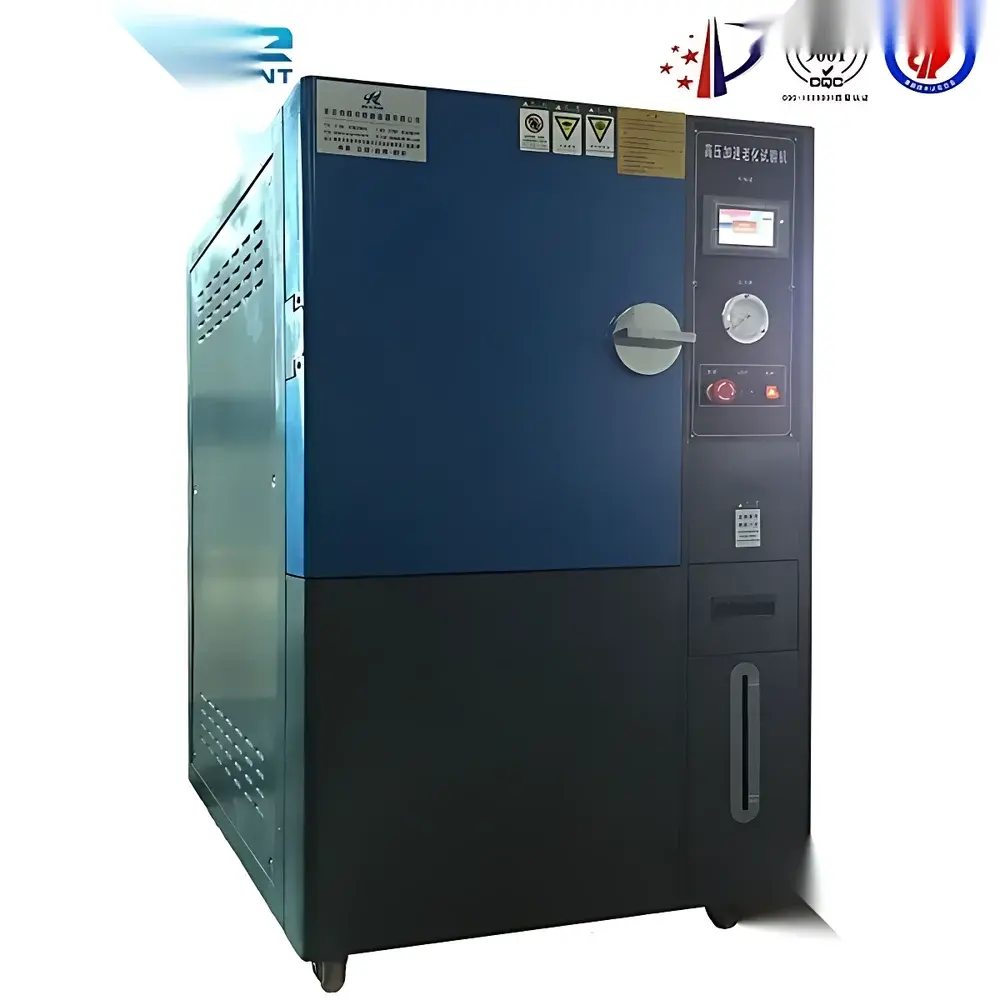
HAST High-Pressure Steam Test Chamber
| Brand | Other Brands |
|---|---|
| Origin | Imported |
| Manufacturer Type | General Distributor |
| Price | USD 14,000 (approx.) |
| Internal Chamber Dimensions | Φ250×450 mm / Φ300×450 mm / Φ400×450 mm |
| Temperature Range | 100–132 °C |
| Humidity Range | 75–100 % RH (saturated steam) |
| Pressure Range | 0–2.5 kg/cm² above ambient atmospheric pressure |
| Circulation Method | Natural convection of saturated steam |
| Temperature Sensor | PT-100 Ω RTD (platinum resistance thermometer) |
| Heating Element | Insulated, high-voltage-rated resistive heater |
| Chamber Material | Stainless steel cylindrical inner chamber with arc-shaped interior walls |
| Sealing Mechanism | Self-tightening elastomeric packing under internal pressure |
| Pre-test Vacuum Function | Integrated vacuum pump with ≤1 µm particulate filtration |
| Safety Protection | Critical-point limit monitoring with fault indication and automatic shutdown |
| Auxiliary Functions | Timed post-test drying cycle |
| Water Management | Automatic water replenishment and controlled pressure release at test completion |
Overview
The HAST High-Pressure Steam Test Chamber is an accelerated environmental stress testing system engineered for reliability validation of electronic components, printed circuit boards (PCBs), semiconductor packages, and insulating materials under elevated temperature, humidity, and pressure conditions. Unlike conventional Temperature-Humidity-Bias (THB) or damp heat tests, this chamber operates on the principle of Highly Accelerated Stress Testing (HAST), leveraging super-saturated steam environments at pressures up to 2.5 kg/cm² above ambient to significantly reduce test duration while maintaining thermodynamic equivalence to real-world failure mechanisms—particularly moisture diffusion-induced corrosion, intermetallic growth, and dielectric degradation. Designed in strict compliance with industry-standard test methodologies—including JEDEC JESD22-A110, JESD22-A118, and IEC 60068-2-66—the chamber replicates worst-case field conditions encountered during storage, transportation, and operational life cycles in humid tropical or sealed enclosure environments.
Key Features
- Cylindrical stainless-steel inner chamber conforming to ASME BPVC Section VIII pressure vessel design guidelines, minimizing condensate pooling and eliminating cold-spot-induced drip contamination;
- Self-sealing elastomeric gasket system: increases sealing force proportionally with internal pressure—distinct from static compression seals—extending gasket service life and ensuring long-term leak integrity;
- Integrated pre-test vacuum evacuation stage with HEPA-class particulate filter (≤1 µm retention), removing ambient air and contaminants prior to steam injection to maintain chamber purity;
- PT-100 Ω platinum RTD sensors mounted at multiple strategic locations for spatial temperature uniformity verification per IEC 60068-3-5;
- Insulated, high-dielectric-strength heating elements rated for continuous operation under saturated steam conditions without thermal runaway risk;
- Automated water replenishment system enabling uninterrupted multi-day test sequences without manual intervention;
- Programmable post-test drying cycle with timed airflow and residual pressure venting to prevent post-test condensation on samples;
- Critical-point limit monitoring with discrete fault-code LED indicators and automatic thermal/pressure shutdown to protect both equipment and DUTs.
Sample Compatibility & Compliance
This chamber accommodates a broad range of sample configurations—from bare die and wafer-level devices to fully assembled modules and encapsulated sensors—within its three standard internal diameters (Φ250, Φ300, Φ400 mm), all sharing a consistent 450 mm depth. The natural convection circulation of saturated steam ensures homogeneous exposure without forced-air turbulence that may disturb delicate surface finishes or solder joints. All structural and control systems comply with CE marking requirements (EMC Directive 2014/30/EU, Machinery Directive 2006/42/EC) and support audit-ready documentation for ISO/IEC 17025-accredited laboratories. When operated per defined test profiles, data generated meets traceability requirements for GLP and GMP environments, including full logging of setpoints, actual readings, alarms, and operator actions—all timestamped and exportable in CSV format.
Software & Data Management
The chamber integrates with optional PC-based control software supporting dual-mode operation: local touchscreen interface for standalone use and Ethernet-connected remote supervision via TCP/IP. Software provides real-time graphical trending of temperature, pressure, and humidity (derived from saturation tables), configurable alarm thresholds, and automated report generation compliant with ASTM E29 and ISO/IEC 17025 record-keeping standards. Audit trails include user login logs, parameter modification history, and calibration event timestamps—fully aligned with FDA 21 CFR Part 11 requirements when configured with electronic signature and role-based access controls. Raw sensor data is stored internally with ≥30-day buffer capacity and supports USB export for third-party statistical process analysis (SPC) integration.
Applications
- Qualification testing of lead-free solder joints and Cu–Al wire bonds under accelerated moisture ingress conditions;
- Reliability screening of molded plastic IC packages (e.g., QFP, BGA, SOP) for delamination and popcorning phenomena;
- Evaluation of conformal coating performance and substrate adhesion stability under cyclic HAST exposure;
- Accelerated aging studies of polymer-based insulators, connectors, and flexible printed circuits;
- Process validation for moisture-sensitive level (MSL) classification per J-STD-020;
- Failure mode analysis (FMA) correlation between HAST-induced defects and field return data.
FAQ
What is the maximum allowable test duration per cycle without manual intervention?
Standard configuration supports unattended operation for up to 96 hours, contingent upon initial water reservoir fill level and ambient water supply connectivity.
Does the chamber meet JEDEC JESD22-A118 requirements for unbiased HAST testing?
Yes—when operated within specified temperature (110–130 °C), pressure (1.1–2.5 kg/cm²), and humidity (≥85 % RH) bands, the system satisfies all physical and procedural criteria outlined in JESD22-A118 Rev. E.
Can the vacuum pre-conditioning step be disabled or bypassed?
The vacuum sequence is programmable and may be omitted for specific test protocols; however, omission voids compliance with IEC 60068-2-66 Annex A recommendations for contaminant control.
Is third-party calibration certification available?
Factory calibration certificates traceable to NIST standards are provided with each unit; accredited on-site calibration services are available through authorized regional partners.
What maintenance intervals are recommended for the sealing system?
Gasket inspection is advised every 200 operational hours or annually—whichever occurs first—with replacement recommended after 1,000 hours of cumulative pressurized operation or visible compression set exceeding 15 %.



