
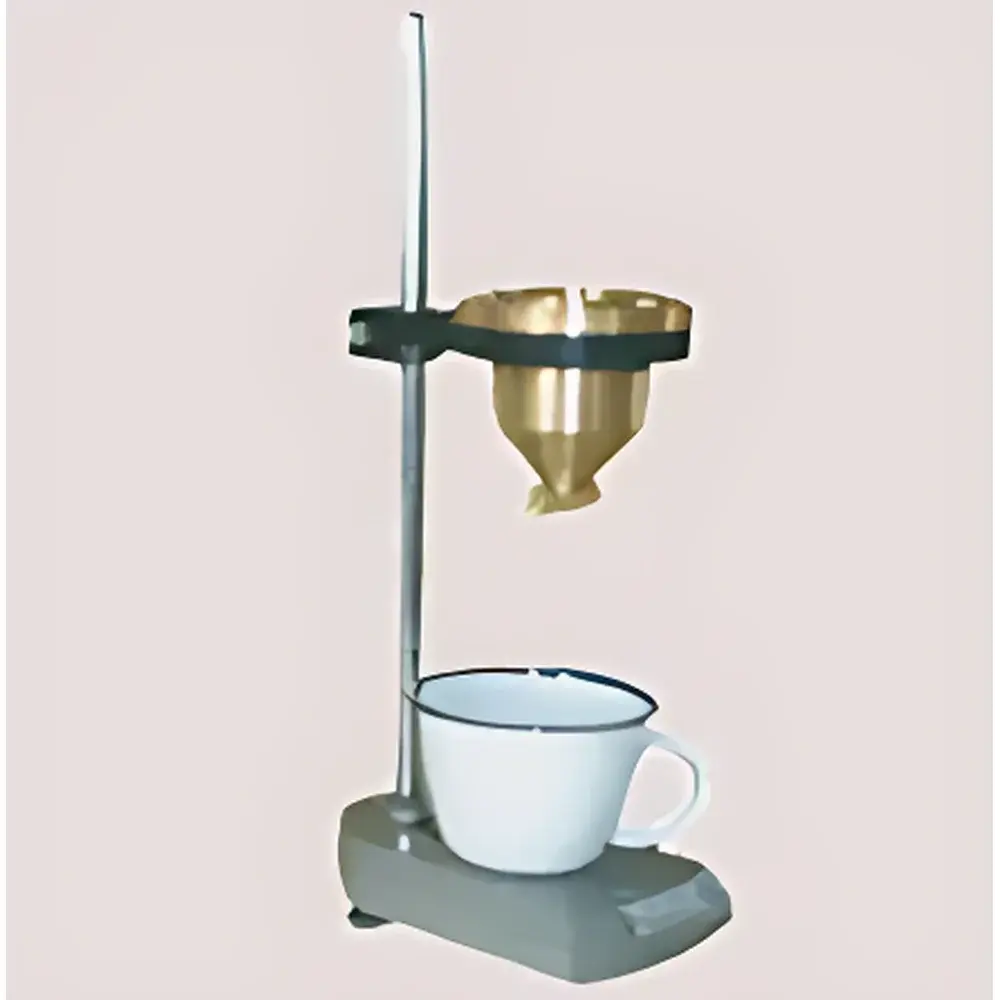
T4 Efflux Viscometer (Cup-Type, ASTM D1200 / GB/T 1723 Compliant)
| Origin | Shanghai, China |
|---|---|
| Manufacturer Type | Authorized Distributor |
| Origin Category | Domestic (China) |
| Model | T4 |
| Price | Upon Request |
| Cup Volume | 100 mL |
| Orifice Diameter | Φ4 mm |
| Temperature Range for Calibration | 25 ± 2 °C |
| Calibration Correction Factor | 0.97–1.03 |
| Max. Measurable Efflux Time | 150 s |
| Material | High-Purity Electrolytic Copper |
| Compliance | GB/T 1723–1993, ASTM D1200–2022, ISO 2431:2019 |
Overview
The T4 Efflux Viscometer is a gravity-driven, cup-type viscometer engineered for rapid, standardized measurement of kinematic viscosity in low-to-medium viscosity liquids—primarily solvent-based and waterborne coatings, varnishes, inks, and industrial fluids. Based on the principle of efflux time measurement under controlled gravitational flow through a precisely machined orifice, the T4 adheres to the fundamental Couette-flow-free methodology defined in GB/T 1723–1993 (“Determination of Viscosity of Paints, Varnishes and Related Products”) and harmonized with international standards including ASTM D1200 (“Standard Test Method for Saybolt Viscosity of Transparent and Opaque Liquids by the Saybolt Universal Viscometer”) and ISO 2431 (“Paints and Varnishes — Determination of Flow Time by Use of Flow Cups”). Unlike rotational rheometers, the T4 delivers conditionally comparable kinematic viscosity values (in seconds) rather than absolute dynamic viscosity (mPa·s), making it ideal for routine QC checks where reproducibility, speed, and inter-laboratory comparability are prioritized over microstructural rheological profiling.
Key Features
- High-precision electrolytic copper cup body ensures dimensional stability, thermal uniformity, and corrosion resistance during repeated solvent exposure.
- Factory-calibrated Φ4 mm stainless steel orifice with tight tolerance control (±0.02 mm), validated at 25 ± 2 °C using certified reference oils traceable to NIM (National Institute of Metrology, China).
- 100 mL nominal cup volume optimized for consistent meniscus positioning and minimal surface tension influence across standard test protocols.
- Integrated correction factor (0.97–1.03) applied to raw efflux time to align measured values with reference kinematic viscosity scales per GB/T 1723 and ASTM D1200 Annex A1.
- Ergonomic handle design with non-slip knurling and vertical alignment guide marks for operator-controlled, repeatable immersion and lift-off timing.
- No power supply, electronics, or software required—enabling use in production lines, field labs, or ISO 8 cleanrooms where electromagnetic interference or validation complexity must be avoided.
Sample Compatibility & Compliance
The T4 viscometer is validated for Newtonian and near-Newtonian liquids with efflux times between 20 s and 150 s at 25 °C. Typical compatible samples include alkyd resins, acrylic emulsions, nitrocellulose lacquers, UV-curable monomers, and pigment dispersions with low shear-thinning indices (n > 0.92 per Ostwald–de Waele model). It is not suitable for highly thixotropic, gel-forming, or particle-laden suspensions (>5 vol% solids) where orifice clogging or non-steady flow invalidates time-based correlation. Regulatory alignment includes full traceability to GB/T 1723–1993 Clause 5.2 (cup geometry and calibration), ASTM D1200 Section 7 (temperature control and timing protocol), and ISO 2431:2019 Annex B (uncertainty budget for efflux cup systems). Documentation supports GLP-compliant audit trails when used with calibrated stopwatches (e.g., ISO/IEC 17025-accredited timing devices) and temperature-controlled water baths (±0.1 °C).
Software & Data Management
As a passive mechanical instrument, the T4 requires no embedded firmware or proprietary software. However, it integrates seamlessly into digital QA workflows via third-party LIMS or ELN platforms. Raw efflux time data (in seconds) is manually entered or barcode-scanned alongside batch ID, operator ID, ambient temperature, and cup identification number. When paired with validated conversion tables (e.g., ASTM D1200 Table 1 or GB/T 1723 Annex B), time-to-kinematic-viscosity (mm²/s or cSt) transformation is performed automatically. All entries support 21 CFR Part 11–compliant electronic signatures when captured through validated systems—ensuring full auditability for FDA-regulated coating applications (e.g., pharmaceutical packaging inks or medical device coatings).
Applications
- Routine viscosity screening of incoming raw materials (resins, solvents, thinners) prior to formulation.
- In-process quality control during paint mixing, grinding, and let-down stages to ensure batch consistency.
- Final product release testing against internal specifications aligned with ISO 1514 or ISO 2808 coating standards.
- Supplier qualification audits requiring rapid, portable verification of declared viscosity grades.
- Technical service support for OEMs in automotive refinish, coil coating, and architectural paint sectors.
- Educational laboratories demonstrating Newtonian fluid behavior and empirical viscosity correlations.
FAQ
What is the difference between T4 and Zahn cup viscometers?
The T4 cup (Φ4 mm orifice) corresponds closely to Zahn Cup #2 in efflux range but differs in geometry, material specification (electrolytic copper vs. stainless steel), and calibration traceability—T4 is explicitly referenced in GB/T 1723, while Zahn cups follow ASTM D4290.
Can the T4 be used at temperatures other than 25 °C?
Yes, but viscosity results must be corrected using published temperature-viscosity coefficients (e.g., ASTM D341) and the cup’s certified correction factor applies only at 25 ± 2 °C.
How often should the orifice be cleaned and inspected?
Before each use: rinse with compatible solvent (e.g., xylene for solvent-borne systems), dry with lint-free cloth, and inspect under 10× magnification for burrs or deformation—replace orifice if wear exceeds ±0.03 mm.
Is calibration certification included with purchase?
Each unit ships with a factory calibration report (NIST-traceable reference oil verification at 25 °C), valid for 12 months under proper handling; annual recalibration is recommended per ISO/IEC 17025 guidelines.
Does the T4 comply with FDA or EU REACH requirements for food-contact coatings?
The copper construction meets EC No. 1935/2004 for food-contact compliance when passivated per ASTM B117; full regulatory dossier available upon request for specific coating chemistries.



