
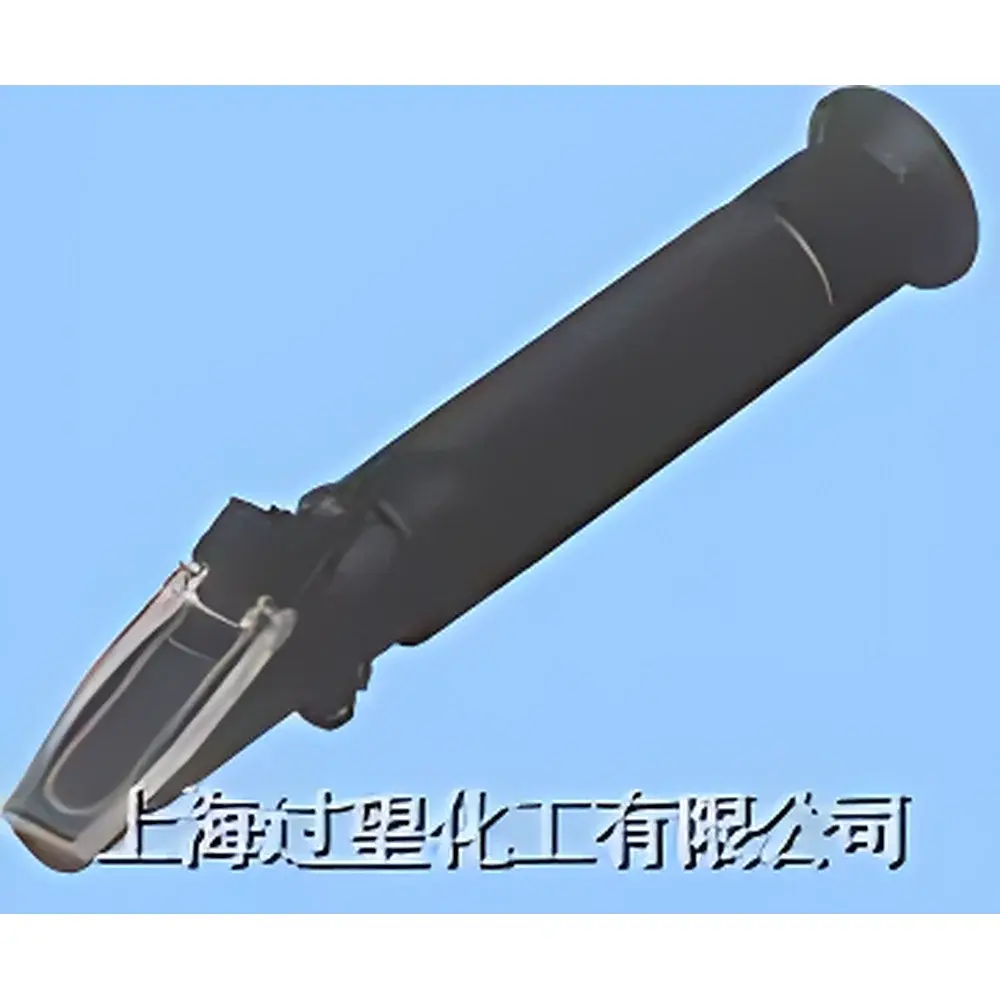
Antifreeze Freeze Point Tester VBC Series
| Origin | Shanghai, China |
|---|---|
| Manufacturer Type | Authorized Distributor |
| Product Origin | Domestic (China) |
| Models | VBC-1, VBC-2, VBC-3, VBC-4, VBC-1T, VBC-2T, VBC-3T, VBC-4T |
| Temperature Range | −50 °C to 0 °C (VBC-2/3/4/T variants) or −60 °F to 30 °F (VBC-1/VBC-1T) |
| Specific Gravity Range | 1.15–1.30 sg (standard) |
| Resolution | 0.01 sg or 0.01 kg/L |
| Temperature Resolution | 5 °C or 10 °C (model-dependent) |
| Dimensions | 27 × 40 × 160 mm |
| Weight | 176 g (standard), 215 g (T-series with enhanced thermal stability) |
Overview
The Antifreeze Freeze Point Tester VBC Series is a handheld, optical refractometer-based instrument engineered for rapid, field-deployable assessment of freezing point depression and concentration in aqueous glycol-based coolant and battery electrolyte solutions. Unlike thermodynamic freezing point apparatuses that rely on phase-change detection, the VBC Series employs calibrated Abbe refractometry—measuring the refractive index (nD) of the sample—and correlates it to freeze point (°C or °F) and specific gravity (sg) via pre-programmed, empirically validated calibration curves for ethylene glycol (EG), propylene glycol (PG), and common automotive coolant formulations (e.g., G11, G12, G13, SRF-I). This principle enables immediate, solvent-free analysis without sample cooling or crystallization delay—critical for maintenance technicians performing on-site engine bay diagnostics, fleet service centers validating coolant replacement cycles, and battery recycling facilities verifying sulfuric acid concentration in lead-acid electrolytes.
Key Features
- Compact, ergonomic design (27 × 40 × 160 mm) optimized for one-handed operation in confined spaces such as engine compartments or service bays.
- Dual-scale readout capability: simultaneous display of freeze point (°C or °F) and specific gravity (sg or kg/L), with model-specific range configurations—including extended low-temperature resolution (±5 °C) in VBC-3T and VBC-4T variants.
- T-series models (VBC-1T–VBC-4T) incorporate temperature-compensated optics and reinforced housing (215 g) to maintain measurement stability across ambient conditions from −10 °C to +45 °C.
- High-precision prism assembly with anti-scratch sapphire coating ensures long-term optical fidelity and resistance to corrosion from acidic or glycol-rich residues.
- No external power required: daylight-optimized optical path eliminates dependency on batteries or charging infrastructure—ideal for mobile service applications.
- Calibration traceability supported via included NIST-traceable sucrose reference solution (1.3330 nD at 20 °C) and standardized verification protocol compliant with ASTM D1120 (Standard Test Method for Freeze Point of Engine Coolants).
Sample Compatibility & Compliance
The VBC Series is validated for use with ethylene glycol– and propylene glycol–based antifreeze/coolant mixtures (including OEM-specified G11, G12++, G13, and SRF-I formulations), as well as aqueous sulfuric acid solutions (battery electrolytes, 25–40% w/w H2SO4). It is not suitable for non-aqueous fluids, silicone-based coolants, or highly viscous or particulate-laden samples. All models comply with ISO 21748:2017 (Guidance for the use of repeatability, reproducibility and trueness estimates in measurement uncertainty evaluation) for refractometric concentration determination. The instrument’s calibration methodology aligns with the technical basis of ASTM D1120 and JIS K 2234, supporting documentation requirements for preventive maintenance logs in ISO 9001-certified workshops and OEM-recommended service intervals.
Software & Data Management
As an analog optical instrument, the VBC Series does not incorporate embedded firmware, digital connectivity, or data logging capabilities. Measurement results are interpreted visually through the eyepiece scale, eliminating software validation burdens associated with FDA 21 CFR Part 11 or EU Annex 11 compliance. This architecture ensures operational continuity in environments where electromagnetic interference, cybersecurity constraints, or regulatory audit scope preclude electronic data capture—such as military vehicle depots, offshore marine engine rooms, or GLP-compliant battery testing laboratories requiring manual entry into bound logbooks with witness signatures.
Applications
- Routine freeze point verification during seasonal coolant servicing in automotive, heavy-duty truck, and rail traction systems.
- Preventive maintenance screening for glycol degradation or dilution-induced corrosion risk in HVAC chillers and industrial heat transfer loops.
- Field validation of battery electrolyte concentration prior to load testing or capacity assessment in telecom backup systems and renewable energy storage installations.
- Quality control spot-checking of incoming coolant batches against supplier specifications (e.g., 50/50 EG/H2O nominal freeze point ≈ −37 °C).
- Educational use in mechanical engineering and automotive technology curricula for demonstrating colligative property relationships between solute concentration and phase transition behavior.
FAQ
Does the VBC Series require periodic recalibration by an accredited lab?
No—field recalibration is performed manually using the supplied reference standard before each shift or after exposure to extreme ambient temperature shifts. Full metrological recalibration is recommended annually or per internal QA policy, but no external certification is mandated for routine maintenance use.
Can the instrument measure pure propylene glycol or undiluted ethylene glycol?
No. The calibration curves are optimized for aqueous mixtures within defined concentration ranges (typically 20–65% v/v glycol). Neat glycols exceed the refractive index limits of the optical system and yield invalid readings.
Is the prism resistant to corrosion from battery acid splashes?
Yes—the sapphire-coated measuring surface withstands brief incidental contact with 30–40% sulfuric acid; however, prolonged exposure or residue buildup must be removed immediately with deionized water and lint-free tissue to preserve optical accuracy.
What is the measurement uncertainty under typical workshop conditions?
At 23 °C ambient, the combined standard uncertainty for freeze point determination is ±1.2 °C (k = 2) for samples within the central 40–60% glycol range, as verified per ISO/IEC 17025 internal validation protocols.



