
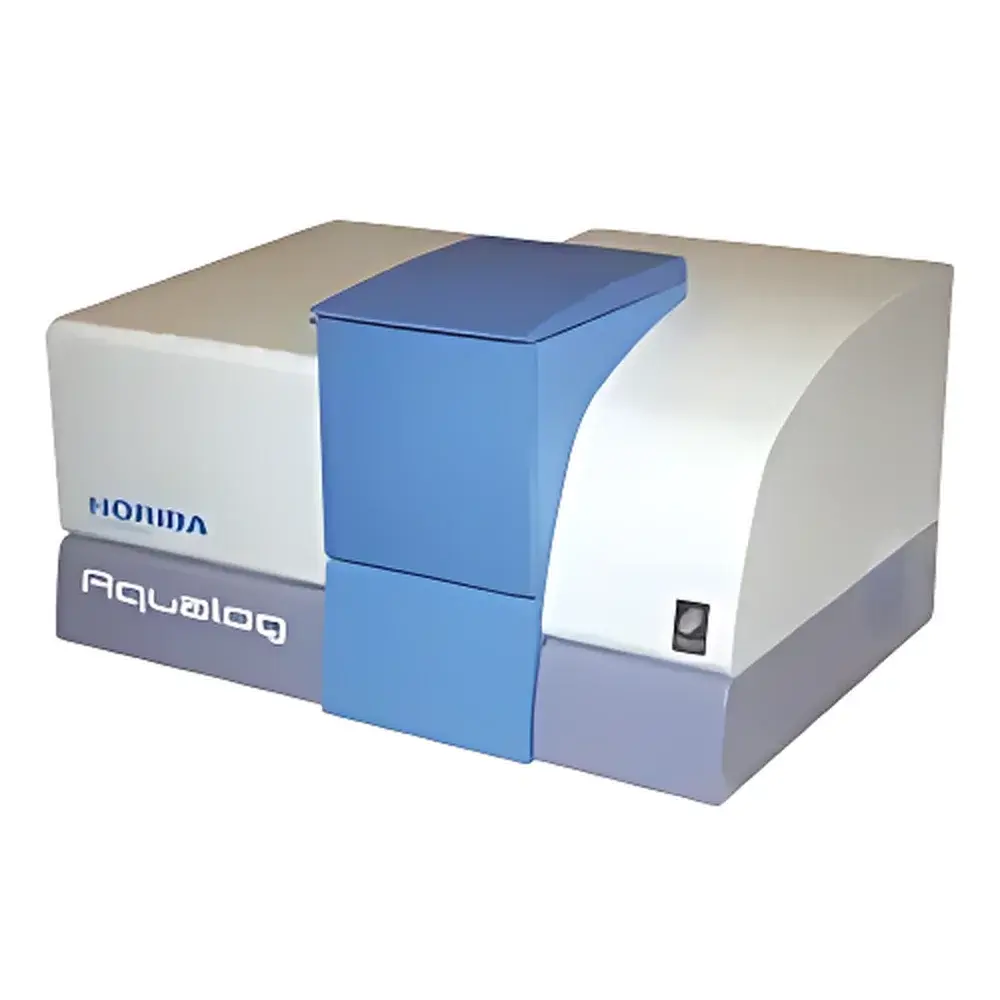
HORIBA Scientific Aqualog Absorption and 3D Fluorescence Spectrometer
| Brand | HORIBA |
|---|---|
| Origin | USA |
| Model | Aqualog |
| Dispersion Element | Grating and Filter |
| Slit Width (Spectral Bandpass) | 5 nm |
| Resolution | 0.41 nm/pixel |
| Sensitivity | 20,000:1 (water Raman SNR, RMS, 350 nm excitation, 30 s integration) |
| Wavelength Accuracy | ±1 nm |
Overview
The HORIBA Scientific Aqualog Absorption and 3D Fluorescence Spectrometer is a purpose-built, dual-mode molecular spectroscopic platform engineered for the simultaneous acquisition of UV-Vis absorption spectra and excitation-emission matrix (EEM) fluorescence spectra. Designed specifically for environmental aquatic chemistry and water quality research, the Aqualog leverages coupled optical path architecture to eliminate sequential measurement errors and ensure intrinsic spectral alignment between absorption and fluorescence datasets. Its core measurement principle integrates broadband absorption quantification (190–750 nm) with high-fidelity EEM mapping (excitation: 200–700 nm; emission: 200–800 nm), enabling robust characterization of colored dissolved organic matter (CDOM), humic substances, protein-like fluorophores, and anthropogenic contaminants. The system employs a 150 W ozone-free xenon lamp as its stable, continuum light source, paired with a double-grating excitation monochromator to suppress stray light and maintain spectral fidelity—critical for low-concentration natural water samples where signal-to-noise ratio and photostability directly impact quantitative reproducibility.
Key Features
- Simultaneous, co-registered acquisition of absorption and 3D fluorescence (EEM) spectra—eliminating temporal drift and sample handling variability
- High-speed spectral scanning: up to 100× faster than conventional sequential fluorometers due to TE-cooled CCD detection and optimized optical throughput
- Double-grating excitation monochromator with <5 nm spectral bandpass, delivering superior stray-light rejection and photometric linearity
- Matched spectral bandwidths between absorption and fluorescence channels (both 5 nm), ensuring consistent resolution for comparative spectral deconvolution
- Integrated reference and absorbance detection using calibrated silicon photodiode arrays—enabling real-time baseline correction and Beer-Lambert compliance verification
- Automated sample handling with selectable 2-position or 4-position motorized sample changers, supporting unattended operation in multi-sample monitoring workflows
- NIST-traceable performance validation suite included—covering wavelength accuracy (±1 nm), photometric linearity, sensitivity (water Raman SNR >20,000:1), and EEM reproducibility per ASTM D8256 and ISO 10694 protocols
Sample Compatibility & Compliance
The Aqualog accommodates liquid, semi-solid, and solid-state samples via interchangeable accessories—including temperature-controlled magnetic stirrer sample holders (2-, 4-, or single-position), HPLC flow cells, fiber-optic probes, cryogenic liquid nitrogen Dewars for low-temperature fluorescence studies, and dedicated solid-sample stages. All configurations maintain optical path integrity and comply with EPA Method 415.3, ASTM D8256 (Standard Test Method for Determination of CDOM Fluorescence), and ISO 10694 (Water Quality — Determination of Fluorescent Dissolved Organic Matter). Data acquisition and processing adhere to GLP/GMP-aligned audit trail requirements, with optional FDA 21 CFR Part 11-compliant software modules available for regulated laboratories.
Software & Data Management
The Aqualog operates under HORIBA’s dedicated FluoroMax®-based software environment, fully integrated with OriginLab for advanced post-processing. Key capabilities include automated Quinine sulfate calibration traceability, inner-filter effect correction using concurrent absorption data, and precise removal of Rayleigh and Raman scatter peaks via dynamic background subtraction. Raw EEM matrices are exportable in standardized .csv or .mat formats compatible with PARAFAC, PCA, and other multivariate statistical packages. Software supports batch processing, spectral normalization, peak integration, and generation of fluorescence indices (e.g., HIX, BIX, FI, SUVA254)—all compliant with peer-reviewed methodologies published in *Environmental Science & Technology* and *Water Research*. Audit logs record all user actions, parameter changes, and calibration events.
Applications
- Quantitative tracking of CDOM dynamics in rivers, lakes, estuaries, and wastewater effluents
- Differentiation of terrestrial vs. microbial organic matter sources using fluorescence component modeling
- Monitoring disinfection byproduct precursors (e.g., trihalomethane formation potential) via SUVA254 and fluorescence index correlations
- Assessment of advanced oxidation process (AOP) efficiency through time-resolved EEM decay kinetics
- Validation of membrane filtration performance by detecting low-MW fluorescent organics pre- and post-treatment
- Research-grade characterization of exopolymeric substances (EPS) and extracellular vesicles in bioreactor systems
FAQ
What is the primary advantage of simultaneous absorption and fluorescence acquisition?
Simultaneity eliminates time-dependent sample degradation, evaporation, or thermal drift between measurements—ensuring pixel-level spectral registration critical for inner-filter correction and quantitative EEM modeling.
Can the Aqualog be used for non-aqueous samples?
Yes—when configured with appropriate cuvettes, flow cells, or solid-sample holders, it supports organic solvents, gels, and powdered materials, provided optical clarity and compatibility with the 150 W xenon source are maintained.
Is PARAFAC analysis performed directly within the instrument software?
No—the Aqualog exports native EEM matrices to external statistical platforms; however, the software provides preprocessing tools (scatter removal, normalization, interpolation) optimized for PARAFAC input requirements.
How is wavelength accuracy verified and maintained?
Factory calibration uses NIST-traceable holmium oxide and didymium filters; users may perform routine verification using built-in spectral reference checks aligned with ISO 10694 Annex B protocols.
Does the system support remote operation and networked data storage?
Yes—software supports TCP/IP connectivity, Windows-based remote desktop control, and configurable export to network drives or LIMS-compatible databases via ODBC or REST API extensions.




