
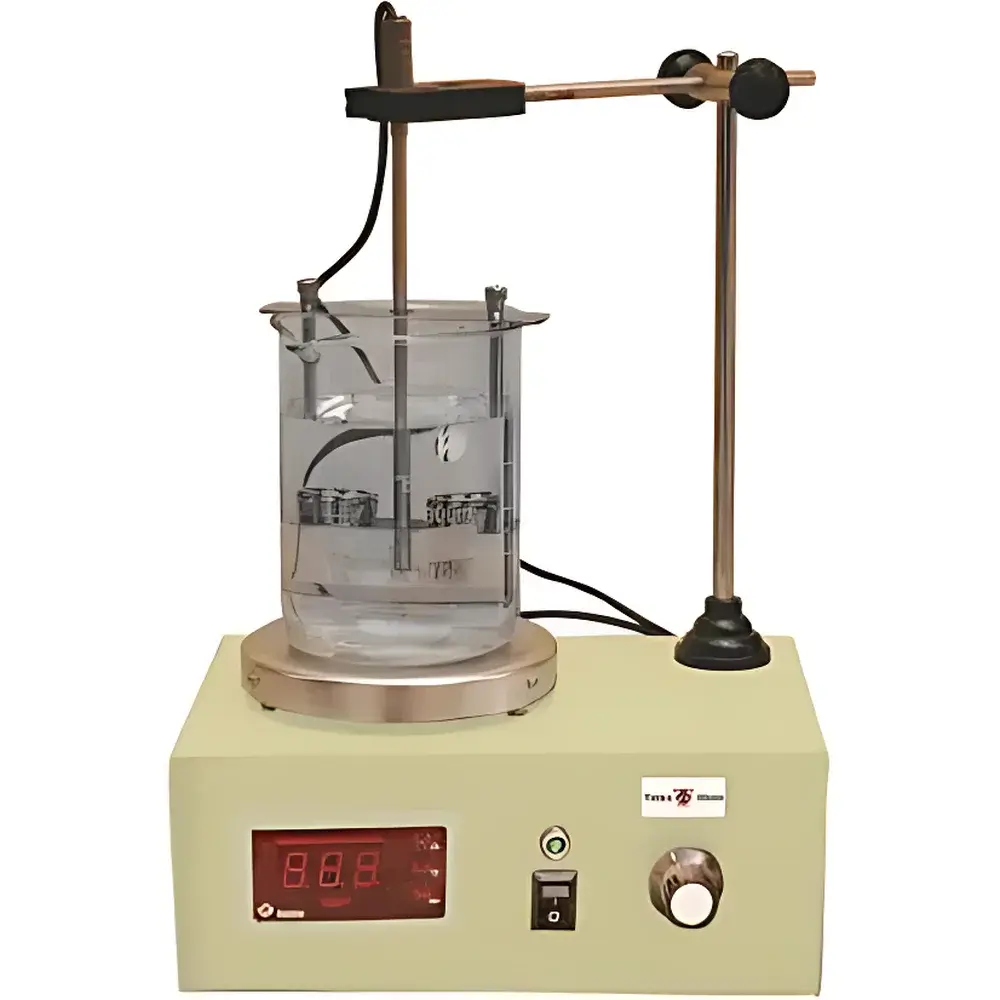
Tinius Olsen TO-561 Ring-and-Ball Softening Point Tester
| Brand | Tinius Olsen |
|---|---|
| Origin | USA |
| Model | TO-561 |
| Compliance | ASTM D 36, ASTM E 28, AASHTO T 53, EN 1427, BS 2000 |
| Voltage/Frequency | 220 V / 50 Hz |
| Sample Holder | Dual brass ring assembly with heat-resistant glass bath |
| Ball Diameter | 9.5 mm steel sphere |
| Heating System | Adjustable electric heating plate with magnetic stirrer |
| Temperature Display | Digital PID-controlled readout (±0.1 °C resolution) |
| Accessories Included | Two conical rings, two ball centering guides, two steel balls, ring holder assembly, heated stirring plate |
Overview
The Tinius Olsen TO-561 Ring-and-Ball Softening Point Tester is a precision-engineered instrument designed for the standardized determination of the softening point of bituminous materials—including paving asphalts, roofing asphalts, coal-tar pitches, and thermoplastic road marking compounds—according to established international test methods. It operates on the classical ring-and-ball principle: a standardized steel ball (9.5 mm diameter) is placed atop a circular asphalt specimen cast in a brass conical ring; the assembly is suspended in a heat-transfer fluid bath (typically water or glycerin), and the temperature is raised at a controlled linear rate (5.0 ± 0.5 °C/min). The softening point is defined as the temperature at which the softened sample deforms sufficiently under its own weight and the applied load of the ball to allow the ball to descend a fixed vertical distance (25.4 mm) and contact a lower support surface. This method provides a reproducible, comparative thermal transition index—not a true melting point—but one that correlates strongly with field performance parameters such as rutting resistance and temperature susceptibility.
Key Features
- Compliance-ready design validated against ASTM D 36, ASTM E 28, AASHTO T 53, EN 1427, and BS 2000 specifications—enabling direct integration into quality control workflows requiring regulatory traceability.
- Dual-sample configuration supports parallel testing of two specimens per run, improving throughput without compromising measurement integrity.
- Digitally controlled heating system with integrated magnetic stirrer ensures uniform thermal distribution across the fluid bath and minimizes temperature gradients (< ±0.3 °C across bath depth).
- PID-regulated digital temperature display offers real-time monitoring with 0.1 °C resolution and automatic endpoint detection logic aligned with standard-defined descent criteria.
- Robust construction featuring corrosion-resistant brass ring holders, borosilicate glass fluid bath vessel, and precision-machined steel ball centering guides for consistent specimen geometry and loading alignment.
- Modular accessory architecture allows field-replacement of critical consumables—including rings, centering guides, and balls—without recalibration or service intervention.
Sample Compatibility & Compliance
The TO-561 accommodates standard 15.9 mm inner-diameter conical brass rings per ASTM D 36 and EN 1427. Specimen preparation follows strict conditioning protocols: samples are cast in preheated rings, cooled under controlled ambient conditions (e.g., 15–30 °C for 30 min), then trimmed flush using a hot spatula. The instrument supports both water (for softening points ≤ 80 °C) and glycerin (for points up to 200 °C) as heating media. All mechanical components meet dimensional tolerances specified in ASTM E 28 Annex A1. The system is routinely employed in laboratories operating under ISO/IEC 17025-accredited quality management systems and supports audit-ready documentation when paired with compliant data recording practices.
Software & Data Management
While the TO-561 operates as a stand-alone analog-digital hybrid instrument, its temperature output signal (0–10 V or 4–20 mA optional) is compatible with third-party LIMS or SCADA interfaces. When used with Tinius Olsen’s optional data acquisition module (TO-DAC-01), users can log time-stamped temperature readings at user-defined intervals (1–30 sec), generate ASTM-compliant test reports including slope verification plots, and export CSV-formatted datasets for statistical process control (SPC) analysis. All digital records maintain full audit trails per FDA 21 CFR Part 11 requirements when deployed with appropriate electronic signature controls and system validation documentation.
Applications
- Quality assurance of asphalt binders in refinery and paving material production facilities.
- Research and development of polymer-modified asphalts (PMBs) and bio-based bituminous alternatives.
- Conformance testing for highway construction contracts governed by AASHTO or EN standards.
- Failure analysis of pavement distress linked to thermal instability or binder aging.
- Calibration verification of dynamic shear rheometer (DSR) and bending beam rheometer (BBR) results via empirical correlation models (e.g., Glover-Rowe parameter mapping).
FAQ
What standards does the TO-561 comply with?
ASTM D 36, ASTM E 28, AASHTO T 53, EN 1427, and BS 2000 — all verified through factory calibration and dimensional inspection reports.
Can the TO-561 be used for materials other than asphalt?
Yes — it is applicable to any thermoplastic material exhibiting a distinct softening transition within the 30–200 °C range, provided specimen geometry and heating medium are selected per relevant method adaptations.
Is manual timing required during the test?
No — the endpoint is determined automatically upon detection of the steel ball contacting the lower support plate, with visual and audible indicators confirming completion.
How often does the system require calibration?
Annual verification of temperature sensor accuracy against NIST-traceable reference thermometers is recommended; mechanical components require only periodic visual inspection for wear or deformation.
Does the TO-561 support GLP/GMP documentation requirements?
Yes — when operated with validated data capture hardware and procedural SOPs, it meets core GLP and GMP data integrity expectations for regulated environments.





