
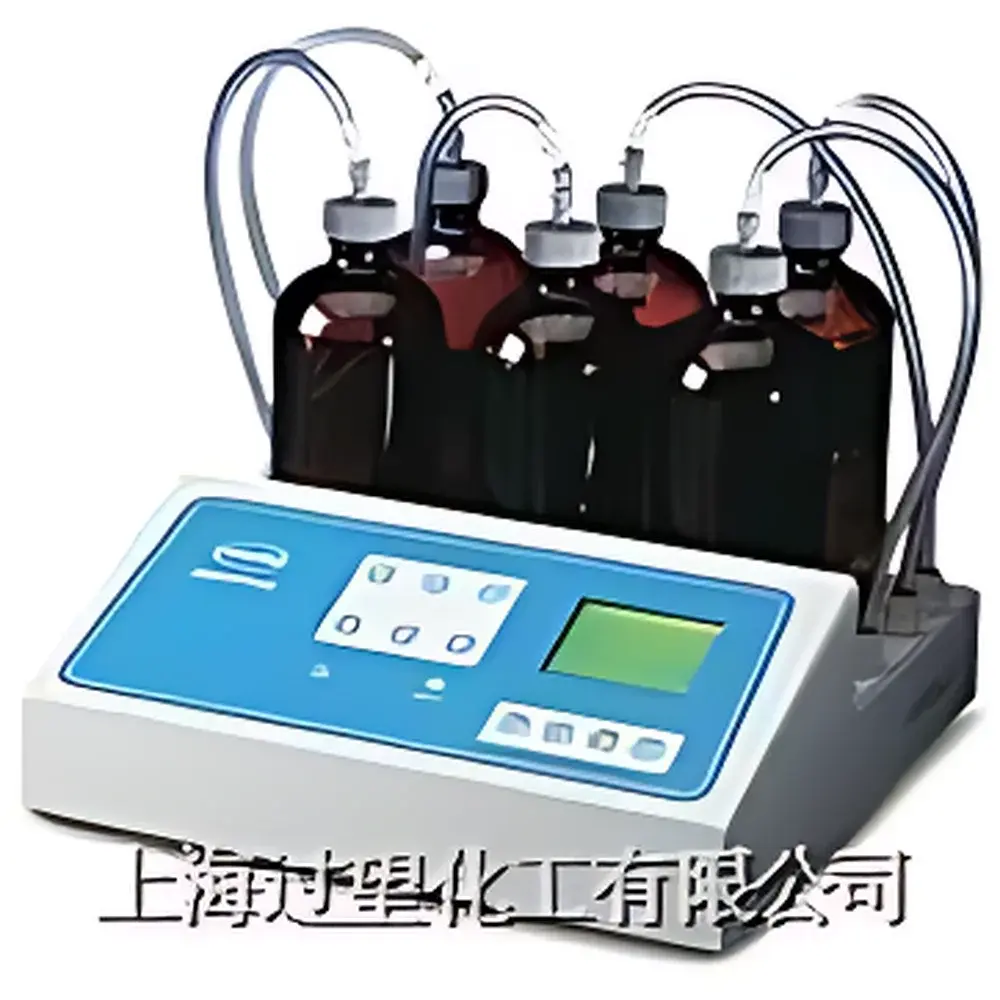
Hach BODTrak II Biochemical Oxygen Demand Analyzer
| Brand | Hach |
|---|---|
| Origin | USA |
| Model | BODTrak II |
| Measurement Principle | Manometric (pressure-difference) respirometry |
| Sample Capacity | 6 simultaneous samples |
| BOD Range | 0–700 mg/L (four auto-ranging scales: 0–35, 0–70, 0–350, 0–700 mg/L) |
| Resolution | 0.1 mg/L |
| Repeatability | CV ≤ 5% |
| Data Logging | 480 points (15-min interval) |
| Display | Backlit LCD with real-time BOD curve and numeric readout |
| Connectivity | USB interface for HachLink™ software |
| Power Supply | AC 220 V / 50 Hz |
| Compliance | ASTM D5210, ISO 5815-1, US EPA 405.1 (respirometric BOD), GLP-compliant data storage with timestamped audit trail |
Overview
The Hach BODTrak II Biochemical Oxygen Demand Analyzer is an automated, manometric respirometer engineered for precise, unattended determination of 5-day biochemical oxygen demand (BOD5) in environmental water samples. Unlike conventional dilution-and-inoculation methods governed by Standard Methods 5210B or ASTM D5210, the BODTrak II employs a sealed-bottle pressure-difference measurement principle grounded in microbial respiration kinetics. During incubation, heterotrophic microorganisms consume dissolved oxygen (DO) while degrading biodegradable organic matter; the resulting decrease in headspace O2 partial pressure—compensated by continuous O2 diffusion from the air phase into the aqueous phase—is quantified via a high-stability, mercury-free piezoresistive pressure transducer. Concurrently, CO2 generated from oxidation is chemically trapped by lithium hydroxide (LiOH) impregnated in the septum cap, preventing back-pressure artifacts and ensuring stoichiometric correlation between pressure drop and oxygen consumed. This direct physicochemical linkage eliminates gravimetric titration steps, calibration drift, and operator-dependent endpoint interpretation—delivering traceable, reproducible BOD5 values compliant with ISO 5815-1 and US EPA Method 405.1 for respirometric BOD.
Key Features
- Automated six-channel operation: Simultaneous analysis of up to six samples under identical incubation conditions (requires external BOD incubator, 20 ± 1 °C)
- Four-range auto-scaling detection: Seamless switching across 0–35, 0–70, 0–350, and 0–700 mg/L BOD ranges—no manual dilution required for samples ≤700 mg/L
- High-resolution pressure sensing: 0.1 mg/L BOD resolution with ≤5% coefficient of variation (CV) across repeated measurements per ASTM D5210 validation protocols
- Continuous data acquisition: 15-minute logging interval with on-device graphical display of real-time BOD accumulation curves and numeric endpoints
- Embedded non-volatile memory: Stores 480 time-stamped data points per run (e.g., full 5-day profile at 15-min intervals = 480 entries)
- GLP-ready data integrity: All stored results include date/time stamps, sample ID fields, incubation duration selection (5/7/10 days), and system diagnostic flags
Sample Compatibility & Compliance
The BODTrak II is validated for use with municipal wastewater, surface water, groundwater, and treated effluents meeting standard BOD testing criteria per ISO 5815-1 and ASTM D5210. Samples containing high suspended solids (>30 mg/L), residual chlorine (>0.1 mg/L), or extreme pH (8.5) require pretreatment per Standard Methods guidelines prior to analysis. The instrument’s pressure-based methodology inherently avoids interference from colored or turbid matrices that impair optical or electrochemical DO sensors. All consumables—including LiOH absorbent pillows, nutrient tablets, and freeze-dried nitrification-inhibited seed culture—are manufactured to Hach’s certified specifications and supplied with lot-specific QC documentation. Device firmware and data handling architecture support 21 CFR Part 11 compliance when used with HachLink™ software configured for electronic signatures and audit-trail archiving.
Software & Data Management
Data export and reporting are enabled through HachLink™ Desktop Software (Windows-compatible), which establishes bidirectional USB communication with the BODTrak II. The software permits batch download of raw pressure-time datasets, automatic BOD5 calculation using integrated polynomial regression models, and generation of PDF reports conforming to laboratory quality management system (QMS) requirements. Export formats include CSV (for LIMS integration), Excel (.xlsx), and XML (for ELN ingestion). Audit trails record user login events, method parameter changes, and data modification history—fully traceable to individual analysts and timestamps. Firmware updates are distributed via Hach’s secure customer portal and maintain backward compatibility with legacy data structures.
Applications
- Regulatory wastewater discharge monitoring per NPDES permits
- Wastewater treatment plant process control and efficiency assessment (influent, effluent, activated sludge supernatant)
- Environmental impact assessment of industrial outfalls and landfill leachate
- Educational laboratory instruction in environmental engineering and analytical chemistry curricula
- Research on biodegradability kinetics of novel organic compounds and pharmaceutical residues
- Validation of alternative BOD methods against reference dilution techniques
FAQ
Does the BODTrak II require daily operator intervention during the 5-day incubation?
No. Once samples are loaded, sealed, and the incubation duration is selected, the system operates autonomously—recording pressure data every 15 minutes without manual oversight.
Can the instrument measure BOD beyond 700 mg/L?
Yes, but samples exceeding 700 mg/L must be diluted prior to analysis to remain within the validated dynamic range and ensure stoichiometric CO2 absorption capacity of the LiOH pillow.
Is nitrification inhibition built into the standard protocol?
Yes. The supplied microbial seed contains sodium allylthiourea (SAT) to suppress nitrifying bacteria, aligning with US EPA 405.1 and ISO 5815-1 requirements for carbonaceous BOD (cBOD) measurement.
What incubator specifications are required for optimal performance?
A Class I biological incubator maintaining 20.0 ± 0.5 °C with uniform temperature distribution across all sample positions and minimal vibration transmission is mandatory.
How is calibration verified?
Calibration is verified using certified glucose-glutamic acid (GGA) standard solution (198 mg/L theoretical BOD5). Daily GGA checks are recommended for routine QA/QC; results must fall within 188–208 mg/L to confirm system accuracy per Standard Methods 5210B.
Related Products







